2025-08-20 11:56
Buying oil from Russia "very profitable" for India, Russian official says Hopes rise for trilateral talks with India, China Russia wants to forge a greater Eurasian partnership NEW DELHI, Aug 20 (Reuters) - Russia expects to continue supplying oil to India despite warnings from the United States, Russian embassy officials in New Delhi said on Wednesday, adding that Moscow hopes trilateral talks will soon take place with India and China. U.S. President Donald Trump has announced an additional tariff of 25% on Indian goods exported to the U.S. from August 27, as a punishment for buying Russian oil, which constitutes 35% of India's total imports compared with a negligible 0.2% before the Ukraine war. Sign up here. "I want to highlight that despite the political situation, we can predict that the same level of oil import (by India)," Roman Babushkin, the charge d'affaires at the Russian embassy in India, told a press briefing. He predicted India and Russia would find ways to overcome Trump's latest tariffs in their "national interests". Trade talks between India and the U.S. broke down over the opening up of India's vast farm and dairy sectors, as well as its purchases of Russian oil. The total tariff announced on Indian goods entering the U.S. is 50%. The Indian foreign ministry did not immediately reply to an emailed request for comment. It has previously said the U.S. decision to single out India for Russian purchases was "extremely unfortunate". Russia's Deputy Trade Commissioner Evgeny Griva on Wednesday said buying oil from Russia is "very profitable" for India, which will not want to change its supplier. On average Russia gives a 5%-7% discount to Indian buyers, he said, adding that Russia has a "very, very special mechanism" to continue oil supplies to India. In addition, he said Russia had started accepting Indian rupee payments for its goods after the resolution of issues that had trapped billions of dollars worth of funds in Indian banks. 'GREATER EURASIAN PARTNERSHIP' As tensions between Washington and New Delhi rise, high-profile visits from New Delhi and Beijing in recent weeks have raised hopes on the part of the Asian neighbours that ties damaged by a 2020 border clash can be repaired. Indian Prime Minister Narendra Modi plans to visit China for the first time in over seven years later this month. The planned visit was reported by Reuters last week, even as other high profile exchanges, including Chinese Foreign Minister Wang Yi's two-day visit to New Delhi, concluded. At the same time, Russia is trying to revive long-standing plans for a trilateral meeting with India and China to help them forge a "greater Eurasian partnership". "As far as the trilateral is concerned, we are quite hopeful that this format will be resumed sooner rather than later because its importance is not questioned," Babushkin said. "This is closely linked to the Russian initiative of the establishment of the greater Eurasian partnership," Babushkin said. Russian President Vladimir Putin will meet Modi in New Delhi by the end of year, he said. Putin, Modi and Chinese President Xi Jinping are also expected to all attend the Shanghai Cooperation Organisation starting August 31. https://www.reuters.com/world/india/russia-expects-india-keep-buying-its-oil-seeks-china-india-russia-talks-2025-08-20/
2025-08-20 11:56
China's State Council to approve new yuan internationalisation plan later this month-sources Yuan-backed stablecoins seen as key amid US dollar dominance-sources Hong Kong and Shanghai to fast-track local implementation of the plan-sources China to discuss wider use of yuan at summit in Tianjin-sources Aug 20 (Reuters) - China is considering allowing the usage of yuan-backed stablecoins for the first time to boost wider adoption of its currency globally, sources familiar with the matter said, in a major reversal of its stance towards digital assets. The State Council - China's cabinet – will review and possibly approve a roadmap later this month for the greater usage of the currency globally, including catching up with a U.S. push on stablecoins, said the sources. Sign up here. The plan is expected to include targets for usage of the Chinese currency in the global markets and outline the responsibilities of domestic regulators, they said, adding that the roadmap will also include guidelines for risk prevention. The country's senior leadership is also expected to meet for a study session as early as the end of this month, focusing on yuan internationalisation and stablecoins, which are gaining momentum worldwide, said one of the sources. In that meeting, senior leaders are likely to deliver remarks to set the tone for stablecoins and define the boundaries of its application and development in business, said the source. China's plan for the usage of stablecoins, if approved, would mark a major shift in its approach towards digital assets. The country banned cryptocurrency trading and mining in 2021 due to concerns about the stability of the financial system. China has long aspired for the yuan to achieve global currency status, akin to the dollar or euro, reflecting its weight as the world's second-biggest economy. However, its tight capital controls and its trillion-dollar annual trade surpluses have worked against that aim. Those restrictions are likely to be a key hurdle to the development of stablecoins as well, market participants have said. Stablecoins are a type of cryptocurrency designed to maintain a constant value. They are usually pegged to a fiat currency such as the U.S. dollar and are commonly used by crypto traders to move funds between tokens. The yuan's share as a global payment currency , opens new tab fell to 2.88% in June, its lowest in two years, according to payment platform SWIFT. In contrast, the U.S. dollar commanded a 47.19% market share. China places strong capital controls to manage flows in and out of the border, with a few connect schemes permitting capital to be deployed in some key offshore market such as Hong Kong. In the U.S., President Donald Trump backed stablecoins days after his inauguration in January and is establishing a regulatory framework that helps legitimise dollar-pegged cryptocurrencies. Their underlying blockchain technology enables instant, borderless and round-the-clock transfer of funds at low cost, giving stablecoins the potential to disrupt traditional daily money moves and cross-border payment systems. Financial innovation, specifically stablecoins, is viewed by Beijing as a promising tool for yuan internationalisation amid the growing influence of U.S. dollar-linked cryptocurrencies in global finance, said the sources. Details of the plan are expected to be unveiled in the coming weeks, with Chinese regulators, including the central bank, the People's Bank of China (PBOC), being assigned implementation duties, said the sources. The sources declined to be named as they were not authorised to speak to the media. The State Council Information Office (SCIO) did not immediately respond to Reuters requests for comment. The PBOC could not be immediately be contacted for comment outside of normal business hours. MAJOR SHIFT Stablecoins backed by the U.S. dollar currently dominate the market, accounting for over 99% of the global stablecoin supply, according to the Bank for International Settlements. In Asia, South Korea has pledged to allow companies to introduce won-based stablecoins and develop the necessary infrastructure, while similar initiatives are underway in Japan. The latest push comes amid mounting geopolitical tensions with Washington, and the growing use of dollar-backed stablecoins by Chinese exporters. Beijing's latest plans come after a Shanghai regulator last month said it had held a meeting for local government officials to consider strategic responses to stablecoins and digital currencies. In a recent interview, PBOC advisor Huang Yiping told local media that an offshore yuan stablecoin in Hong Kong is "a possibility". Separately, Hong Kong's long-awaited stablecoin ordinance took effect on August 1 and positions the Chinese-controlled territory as one of the first markets globally to regulate fiat-backed stablecoin issuers. China's commercial hub Shanghai is also establishing an international operation centre for the digital yuan. According to the sources, Hong Kong and Shanghai will be the main cities to fast-track local implementation of the latest plan. China is expected to discuss expanding the use of yuan and possibly stablecoins for cross-border trade and payments with some countries at the Shanghai Cooperation Organisation (SCO) Summit to be held Aug. 31-Sep. 1 in Tianjin, said the sources. The global stablecoin market is currently small at about $247 billion, according to crypto data provider CoinGecko. However, Standard Chartered Bank estimates it could grow to $2 trillion by 2028. https://www.reuters.com/markets/asia/china-considering-yuan-backed-stablecoins-boost-global-currency-usage-sources-2025-08-21/
2025-08-20 11:53
Aug 20 (Reuters) - Saudi Arabia's crude oil exports slipped in June to their lowest level in three months, according to data from the Joint Organizations Data Initiative (JODI) released on Wednesday. Crude exports from the world's largest oil exporter fell to 6.141 million barrels per day, from 6.191 million bpd in May. Sign up here. Saudi Arabia's crude output for June was 9.752 million bpd, up from 9.184 million bpd in May. Saudi refineries' crude throughput was 2.703 million bpd, down 18,000 bpd from May's 2.721 million bpd, the data showed, while direct crude burning increased by 185,000 bpd to 674,000 bpd. Saudi Arabia and other members of OPEC provide monthly export figures to JODI, which publishes them on its website. OPEC+, comprising OPEC and allies such as Russia, this month agreed to raise oil production by 547,000 bpd for September, the latest in a series of accelerated output hikes to regain market share, as concerns mount over potential supply disruptions linked to Russia. Eight OPEC+ members began raising output in April with a hike of 138,000 bpd, followed by larger-than-planned increases of 411,000 bpd in May, June and July, 548,000 bpd in August and now 547,000 bpd for September. The eight members are Saudi Arabia, Russia, Iraq, UAE, Kuwait, Kazakhstan, Algeria, and Oman. The International Energy Agency said last week that world oil supply would rise more rapidly than expected this year and next as OPEC+ members further increase output and supply from outside the group grows. https://www.reuters.com/world/middle-east/saudi-arabias-june-crude-exports-fall-lowest-since-march-2025-08-20/
2025-08-20 11:37
Traders focused on whether Powell pushes back on easing bets Markets lay 85% odds on a Fed rate reduction next month NZ dollar at 4-month low as RBNZ flags further rate cuts LONDON, Aug 20 (Reuters) - The U.S. dollar was little changed on Wednesday as traders awaited a speech from Federal Reserve Chair Jerome Powell at the annual Jackson Hole central bankers' symposium later this week for clues on the path of monetary policy. The New Zealand dollar tumbled after the central bank reduced its cash rate by a quarter point to 3.0% as expected, and said its board had also considered a half-point cut. Sign up here. The dollar index , which measures the U.S. currency against six others, was down less than 0.1% at 98.265, after earlier touching a more than one week high of 98.441. Friday's speech by Powell is the market's main focus, as traders watch for any pushback against market pricing of a rate reduction at the Fed's September 16-17 meeting. Traders now place odds of about 85% on a quarter-point cut next month and expect about 54 basis points of reductions by year-end. "Powell will try to be fairly balanced, but there is a risk we see a hawkish Powell on Friday," said Kirstine Kundby-Nielsen, FX analyst at Danske Bank. "Some of the developments we've seen in inflation dynamics will keep the Fed more cautious." Traders, who ramped up bets for Fed cuts after a surprisingly weak U.S. payrolls report at the start of this month, were further encouraged after consumer price data showed limited upward pressure from tariffs. However, a hotter-than-expected producer price reading last week complicated the policy picture. Powell has said he is reluctant to cut rates because of expected tariff-driven price pressures this summer. Later on Wednesday, the Fed will issue the minutes of its meeting on July 29 and 30, when it held rates steady, although they may offer limited insight as the meeting came before the weak jobs numbers. The kiwi slumped as much as 1.3% to $0.5815, its weakest since April 11, with policymakers lowering their projected floor for the cash rate to 2.55%, from 2.85% forecast in May. "The market did not expect the bank to send a strong dovish signal that it intends to deliver further cuts," Prashant Newnaha, a rates strategist at TD Securities, wrote in a client note. He has increased his forecast for additional easing, now projecting a cash rate of 2.5% by November. The Swedish crown was steady after its central bank maintained its policy rate at 2%, in line with expectations. The euro was little changed at $1.1647. The greenback retreated 0.1% to 0.8073 Swiss franc and edged down 0.2% to 147.48 yen . The pound rose held broadly steady against the euro and dollar after hotter-than-forecast inflation, leaving Britain with the biggest price growth problem amongst the world's big rich economies. But much of the rise in services inflation was driven by volatile air fares, which some economists said was due to the timing of school holidays. "The BoE (Bank of England) is more concerned about food inflation, which hasn't changed much in today's release," ING's head of research Chris Turner said. "We doubt today's CPI release will alter much of the BoE's current thinking." In cryptocurrencies, bitcoin hovered at around $113,537 after earlier dipping to the lowest since August 3 at $112,578.38, pressured by a strengthening dollar. Ether was up 1.2% at $4,207. https://www.reuters.com/world/middle-east/dollar-holding-pattern-before-jackson-hole-kiwi-drops-dovish-rbnz-2025-08-20/
2025-08-20 11:25
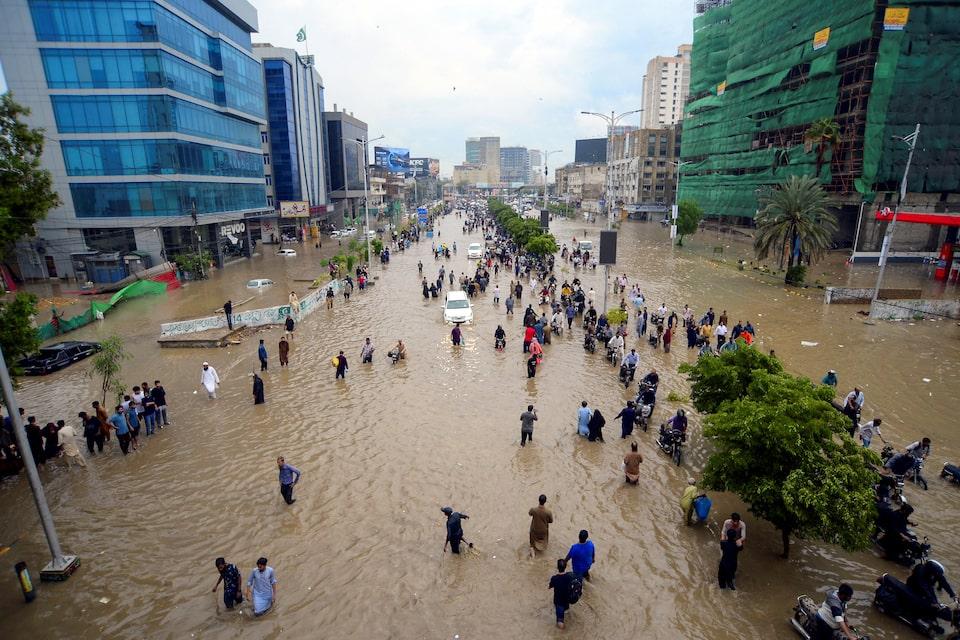
Flooding cripples Pakistan's financial capital More rains to lash the densely populated port city City's drainage system can handle only 40 mm rain, says mayor KARACHI, Pakistan, Aug 20 (Reuters) - Pakistan declared a public holiday in Karachi as the financial capital braced for more rain on Wednesday, after the arrival of the annual monsoon season left at least seven people dead and caused widespread flooding, officials said. The monsoon has brought havoc across Pakistan in recent days with the death toll from flash floods that struck the mountainous northwest on Friday rising to 377. Sign up here. In Karachi, at least seven people have died since the rains began in the southern port city on Tuesday, said Abdul Wahid Halepoto, a provincial government spokesperson. Rainfall reached levels not seen in years in some parts of the city, Pakistan's largest, with a population of more than 20 million. Deaths were caused by drowning, road accidents, building collapse and electrocution, Halepoto said. Authorities ordered educational institutions and offices to shut. "We are expecting more intense rains," said Anjum Nazir, a spokesperson for the provincial meteorological department. Tuesday's rain was recorded between 80 mm (3.15 inches) and 178 mm (7.01 inches) in different parts of the city, he said. Nazir said the area around the airport received 163.5 mm of rain, the highest recorded there since 1979. Some 178 mm of rain was recorded in the northeast of the city, the highest since the weather station there was set up five years ago. The rain also disrupted power, mobile phone services and flights, officials said. Local television footage showed cars and other vehicles floating down streets, with houses submerged in water. Karachi Electric said the sudden downpour had caused some disruption to its distribution network. Restoration efforts faced significant challenges due to waterlogging, access and overall traffic congestion in the city, its spokesperson said. He said KE teams were able to restore the majority of electricity feeders within eight to 12 hours. Rescue workers, police, volunteers and government agencies were helping relief efforts, the city's Mayor Murtaza Wahab told a press conference. "We are using all our resources to clear roads and restore utilities," he said. Wahab said the rain had overwhelmed the city's infrastructure, adding that the city's drainage system has the capacity to handle 40 mm rain, and that anything above that would spill over into flooding. There have also been heavy monsoon rains in Mumbai, India's financial capital, with some parts of the city drenched with as much as 875.1 mm of rain in the five days leading up to August 20, the local weather department said. Many schools in the city were closed for a second straight day on Wednesday, while train services were disrupted. Authorities requested residents avoid venturing out as more rain was predicted. (This story has been corrected to change 'would be able to' to 'were able to' in paragraph 11) https://www.reuters.com/business/environment/pakistans-financial-capital-karachi-hit-by-torrential-rain-flooding-2025-08-20/
2025-08-20 11:15
Reuters poll graphics on foreign portfolio investment so far in 2025: Reuters poll graphics on price-to-earnings ratio of major stock indices: BENGALURU, Aug 20 (Reuters) - Pressured by U.S. tariffs and foreign investor outflows, India's stock markets will manage to eke out only modest gains by year-end, according to a Reuters poll of equity analysts who have pushed back their forecast for a new record high to 2026. Foreign investors have sold more than a net $13 billion of Indian stocks this year, including around $2.4 billion in the first half of August after U.S. President Donald Trump raised tariffs on Indian exports to 50% - among the steepest imposed on any U.S. trading partner. Sign up here. The 5.2% rise in the blue-chip Nifty 50 (.NSEI) , opens new tab index so far this year lags broader Asian (.MIAPJ0000PUS) , opens new tab and emerging markets (.MIEF00000PUS) , opens new tab, which have gained 17.2% and 18.2%, respectively. If the trend continues it would be the first time in five years that the Nifty underperformed those indices. The Nifty 50 is forecast to rise about 3.9% to 25,834 by the end of this year, before reaching 26,500 by mid-2026 and 27,950 by end-2026, according to an August 8-20 poll of 20 equity analysts. Those forecasts are lower than in the previous quarterly survey, with a new record high now not seen until 2026. The BSE Sensex is seen climbing to 85,100 this year, 86,875 by mid-2026 and 91,370 by end-2026. "Until foreign investors are confident in the Indian economy and earnings...I don't think we'll see a substantial rise from here. The danger is they will use every rise to dump their stocks," said Yogesh Kalinge, associate director of research at A.K. Capital Services. "Trump keeps firing tariff volleys, the wind changes every week and honestly it's just hope and speculation keeping this market afloat." Around a third of analysts who usually take part in the poll did not provide forecasts this quarter, with some saying the market has become increasingly difficult to predict. Rajat Agarwal, Asia equity strategist at Societe Generale, who did participate, said weak economic data, tariff uncertainty and tepid earnings meant foreign inflows may take time to return. While India is the world's fastest-growing major economy, expected to expand 6.4% this fiscal year, its listed companies have reported only single-digit profit growth for five straight quarters. That is a sharp slowdown from the 15-25% expansion recorded between 2020-21 and 2023-24, a period over which the Nifty 50 rose around 160%. No major improvement is expected over the coming quarters. A majority of analysts, 16 of 21, said corporate earnings in the Indian stock market would edge up only marginally in the second half of 2025 from the first half, while two expected a significant increase. An expected cut to the goods and services tax (GST) in October to boost household consumption may also help shore up earnings, although analysts say the full impact will take time to filter through the economy. Valuations remain a concern. India's Sensex trades at 23 times forward earnings, among the world's highest, nearly matching Wall Street's S&P 500, LSEG data showed. HDFC Securities senior derivative analyst Subash Gangadharan said the GST cut was a positive step but would have limited impact given already sky-high valuations, and predicted the Nifty 50 to fall to 22,000 by end-2025. (Other stories from the Reuters Q3 global stock markets poll package) https://www.reuters.com/world/india/india-stocks-set-modest-gains-us-tariffs-foreign-outflows-cloud-outlook-2025-08-20/