2025-08-20 06:23
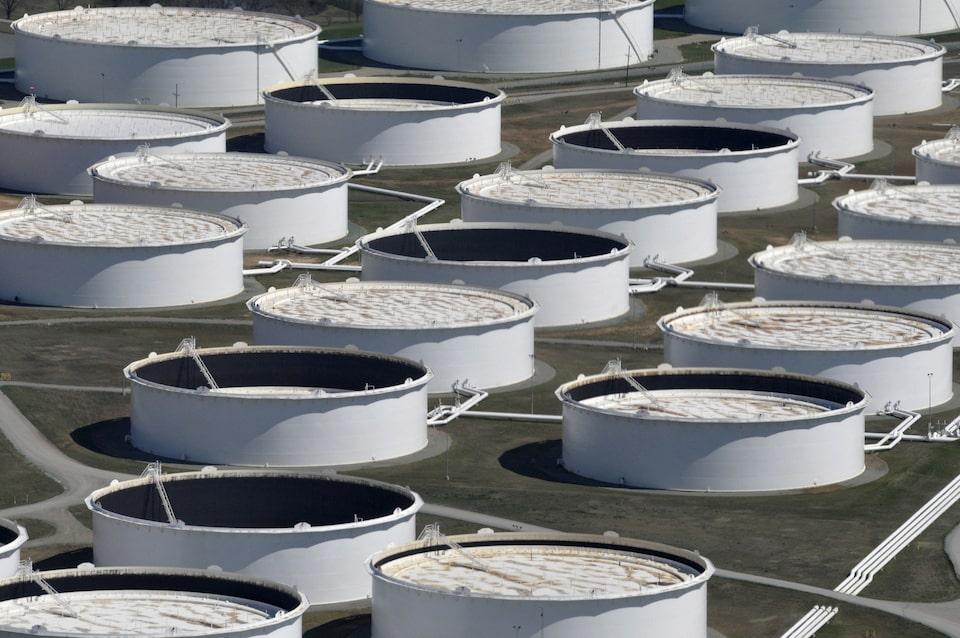
IEA, EIA forecast large supply overhang in coming quarters Yet future Brent oil price do not reflect the need to store oil Geopolitical tensions blur the outlook for supply and demand LONDON, Aug 20 (Reuters) - A glaring mismatch between benchmark oil prices and expectations of a looming supply overhang has created an imbalance that could end badly for traders. Major energy forecasting agencies, banks and producers expect oil supplies to far outstrip demand through the coming months and well into 2026 due to both an expected slowdown in demand growth and sharp production increases from OPEC+ and other major producers including the United States, Canada, Brazil and Argentina. Sign up here. The International Energy Agency projects global oil production will climb by 2.5 million barrels per day to 105.5 million bpd in 2025, then by another 1.9 million bpd in 2026, with a whopping 4.1 million bpd jump expected for Q1 2026. And the U.S. Energy Information Administration also expects sizable stock builds this year and next. Meanwhile, global consumption is expected to be only 103.74 million bpd this year and 104.44 million bpd next year. In response, spot Brent crude prices have already softened, sliding from over $73 a barrel on July 30 to just under $66 this week, also reflecting the waning summer oil demand in the northern hemisphere. But the longer end of the futures curve is telling a different story. THE SMILE In the oil market – as in other big commodity spaces – participants can buy contracts for future delivery months or years ahead, letting producers, refiners, consumers and speculators either hedge or bet on price moves. The forward curve reflects those expectations and comes in two flavours. Backwardation – when prompt prices sit above future prices – usually signals a tightening market and nudges producers to pump more. And contango – future prices above prompt levels – normally points to oversupply, incentivizing storage over drilling activity. Given that a chorus of experts is calling for significant oversupply in today’s oil patch, you’d expect Brent’s forward curve to be steeply in contango through 2026. Instead, it’s in pronounced backwardation from the prompt October contract out to March 2026, then largely flat to September 2026 before swinging into strong contango. The result: a forward curve “smile”. That shape is rare and puzzling. If a sizeable overhang is indeed barrelling down on the market, traders would very likely need to store more crude in tanks or, in a pinch, even on ships in the coming months. This means that a strong price correction may be coming. OPEC TO THE RESCUE What could be driving this mismatch between prices and forecasts? One explanation could be that investors expect OPEC+ to step in if necessary. The group, which includes the Organization of the Petroleum Exporting Countries, Russia and other producers, has sharply increased output since April when it started unwinding 2.2 million bpd of supply cuts, part of a series of cuts introduced since 2022 to prop up prices. The move, led by OPEC's de-facto leader Saudi Arabia, was aimed at re-establishing cohesion within the group after several members exceeded production quotas. Riyadh’s push to pump more crude also appears to be aimed at increasing its own production share in the global market by squeezing higher-cost producers around the world, such as U.S. shale producers. So even though OPEC+ could reintroduce cuts in the fourth quarter to head off a swelling glut, that belief seems like quite a stretch. First, members that have ploughed capital into new capacity in recent months may balk at having to quickly reverse course. New cuts would also undercut Saudi efforts to claw back market share. And slashing supply risks lifting prices, precisely what U.S. President Donald Trump has urged OPEC to avoid. GEOPOLITICAL MESS Maybe geopolitical confusion explains the smile as investors are struggling to price Trump’s trade wars and the sprawl of on-and-off tariffs that – at some point – are likely to sap manufacturing and trade flows, clipping oil demand at the margins. Meanwhile, investors also have to factor in the potential tightening of U.S. and European Union sanctions on Russia and Iran, which could further complicate supply chains. Trump’s threat of secondary sanctions on buyers of Russian crude – particularly China and India – could certainly scramble global trade. And yet, geopolitical jitters are hardly new to oil markets, and they certainly can’t fully explain the curve’s grin. Finally, it could simply be that traders don’t believe the market forecasts. But even if that’s the case, the stubborn disconnect should make them nervous, particularly given all the unknowns. If the IEA’s overhang materializes, the math argues for inventory builds and a forward curve tipping into contango. So traders need to watch out. This deepening smile could well end in tears. Enjoying this column? Check out Reuters Open Interest (ROI), , opens new tabyour essential new source for global financial commentary. ROI delivers thought-provoking, data-driven analysis. Markets are moving faster than ever. ROI , opens new tab can help you keep up. Follow ROI on LinkedIn , opens new tab and X. , opens new tab https://www.reuters.com/markets/commodities/oil-price-smile-could-leave-traders-tears-2025-08-20/
2025-08-20 06:22
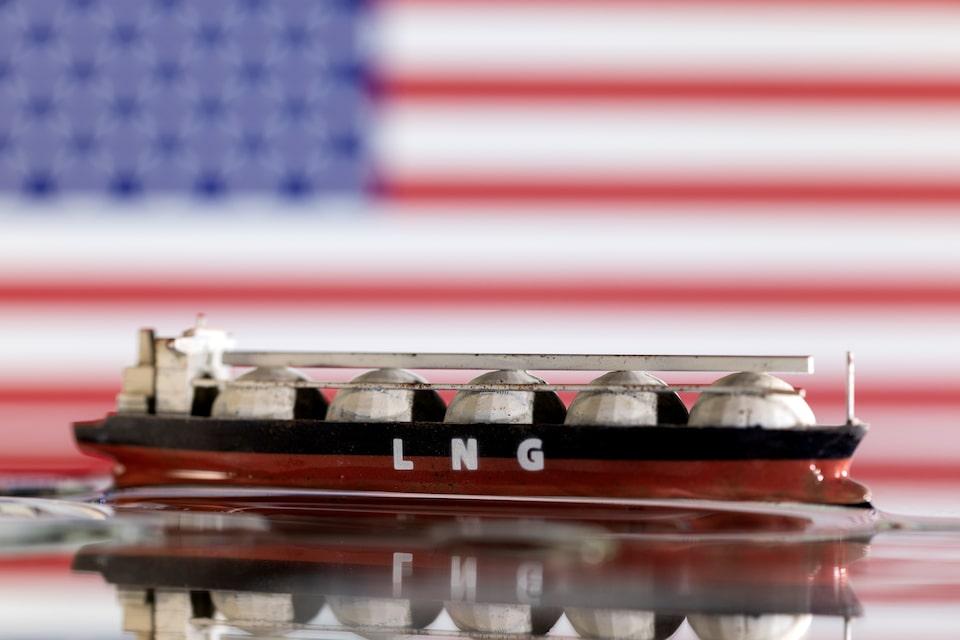
LITTLETON, Colorado, Aug 20 (Reuters) - U.S. power firms are building out the most gas-fired power generation capacity globally, which will cement the country's position as by far the world's largest natural gas consumer and gas-fired power producer. But the growing reliance on natural gas for domestic power generation also stands to stoke tensions with the fast-growing LNG export sector, which is banking on access to abundant and cheap natural gas to drive further expansion. Sign up here. Growing competition for U.S. natural gas by power firms and LNG exporters could also drive up natural gas prices, which may thwart efforts to reduce power bills for homes and businesses and undermine the competitiveness of U.S. LNG on world markets. HITTING THE GAS The United States accounts for roughly a quarter of global gas production, use and exports, and around 27% of worldwide electricity generation from gas-fired power plants, data from the Energy Institute and energy think tank Ember show. Within the global gas power generation network, the United States accounts for 26% of total currently operating gas power capacity, data from Global Energy Monitor (GEM) shows. The roughly 570,000 megawatts (MW) of gas capacity currently deployed in the U.S. vastly exceeds that of all other countries, including the 166,000 MW in second-placed China and 113,000 MW in third-placed Russia. The U.S. ranks third in terms of gas capacity currently under construction, as China is building out roughly 41,000 MW of new capacity compared to 24,000 MW by Saudi Arabia and 16,300 MW being constructed in the U.S., GEM data shows. But the U.S. regains the top spot in terms of gas capacity in so-called pre-construction, which is where generation sites are identified and appropriate permits are being secured ahead of actual construction. FAST-GROWING PIPELINE The U.S. has close to 100,000 MW of new gas-fired power capacity in the pre-construction phase, according to the latest data captured globally by GEM. That capacity total is notable for two important reasons. Firstly, the U.S. total handily exceeds the planned capacity pipeline at the same development phase in all other countries, including second-placed China's 61,500 MW and the 29,200 MW in pre-construction in third-placed Vietnam. That relatively larger development pipeline means that U.S. gas-fired power capacity will grow more quickly than in other countries over the near to medium term. Secondly, the U.S. pre-construction total is more than six times larger than it was just one year ago, when 15,000 MW of new gas-fired power capacity was categorized as being in pre-construction. The rapid swell in U.S. gas capacity in pre-construction since mid-2024 highlights the urgent steps being taken by U.S. power firms to boost generation by all means available, in response to rapidly growing power demand from data centers, AI applications and other major electricity consumers. The sharp jump in gas capacity also highlights the impact of the return to office by U.S. President Donald Trump, whose administration has drastically cut federal support for renewable power supplies and backed rapid fossil fuel power growth. LNG IMPACT The acceleration in U.S. gas-fired power generation capacity means the power sector will increase the amount of natural gas it consumes once that capacity is brought online. For LNG exporters, this means there will be heightened competition for natural gas supplies within the U.S., and potentially higher gas prices in the physical gas market. Somewhat offsetting the impact of higher gas use from power firms are expectations U.S. natural gas production will climb in 2025 by around 3% from 2024's near-record total to new highs, according to the U.S. Energy Information Administration. However, those gas production estimates are subject to change and are based in part on projections for oil prices, which can drive oil and gas extraction rates from gas-rich oil deposits in the United States. So far in 2025, benchmark U.S. crude oil prices have fallen by over 10% due to higher production from OPEC members and slow oil demand growth in key oil import markets. Oil prices could fall further if ongoing discussions between the U.S. and Russia to end the war in Ukraine prove successful and result in an easing of sanctions of Russian oil supplies. Such a scenario could trigger a slowdown in oil and gas production within the U.S., and a potential tightening in domestic gas supplies if demand from power firms and LNG exporters remains firm. PRODUCTION PEAK LOOMING Regardless of the near-term production picture, overall U.S. natural gas output will peak early in the next decade and then hold relatively flat through 2050, according to the EIA's latest long-term energy outlook. That assessment is based on the future production from key U.S. gas basins, many of which have passed their output peaks and are now considered to be in terminal decline. That outlook still implies abundant gas supplies over the coming years, which should be enough to allow for growth from both power users and LNG exporters. However, a key unknown for the gas market is the extent of further demand growth from the power sector, which is clearly in an expansion phase that could accelerate if the supply of alternative power sources grows by less than projected. The recent policy shifts by the Trump administration to slash support for renewable energy projects have the potential to steer utilities away from adding more solar and wind farms towards adding more gas-powered capacity. That in turn could lift gas demand for power by another gear, and trigger a sustained tightening in the U.S. gas market that could steadily underpin gas prices and result in intensifying competition with LNG exporters for supplies. The opinions expressed here are those of the author, a columnist for Reuters. Enjoying this column? Check out Reuters Open Interest (ROI), your essential new source for global financial commentary. ROI delivers thought-provoking, data-driven analysis of everything from swap rates to soybeans. Markets are moving faster than ever. ROI can help you keep up. Follow ROI on LinkedIn , opens new tab and X , opens new tab. https://www.reuters.com/markets/commodities/us-gas-heavy-power-pipeline-set-stoke-lng-exporter-tensions-2025-08-20/
2025-08-20 06:22
Activists push for more trees in poorer Madrid areas Heatwaves worsen health issues, especially for elderly Mayor Almeida's tree policies face criticism from activists MADRID, Aug 20 (Reuters) - As Madrid sweltered at the peak of one of Spain's longest-ever heatwaves, the temperature on a street in one of its poorest neighbourhoods - Puente de Vallecas - measured 41.4 degrees Celsius (106.5 Fahrenheit) by early afternoon. A few hundred metres down the street it was 38.6 C. Sign up here. The difference? One section of the street was treeless while the other was shaded by a row of leafy mulberries. According to scientific studies, trees can play a key role in mitigating the often-deadly effects of heatwaves and as temperatures in Spain rise as a result of global warming they may play a crucial role in helping to regulate temperatures. However, activist groups say that Madrid has been losing tree cover, particularly in some of its poorer neighbourhoods, and are pushing the mayor to plant more. “The difference between having or not having trees on your street has an immediate impact on your health,” said Manuel Mercadal, a member of activist group Sustainable Vallekas, which has been measuring temperature differences on Vallecas's streets to raise awareness. San Diego, a part of Puente de Vallecas, registered some of the highest temperatures in Madrid, according to a Polytechnic University of Madrid study, which identified so-called "urban heat islands" where temperatures were as much as 8 C higher than in other parts of the city, such as parks. The heat is exacerbated by a lack of air conditioning because many households can't afford it, said Pablo Chivato, a coordinator of the neighbourhood association for Puente de Vallecas. More frequent heatwaves are taking their toll on elderly patients, especially those with underlying cardiac problems, said Antonio Cabrera, a family doctor at a primary care centre in La Elipa in southeastern Madrid. "Higher mortality rates were traditionally associated with winter in European countries. Nowadays, for people aged 80–90 with multiple health conditions, this is the time of year when many of them die," Cabrera said. TREE CLASHES As temperatures rise, trees have become a political issue. Madrid’s Mayor Jose Luis Martinez-Almeida has clashed with activists over trees since taking power in 2019, particularly over plans to cut down more than 1,000 trees for the extension of a metro line. Official data show that while the total number of trees has increased by 2.4% under Almeida’s watch, that was mostly in the expanding middle-income districts in the city's east. All except one of the southern districts lost trees. Puente de Vallecas has lost 1,314 trees or 3% of its total tree cover since 2019. Some of the loss was caused by a heavy snowstorm in 2021 that killed 80,000 trees. But many are also felled as the city embarks on construction projects. The mayor's office didn't respond to a request for comment. Left-wing party Mas Madrid has pledged to plant 75,000 more trees so that the city has one tree every seven metres (23 feet). The law used to stipulate that felled trees must be replaced, but a recent reform means local councils in certain circumstances can create a fund into which to pay what it would have cost to plant new trees, said Lola Mendez of the environmental group Ecologists in Action. Almeida's office said it has planted nearly 40,000 trees in empty tree pits under a plan announced in 2022. Data published by the city in 2023 showed 1,318 trees were planted in Puente de Vallecas, but that 719 empty tree pits were covered over. The city hasn't published more recent data. Chivato said his neighbourhood association worked with the mayor's office to plant trees in 75% of empty tree pits in the Puente de Vallecas neighbourhood of San Diego. But many remain empty. https://www.reuters.com/sustainability/cop/madrids-poor-neighbourhoods-clamour-more-trees-cool-streets-deadly-heatwaves-2025-08-20/

2025-08-20 06:19
Aug 20 (Reuters) - North Sea oil and gas company Ithaca Energy (ITH.L) , opens new tab lifted its 2025 production forecast on Wednesday to 119,000 to 125,000 barrels of oil equivalent per day (boepd) assisted by its expanded portfolio and improved first-half production. Ithaca earlier expected full-year production of 109,000 to 119,000 boepd. Sign up here. https://www.reuters.com/business/energy/uks-ithaca-energy-raises-annual-production-forecast-2025-08-20/
2025-08-20 06:11
Markets eye Fed's Jackson Hole symposium for policy hints Minutes of the Fed's July policy meeting due later in day Zelenskiy hails summit with Trump as a step towards peace Aug 20 (Reuters) - Gold edged higher on Wednesday but remained near a three-week low as the dollar strengthened, while investors awaited the Federal Reserve's Jackson Hole symposium later this week for potential signals on monetary policy. Spot gold was up 0.2% at $3,321.83 per ounce, as of 0601 GMT, after reaching its lowest level since August 1. Sign up here. U.S. gold futures for December delivery rose 0.2% to $3,364.30. A stronger dollar and improving risk appetite from recent geopolitical developments are weighing on gold prices, with markets looking out for Fed Chair Jerome Powell's speech in Jackson Hole, OANDA senior market analyst Kelvin Wong said. The U.S. dollar index (.DXY) , opens new tab climbed to a more than one-week high, making gold less affordable for buyers using other currencies. Powell is due to speak at the Kansas City Federal Reserve's Jackson Hole symposium on Friday and investors are watching for any clues on monetary policy trajectory. Minutes of the Fed's July meeting, due later in the day, are anticipated to offer further insights into the central bank's policy stance. "The macroeconomic backdrop is likely to turn supportive, with Fed resuming its interest rate cuts from September. Higher tariffs will impact economic growth, keeping investment strong for gold," ANZ said in a note. Gold typically performs well in a low-interest-rate environment and amid heightened uncertainties. Meanwhile, U.S. President Donald Trumpruled out deploying ground troops to Ukraine on Tuesday but suggested air support could be part of a deal to end Russia's war in the region. Ukrainian President Volodymyr Zelenskiy hailed the White House talks as a "major step forward" towards ending Europe's deadliest conflict in 80 years and setting up a trilateral meeting with Russian President Vladimir Putin and Trump. Elsewhere, spot silver fell 0.5% to $37.20 per ounce, platinum gained 0.6% to $1,314.25 and palladium was down 0.6% to $1,108.25. https://www.reuters.com/world/china/gold-hits-near-3-week-low-stronger-dollar-fed-symposium-focus-2025-08-20/

2025-08-20 06:08
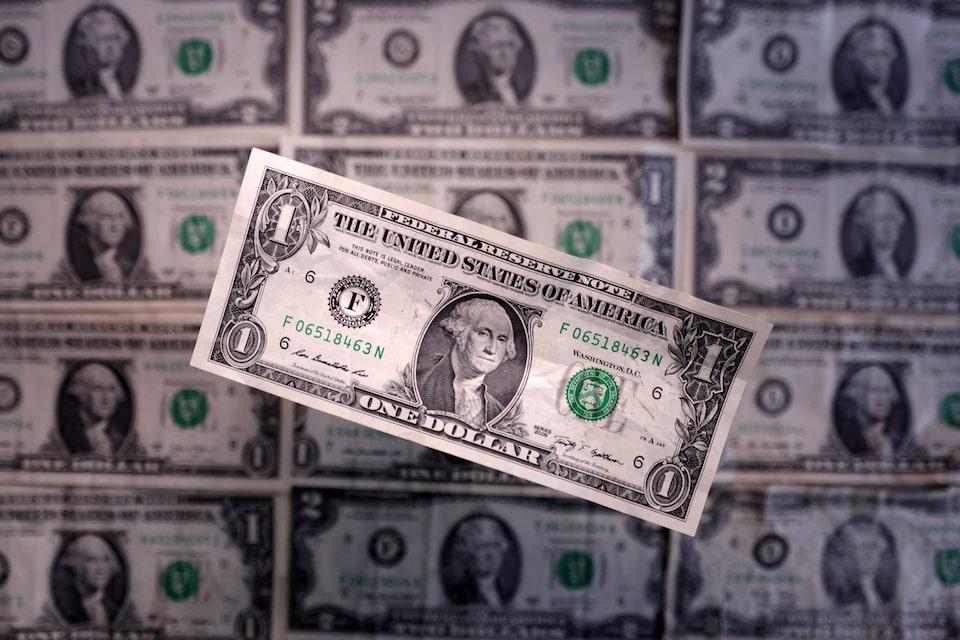
Traders focused on whether Powell pushes back on easing bets Markets lay 84% odds on a Fed rate reduction next month NZ dollar at 4-month low as RBNZ flags further rate cuts TOKYO, Aug 20 (Reuters) - The U.S. dollar gained for a third straight session on Wednesday against the euro and sterling as traders awaited the Federal Reserve's annual Jackson Hole symposium this week for clues on the monetary policy path. The New Zealand dollar tumbled after the central bank reduced its cash rate by a quarter point to 3.0% as expected, but said its board had also considered a half-point cut. Sign up here. The kiwi slumped as much as 1.3% to $0.5820, its weakest since April 14, with policymakers lowering their projected floor for the cash rate to 2.55%, from 2.85% forecast in May. "The market did not expect the bank to send a strong dovish signal that it intends to deliver further cuts," Prashant Newnaha, a rates strategist at TD Securities, wrote in a client note. He has increased his forecast for additional easing, now projecting a cash rate of 2.5% by November. The U.S. dollar index , which measures the currency against six major counterparts, rose as high as 98.441 for the first time since August 12 on Wednesday, after gaining a combined 0.4% over the first two days of the week. The euro eased 0.1% to $1.1638, and sterling slipped 0.1% to $1.3480. The greenback advanced 0.1% to 0.8080 Swiss franc , though it edged down 0.1% to 147.46 yen . Friday's speech by Fed Chair Jerome Powell is the market's main focus, as traders watch for any pushback against market pricing of a rate reduction next month. Traders now place odds of 84% on such a cut and expect about 54 basis points of reductions by year-end. "Given the relatively high bar for Powell to meet, there's a bit of risk being baked into the markets that he leans to the hawkish side and the proverbial rug gets pulled from beneath investors," said Kyle Rodda, an analyst at Capital.com. Traders, who ramped up bets for a Fed cut on September 17 after a surprisingly weak payrolls report at the start of this month, were further encouraged after consumer price data showed limited upward pressure from tariffs. However, a hotter-than-expected producer price reading last week complicated the policy picture. Powell has said he is reluctant to cut rates because of expected tariff-driven price pressures this summer. Later on Wednesday, the Fed will issue the minutes of its meeting on July 29 and 30, when it held rates steady, although they may offer limited insight as the meeting came before the weak jobs numbers. In cryptocurrencies, bitcoin hovered at around $113,612 after earlier dipping to the lowest since August 3 at $112,578.38, pressured by a strengthening dollar. Ether was little changed at around $4,170. https://www.reuters.com/world/middle-east/dollar-strengthens-ahead-jackson-hole-kiwi-drops-dovish-rbnz-2025-08-20/