2025-08-20 05:11
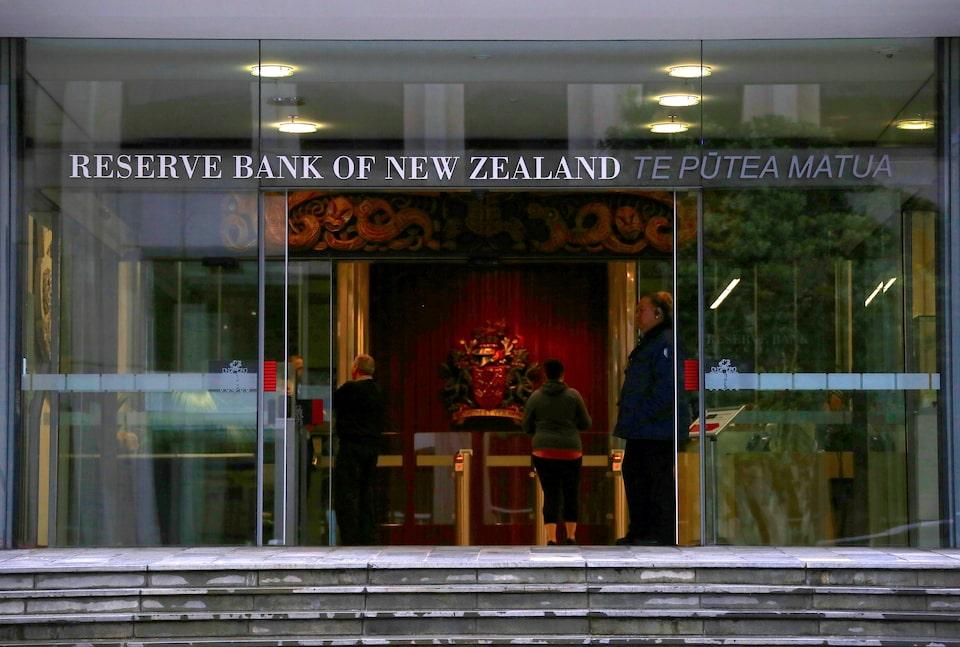
RBNZ cuts rates by 25 bps, signals more reductions Warns of global, domestic headwinds to growth Two of the RBNZ's 6 committee members voted for 50 bps cut NZ dlr and swaps tumble as markets surprised by dovish tone WELLINGTON, Aug 20 (Reuters) - New Zealand's central bank cut its policy rate by 25 basis points to a three-year low of 3.00% on Wednesday, and flagged further reductions in coming months as policymakers warned of domestic and global headwinds to growth. The central bank's dovish tone caught markets offguard and sent the New Zealand dollar tumbling 1.2% to a 4-month low at $0.5819, while two-year swap rates slumped as deep as 2.93% -- their lowest level since early 2022. Sign up here. The Reserve Bank of New Zealand said the economy had stalled in the second quarter, and lowered its projected floor for the cash rate to 2.55%, from 2.85% forecast in May. Two members of the six-strong policy committee even voted to cut by 50 basis points on Wednesday. Addressing a press conference, RBNZ Governor Christian Hawkesby said the outlook is data-dependent, but if businesses and consumers remain cautious "and need more support that might be something that prompts more action." The quarter point cut in the official cash rate (NZINTR=ECI) , opens new tab was in line with a large majority of economists in a Reuters poll, but the central bank's broadly bearish tone around economic risks and rates jolted markets. The central bank has slashed rates by 250 basis points since August 2024 to underpin a fragile recovery, but it said "consumption and investment demand appear to have weakened in the second quarter of 2025, partly in response to heightened trade policy uncertainty" after a shakeup in U.S. tariff policy in April this year. "The fact that members gave serious consideration to an outsized 50bp cut is quite telling," said Abhijit Surya, a senior APAC economist at Capital economics. The central bank forecast in its Monetary Policy Statement that the cash rate will be at 2.71% in the fourth quarter, below a forecast of 2.92% in May. In the first quarter of 2026 it expects it to average 2.55%, from the previously forecast 2.85%. "It is possible that pessimistic sentiment, together with the initial negative effects of the global tariff shock, have dampened the effects of the reduction in the OCR since last August," RBNZ said in its meeting minutes. TWO MORE RATE CUTS? Markets quickly moved to narrow the odds on two more cuts, implying a 50% chance of a move in October and over 100% for November. The bottom is now implied around 2.57%, compared to 2.76% before the RBNZ announcement. A snap Reuters poll showed 10 of 12 economists picking the cash rate to bottom at 2.5%, compared with 2.75% in a broader pre-RBNZ poll last week. Bank of New Zealand head of research Stephen Toplis said that given the central bank's dovish tone, the BNZ is now forecasting 25-basis-point cuts in both October and November. ANZ bank is also now expecting two quarter point cuts in October and November, from previous expectations for easings in November and February, saying the RBNZ was "much more dovish than expected." New Zealand's annual inflation remains within the RBNZ's 1%-3% target band at 2.7%, giving the central bank leeway to cut rates further. The bank is forecasting inflation to rise to 3% in the third quarter, and then ease to around 2% by the middle of next year. A global front-runner in withdrawing pandemic-era stimulus, the RBNZ lifted rates 525 basis points between October 2021 and September 2023 to curb inflation in the most aggressive tightening since the official cash rate was introduced in 1999. The punishing borrowing costs tipped the South Pacific nation's economy into recession last year, and the recovery has been hampered by tariff risks, slowing global growth and the government’s tight fiscal policy. ANZ chief economist Sharon Zollner said the economic weakness has prompted the central bank to act forcefully. "The RBNZ has come around to our big-picture view more quickly than we anticipated." https://www.reuters.com/world/asia-pacific/nz-central-bank-cuts-rates-3-year-low-flags-more-easing-kiwi-tumbles-2025-08-20/
2025-08-20 05:09
Shares track tech-led decline on Wall Street Trump's growing influence over tech companies raises concerns Eyes on Jackson Hole symposium, Powell's speech SINGAPORE, Aug 20 (Reuters) - Global share markets came under pressure on Wednesday after a tech-led selloff on Wall Street, while the dollar gained some ground ahead of a key meeting of central bankers later in the week. Stock futures pointed to a lower opening in Europe and most Asian bourses were in the red, with tech-heavy indexes in Taiwan (.TWII) , opens new tab and South Korea (.KS11) , opens new tab among the biggest losers, in part due to worries about the Trump administration's growing influence on companies in the sector. Sign up here. U.S. Commerce Secretary Howard Lutnick is looking into the government taking equity stakes in Intel (INTC.O) , opens new tab as well as other chip companies in exchange for grants under the CHIPS Act that was meant to spur factory-building around the country, sources told Reuters. The move comes on the back of other unusual deals Washington has recently struck with U.S. companies, including allowing AI chip giant Nvidia (NVDA.O) , opens new tab to sell its H20 chips to China in exchange for the U.S. government receiving 15% of the revenue from those sales. "These developments signal that the U.S. government is heading in a concerning and more interventionist direction," said Tony Sycamore, a market analyst at IG. MSCI's broadest index of Asia-Pacific shares outside Japan (.MIAPJ0000PUS) , opens new tab slid more than 1%, while EUROSTOXX 50 futures lost 0.64% and DAX futures shed 0.63%. S&P 500 futures dipped 0.27% and Nasdaq futures lost 0.44%, extending a fall from the cash session overnight. Japan's Nikkei (.N225) , opens new tab lost 1.7% and Hong Kong's Hang Seng Tech Index (.HSTECH) , opens new tab shed 1.3%. In commodities, oil prices trimmed losses from the previous session, as investors awaited the next steps in talks to end Russia's war on Ukraine, with uncertainty over whether oil sanctions might be eased or tightened. While a meeting between U.S. President Donald Trump, Ukrainian President Volodymyr Zelenskiy and a group of European allies over the Russia-Ukraine war concluded without much fanfare, Trump said the United States would help guarantee Ukraine's security in any deal to end Russia's war there. He later said on Tuesday that the United States might provide air support to Ukraine, while ruling out putting U.S. troops on the ground. "The U.S. is not categorically underwriting anything, any security for Ukraine, even if they're open to provide some, because we don't know the conditions under which they will. So there's quite a bit of risk left out there," said Vishnu Varathan, head of macro research for Asia ex-Japan at Mizuho. Brent crude futures were last up 0.15% at $65.89 a barrel, while U.S. crude tacked on 0.1% to $62.41 per barrel. AWAITING JACKSON HOLE All eyes are now on the Kansas City Federal Reserve's August 21-23 Jackson Hole symposium, where Fed Chair Jerome Powell is due to speak on the economic outlook and the central bank's policy framework on Friday. Focus will be on what Powell says about the near-term outlook for rates, with traders almost fully pricing in a rate cut next month. "Given the apparent tensions between U.S. CPI and PPI data, (it) does come across as ... premature to declare one way or the other. And most importantly, given this kind of dilemma embedded within the data, it is hard to decipher whether the Fed would take or would emphasise the risks that start to mount on the job side of the equation or (the) need to sit firm," said Mizuho's Varathan. Ahead of the gathering, the dollar firmed slightly, pushing the euro down 0.13% to $1.1633, while sterling fell 0.16% to $1.3470. The New Zealand dollar tumbled more than 1% after its central bank cut rates as expected and flagged further reductions in coming months as policymakers warned of domestic and global headwinds to growth. The kiwi last bought $0.5835. Elsewhere, spot gold fell 0.07% to $3,312.89 an ounce. https://www.reuters.com/world/china/global-markets-wrapup-2-2025-08-20/
2025-08-20 04:35
A look at the day ahead in European and global markets from Rae Wee Markets in Europe were set for a dour opening on Wednesday, after a slump on Wall Street pushed Asian shares into the red, with technology stocks leading the decline. Sign up here. While there was no immediate trigger, analysts pointed to a confluence of factors, such as doubts over the lofty valuations of tech heavyweights and President Donald Trump's growing influence over the sector. U.S. Commerce Secretary Howard Lutnick is looking into the government taking equity stakes in Intel (INTC.O) , opens new tab as well as other chip companies in exchange for grants under the CHIPS Act that was meant to spur factory-building around the country, sources told Reuters. The move comes on the back of other unusual deals Washington has recently struck with U.S. companies, including allowing AI chip giant Nvidia (NVDA.O) , opens new tab to sell its H20 chips to China in exchange for the U.S. government receiving 15% of those sales. The government's intervention in corporate matters has worried critics who say Trump's actions create new categories of corporate risk and that a bad bet could mean a hit to taxpayer funds. "This U.S. state/Presidential creep into tech, and the wider private sector, is unhealthy as it threatens to erode margins and dent demand/topline," said Mizuho's head of macro research for Asia ex-Japan Vishnu Varathan. Asia's tech-heavy indexes in Taiwan (.TWII) , opens new tab and South Korea (.KS11) , opens new tab slid 2.6% and 1.7%, respectively, while EUROSTOXX 50 futures shed 0.7%. Nasdaq futures were down 0.5%. Apart from the tech gloom, traders in London will be waking up to UK inflation figures, where expectations are for headline consumer prices to have picked up slightly in July on an annual basis. Inflation in Britain remains the highest of any major advanced economy and is around one percentage point more than in the United States or the euro zone. Any upside surprise would prove a headache for the Bank of England, with economists polled by Reuters expecting the central bank to cut interest rates by a quarter-point once more this year and then again in early 2026. Elsewhere in markets, the New Zealand dollar tumbled on Wednesday after the central bank cut rates and flagged further reductions in coming months as policymakers warned of domestic and global headwinds. The Reserve Bank of New Zealand said the economy had stalled in the second quarter, and lowered its projected floor for the cash rate to 2.55%, from 2.85% forecast in May. Key developments that could influence markets on Wednesday: - UK inflation (July) - FOMC July meeting minutes - Fed's Waller, Bostic speak https://www.reuters.com/world/china/global-markets-view-europe-2025-08-20/

2025-08-20 03:02
MUMBAI, Aug 20 (Reuters) - The Indian rupee's rally to a three-week high is at risk of stalling on Wednesday, pressured by a decline in Asian currencies and lacklustre equity flows. The 1-month non-deliverable forward indicated the rupee will open in the 87.10-87.14 range versus the U.S. dollar, compared with 86.95 on Tuesday, when it hit a three-week high of 86.92. Sign up here. Unwinding of long-dollar positions, Prime Minister Narendra Modi's planned tax cuts and cautious optimism on the Ukraine-Russia front drove the rupee to its best day in seven weeks on Tuesday. The "washout" of dollar longs has left positioning much lighter, and it won’t be a driver for the rupee anymore, a trader at a Mumbai-based bank said. "And without a pickup in equity flows, it’s hard to see the currency holding near 87." While Indian equities have rallied on hopes that Modi’s planned tax cuts will bolster growth, foreign flows remain tepid. Overseas investors were net sellers of local shares on Tuesday after putting in just over $100 million the previous day. ASIA FX DOWN, RISK SOURS Asian currencies slipped between 0.1% and 0.5% on the day, while the dollar index inched up to 98.40. Regional equities were mostly lower, tracking the tech-led selloff on Wall Street. U.S. Treasury yields, meanwhile, fell on Tuesday after S&P affirmed the U.S. credit rating. Much of attention was on a meeting between U.S. President Donald Trump, Ukrainian President Volodymyr Zelenskiy and European allies over the Russia-Ukraine war. Focus now shifts to Federal Reserve Chair Jerome Powell’s speech on Friday, with markets watching for any pushback against expectations of a September rate cut. Traders are largely confident a cut is coming, with futures pricing in a more than 80% chance. KEY INDICATORS: ** One-month non-deliverable rupee forward at 87.23; onshore one-month forward premium at 12 paise ** Dollar index up at 98.42 ** Brent crude futures up 0.1% at $65.9 per barrel ** Ten-year U.S. note yield at 4.31% ** As per NSDL data, foreign investors bought a net $116.2 million worth of Indian shares on Aug. 18 ** NSDL data shows foreign investors sold a net $12.7 million worth of Indian bonds on Aug. 18 https://www.reuters.com/world/india/rupee-rally-hit-speed-bump-weak-asian-cues-tepid-equity-flows-2025-08-20/
2025-08-20 01:41
India's July oil imports lowest since Sept 2023 Share of OPEC's oil rises in July Skips LatAm oil imports for the 1st time at least since 2011 NEW DELHI, Aug 19 (Reuters) - India's Russian oil imports declined in July after jumping the previous month as some refiners slowed purchases due to smaller discounts, while Indian fuel demand also typically dips during the monsoon season, according to trade sources and data. Russian oil imports for the world's third-biggest oil importer and consumer are likely to slow further in August and September as Indian state refiners paused Urals crude purchases as discounts have narrowed while U.S. President Donald Trump warned India not to buy Russian oil. Sign up here. India imported 1.5 million barrels per day of Russian crude in July, down 24.5% from the previous month, the data showed. Private refiners - Reliance Industries (RELI.NS) , opens new tab, Russia-backed Nayara Energy and HPCL-Mittal Energy Ltd - took around 60% of India's Russian oil imports in July while the remainder went to state refiners, according to the data. In July, Russia accounted for 34% of India's overall imports of 4.44 million bpd. India's oil imports in July were the lowest since September 2023, the data showed. Russia remained India's top oil supplier, followed by Iraq and Saudi Arabia. India's Russian oil imports also declined partly because Reliance, operator of the world's largest refining complex, reduced its purchases by about 19% in July from a high base in the previous month, the data showed. State refiners have switched to alternative supply from the Middle East and the United States to replace Russian oil in August and September. Meanwhile, the share of OPEC nations, mainly Middle Eastern producers, in India's overall imports rose to a five-month high in July, the data showed. In January-July, India's Russian oil imports fell about 3.6% to 1.73 million bpd, while purchases from the U.S. rose 58%, the data showed. Also, India skipped imports of oil from Latin America in July, for the first time at least since 2011 when Reuters started compiling the monthly data. https://www.reuters.com/business/energy/indias-russian-oil-imports-dip-july-skips-latam-supply-data-shows-2025-08-19/

2025-08-20 00:37
Traders focused on whether Powell pushes back on easing bets Markets currently lay 84% odds on a Fed rate cut next month NZ dlr hovers near 2-week low with markets braced for RBNZ cut TOKYO, Aug 20 (Reuters) - The dollar got off on the front foot on Wednesday following two days of gains as traders awaited the Federal Reserve's Jackson Hole annual symposium later this week for clues on the path for monetary policy. A speech on Friday by Fed Chair Jerome Powell is the main focus, with the market watching for any push back against market pricing of a rate reduction next month. Sign up here. Traders currently place 84% odds on a cut next month, and expect around 54 basis points of reductions by year-end. The dollar index , which measures the currency against six major counterparts, edged up to 98.393 early on Wednesday, the highest since August 12. It had gained about 0.4% in the first two days of this week. "Given the relatively high bar for Powell to meet, there's a bit of risk being baked into the markets that he leans to the hawkish side and the proverbial rug gets pulled from beneath investors," said Kyle Rodda, an analyst at Capital.com. In Asian hours, the Reserve Bank of New Zealand sets policy later in the day, with a large majority of economists predicting a quarter-point cut to the cash rate. The New Zealand dollar drooped close to Tuesday's nearly two-week low, last changing hands at $0.5895. "There's little reason for RBNZ to keep rates on hold," said Rodda. "Inflation is within its target band, and although it is no longer mandated to target the labour market, the unemployment rate is at a post-COVID high." For the Fed, traders ramped up bets for a cut on September 17 after a surprisingly weak payrolls report at the start of this month, and were further encouraged after consumer price data showed limited upward pressure from tariffs. However, a hotter-than-expected producer price reading last week complicated the policy picture. Powell has said he is reluctant to cut rates due to expected tariff-driven price pressures this summer. The Fed will release minutes from its July 29-30 meeting later on Wednesday, when the central bank held rates steady, although they may offer limited insight as the meeting came before the weak jobs numbers. The dollar advanced 0.1% to 147.78 yen . The euro eased 0.1% to $1.1633, the weakest since August 14. Sterling slipped 0.1% to $1.3476, the lowest since August 12. Australia's dollar edged down to $0.64485, a level last seen on August 1. https://www.reuters.com/world/middle-east/dollar-grinds-higher-with-fed-focus-run-up-jackson-hole-2025-08-20/


