2025-08-13 06:49
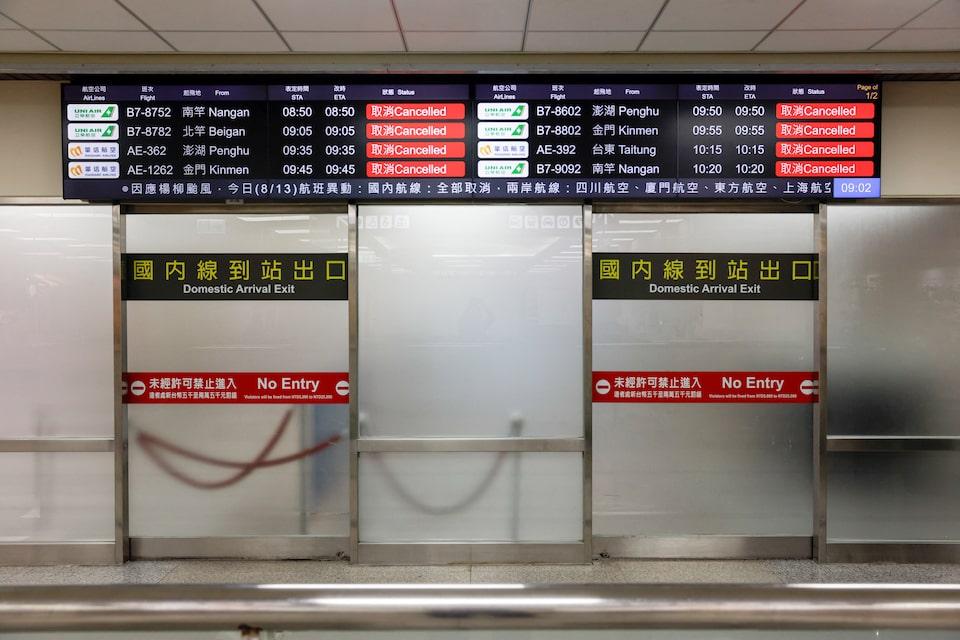
TAIPEI, Aug 13 (Reuters) - Typhoon Podul hit Taiwan's sparsely populated southeast coast on Wednesday packing winds of up to 191 kph (118 mph), as a large swathe of southern and eastern parts of the island shut down and hundreds of flights were cancelled. Taiwan is regularly hit by typhoons, generally along its mountainous east coast facing the Pacific. Sign up here. Podul slammed into the southeastern city of Taitung around 1 p.m. (0500GMT), Taiwan's Central Weather Administration said. "Destructive winds from typhoon expected. Take shelter ASAP," read a text message alert issued to cellphone users in parts of Taitung early on Wednesday. The alert warned people of gusts above 150 kph (93 mph) in the coming hours. Nine cities and counties announced the suspension of work and school for Wednesday, including the southern metropolises of Kaohsiung and Tainan. In the capital Taipei, home to Taiwan's financial markets, there were blustery winds but no impact. Authorities are also working to evacuate those whose homes were damaged by a July typhoon that brought record winds and damaged the electricity grid in a rare direct hit to Taiwan's west coast. The government said more than 5,500 people had been evacuated ahead of the typhoon's arrival. All domestic flights were cancelled on Wednesday - 252 in total - while 129 international ones were axed too, the transport ministry said. Taiwan's two main international carriers China Airlines (2610.TW) , opens new tab and EVA Air (2618.TW) , opens new tab said their cancellations were focused on routes out of Kaohsiung, with some flights from the island's main international airport at Taoyuan stopped as well. After making landfall, the storm is expected to hit Taiwan's much more densely populated western coast before heading for China's southern province of Fujian later this week. As much as 600 mm (24 inches) of rain was forecast in southern mountainous areas over the next few days, the Central Weather Administration said. More than a year's rainfall fell in a single week this month in some southern areas, unleashing widespread landslides and flooding, with four deaths. https://www.reuters.com/business/environment/typhoon-podul-slams-into-southern-taiwan-hundreds-flights-cancelled-2025-08-13/
2025-08-13 06:41
Interest in yuan-denominated settlements from China likely to continue DBS's CIPS settlement flows up 30% y/y in 2024 Bank seeks to grow FI clearing capabilities, enhance ROE SINGAPORE, Aug 13 (Reuters) - DBS Group (DBSM.SI) , opens new tab, Southeast Asia's largest lender by assets, is seeing growing interest from Chinese exporters to settle trades in renminbi (RMB), or yuan, particularly with counterparts in Latin America and the Middle East, a senior executive said. "Right now, you see the Chinese exporters, some are beginning to ask and say, I'm going to sell in RMB, please settle in RMB," said Han Kwee Juan, speaking to Reuters in his first media interview since becoming DBS's group head of institutional banking in January. Sign up here. "Is that a trend that will continue? I think that it's something that they will continue to ask for as they trade more with the rest of the world, outside of the U.S.," he said. The shift comes as decades of unwavering faith in the U.S. dollar's dominance in global trade and capital flows faces scrutiny. Major emerging market economies are stepping up efforts to trade in local currencies, underscoring efforts to reduce reliance on the dollar in the global financial system. However, Han said that most settlements outside of China remain "largely in dollars". The bank's subsidiary, DBS China, has been a member of China's Cross-Border Interbank Payment System (CIPS) since 2015. China launched CIPS in 2015 to promote the yuan's usage in international trade. It allows global banks to clear cross-border yuan transactions directly onshore, instead of through clearing banks in offshore yuan hubs. DBS's settlement flows through the CIPS clearing system grew 30% year-on-year in 2024, Han said, though he maintained that the shift toward more yuan-denominated settlements remains gradual. In a wide-ranging interview, Han spoke of how businesses are dealing with the uncertainty over Trump's tariffs and outlined DBS's growth strategy in the current economic environment. "One of the things that we have been growing this year is we have been growing our capability for FI clearing," he said. "We have been quite purposeful in terms of investment that we have made in the clearing capabilities." The bank is also looking to capitalise on its institutional banking business to drive its return on equity, which currently stands at 17%, Han said. Last week, DBS posted a quarterly profit that beat estimates, sending its shares to a record high. "By being able to work with the customers holistically, not just with lending, but also with advisory and as well as cash management, enables us to not only just look at lending or (net interest income) as a source of revenue, but really growing our fee-based revenues," Han said. https://www.reuters.com/business/finance/dbs-sees-rising-demand-yuan-settlements-chinese-exporters-2025-08-13/

2025-08-13 06:40
Vestas second quarter profit lags forecast, orders down Keeps 2025 outlook despite US trade policy uncertainty COPENHAGEN, Aug 13 (Reuters) - Wind turbine maker Vestas (VWS.CO) , opens new tab on Wednesday reported a smaller-than-expected rise in operating profit for the second quarter but maintained its financial outlook for the year as it expected to absorb the impact of U.S. policy uncertainty. Vestas reported an April-June operating profit before one-off items of 57 million euros ($66.56 million), below the 89 million euros expected by 22 analysts in a poll compiled by the company, but up from a year-ago loss of 185 million euros. Sign up here. "In the quarter, we had good order momentum in EMEA, but political uncertainty impacted key markets," CEO Henrik Andersen said in a statement, adding that the company was working to address challenges. The largest wind turbine maker outside of China kept its 2025 forecast unchanged for an operating profit margin before special items of 4%-7% and revenue of 18 billion to 20 billion euros, slightly up from 17.3 billion euros in 2024. There remained considerable uncertainty over tariffs, especially in the United States, Vestas said. Wind turbines include components and materials sourced globally, making the sector vulnerable to trade tariffs. U.S. President Donald Trump has issued executive orders and bills that curtail the use of incentives for wind and solar energy, which dominate the queue of new power generation waiting to connect to the electric grid. Vestas said its second quarter wind turbine orders dropped by 44% in megawatts (MW), as orders fell in some core markets such as the U.S.. While rising tariffs will likely raise costs, Vestas expected this would also lead to higher electricity prices. ($1 = 0.8564 euros) https://www.reuters.com/sustainability/climate-energy/wind-turbine-maker-vestas-second-quarter-profit-lags-forecast-keeps-outlook-2025-08-13/
2025-08-13 06:23
MUMBAI, Aug 13 (Reuters) - The Indian rupee and forward premiums traded higher on Wednesday, lifted by tame headline U.S. inflation data that reinforced bets of a Federal Reserve rate cut next month. The local currency quoted at 87.6750 at 11.00 am IST, compared to 87.7125 on Tuesday. The U.S. consumer price index for July showed limited impact from recent tariffs. Sign up here. That provided a boost to emerging market currencies, with Fed rate cut odds for September climbing to 94%, and markets now pricing in 60 basis points of cuts this year. Based on the details in the CPI report, Goldman Sachs estimates that the U.S. core PCE price index - the Fed's preferred measure of inflation - rose 0.26% in July versus their expectation of 0.31% prior to the report, corresponding to a year-over-year rate of 2.88%. The inflation data has lent the rupee a bit of a reprieve ahead of the crucial Trump-Putin meeting on Friday, a currency trader at a bank said. The relief is unlikely to extend much beyond the current level — at most to 87.50 — with companies hedging more and interbank positioning expected to remain light until the outcome of the meeting is known. The stakes of the meeting, which aims to explore a resolution to the war in Ukraine, are high for the rupee. Market participants expect any resolution to the conflict to have a bearing on additional tariffs that President Trump has imposed on Indian goods in response to New Delhi’s continued purchases of Russian oil. Dollar/rupee forward premiums moved higher, with the one-year dollar/rupee implied yield rising 2 bps to 2.09%, supported by the drop in U.S. yields amid Fed rate cut bets. https://www.reuters.com/world/india/rupee-rides-us-inflation-relief-forward-premiums-perk-up-fed-cut-bets-2025-08-13/

2025-08-13 06:20
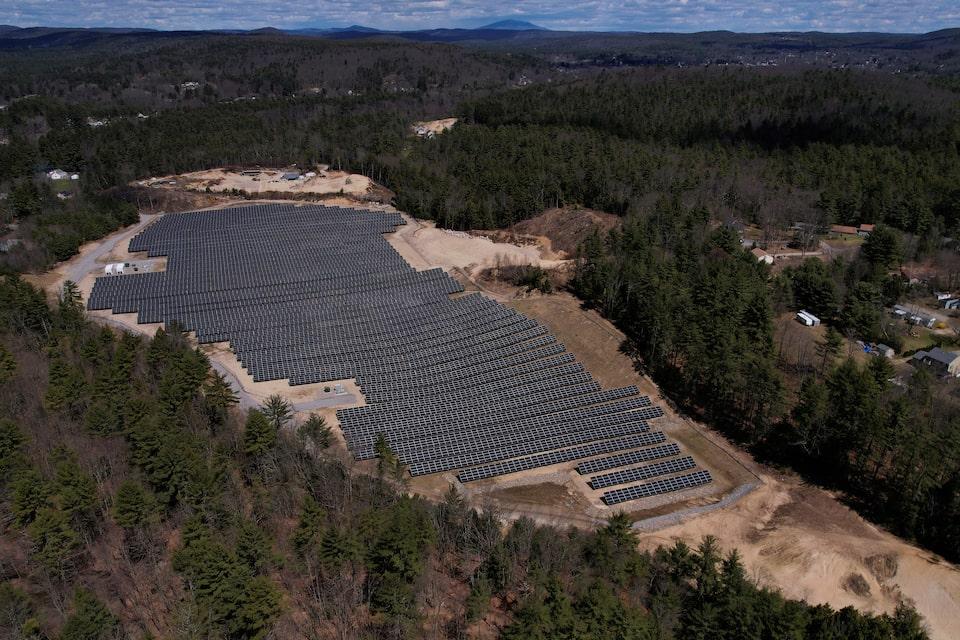
LITTLETON, Colorado, Aug 13 (Reuters) - The pace of new capacity of U.S. solar, wind and battery systems has slowed nationally and in key states this year, hurting clean energy sector sentiment. But climate trackers can take heart from the continued growth outside Texas and California. Combined installations of solar, wind and battery storage systems are on track to climb by around 7% in 2025 from the year before, according to data compiled by energy data platform Cleanview as of mid-2025. Sign up here. That would mark the smallest year-over-year percentage expansion in the footprint of those energy technologies in over a decade, and comes amid aggressive cuts to support for clean power since U.S. President Donald Trump returned to office. Climate advocates are particularly alarmed by the slowing in capacity growth in Texas and California, which account for over a third of national combined clean energy capacity but have grown by less than the national average this year. But while there's plenty for clean energy trackers to be concerned about, there are signs that expansions continue outside of the main clean energy states to suggest the U.S. energy transition may be widening even as it slows in 2025. SOLAR SLOWDOWN Solar power capacity has been the fastest-growing form of clean power generation over the past five years, with national capacity expanding by 181% since 2020 to roughly 136,250 megawatts (MW) as of mid 2025, Cleanview data shows. Total U.S. solar capacity has grown by an annual average of 27% since 2020, but so far in 2025 has only grown by 10% from 2024's total due to the sharp slowdown in developer activity. The growth pace of the combined solar installations in California and Texas - the top two solar producing states - was 8% so far in 2025, and so was less than the national average due mainly to the lowest capacity growth in California on record. Capacity growth in Florida, Nevada, Georgia and Virginia - all top 10 solar states - was also well below the national average. However, Arizona, Ohio and Indiana, which are also in the top 10 list, posted growth rates of well over twice the national average to sustain the overall national growth trend. WIND WOES Wind power capacity growth has been slowing steadily in recent years due to cost increases for parts and labour, as well as difficulties in securing new suitable sites for wind farms. Even so, the 1.8% expansion in total U.S. wind capacity so far this year is the smallest annual increase in the U.S. wind power footprint since at least 2010. Among the 10 largest wind power producing states, only Texas (+2.1%) and Illinois (+4.5%) recorded growth in excess of the national average this year, while seven of the top ten states have so far recorded no increase in capacity versus 2024 at all. That said, states outside the 10 largest wind power producers have expanded capacity by 3% so far this year from 2024's total, which is helping the national total tick higher even as the core wind states tread water. BATTERY BUFFERS Battery energy storage systems (BESS) have been the fastest-growing segment of the clean energy space in recent years, and continue to expand at a faster pace than wind and solar farms in 2025. Total installed utility-scale BESS capacity was 33,212 MW as of mid-2025, Cleanview data shows, which is up 22% from 2024's total. Again, California and Texas have posted growth rates below the national average so far in 2025, of 11% and 14% respectively. However, Arizona, Nevada, Massachusetts and Idaho - all top 10 states for battery capacity - have registered capacity increases of far more than the national average. And with federal support for battery systems still available under the Trump administration even as incentives for solar and wind power are slashed, batteries look set to remain the leading growth driver of U.S. clean energy capacity going forward. COMBINED TAKEAWAYS Combined capacity of solar, wind and battery systems hit 325,700 MW as of mid-2025, which marks a 7% or 20,700 MW rise from a year ago. Among the 10 largest states by combined solar, wind and battery capacity, Texas brought on the largest volume, with a 5,250 MW rise, followed by Arizona, California and Indiana. Florida and Illinois also increased their overall clean energy footprints, mainly through battery systems, and look set to remain attractive markets for battery developers going forward given the need for local utilities to ease grid strain. Batteries will also remain in high demand in areas with large volumes of surplus solar generation that utilities want to harness for use during peak consumption periods. That suggests even if the roll-out of new solar and wind capacity remains stunted as the federal support gets phased out, the overall footprint of clean technology looks set to keep rising as more batteries take root. The opinions expressed here are those of the author, a columnist for Reuters. Enjoying this column? Check out Reuters Open Interest (ROI), your essential new source for global financial commentary. ROI delivers thought-provoking, data-driven analysis of everything from swap rates to soybeans. Markets are moving faster than ever. ROI can help you keep up. Follow ROI on LinkedIn , opens new tab and X , opens new tab. https://www.reuters.com/markets/commodities/us-clean-energy-capacity-growth-gets-slower-wider-2025-2025-08-13/
2025-08-13 05:28
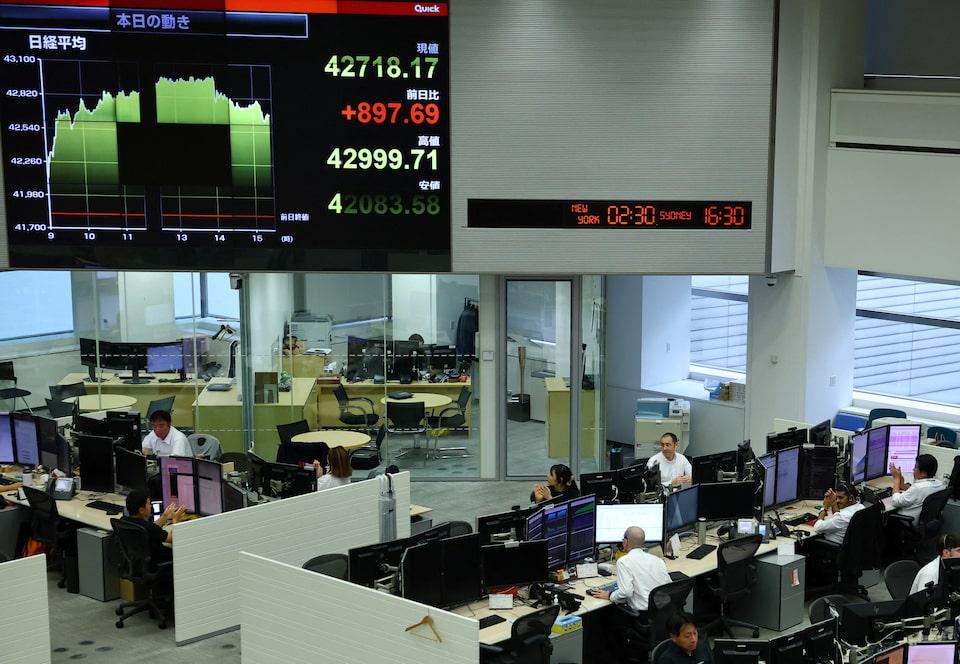
Fed rate cut expected, boosting Wall Street and Asian markets U.S. inflation data below expectations, easing stagflation fears Nikkei hits new high, breaches 43,000 TOKYO, Aug 13 (Reuters) - Stocks in Asia climbed and the U.S. dollar was subdued on Wednesday, as data showed both resilience in major economies and the need for central banks to remain accommodative. Wall Street scaled new heights on Tuesday, driven by increasing certainty the Federal Reserve will cut interest rates next month. Japan's Nikkei broke through the 43,000 level for the first time and cryptocurrency ether rose to an almost four-year high. Sign up here. Pan-region Euro Stoxx 50 futures were up 0.5%, German DAX futures rose 0.5% and FTSE futures climbed 0.2%. U.S. stock futures, the S&P 500 e-minis , were flat. The highly-anticipated U.S. inflation readings indicated President Donald Trump's tariff regime had yet to filter down to consumer prices. In Japan, a report showed manufacturers grew more confident about business conditions after a trade agreement with the United States. "It's clear that almost any good news leads investors to pile money into markets, particularly tech stocks, despite their lofty price tags," Paco Chow, dealing manager at Moomoo Australia and New Zealand, wrote in a note to clients. "They're riding on 95% odds of a Fed rate cut in five weeks and feeling comfort that inflation is only creeping higher, not running amok," Chow said. The MSCI All Country World Index (.MIWD00000PUS) , opens new tab of shares climbed for a second day and reached 949.19, an all-time high. Japan's Nikkei stock index (.N225) , opens new tab rose 1.2%, also setting a fresh peak for a second-straight session. U.S. Labor Department data showed the consumer price index rose 2.7% in the 12 months through July, slightly below the 2.8% rate that economists polled by Reuters had forecast. A Reuters poll that tracks the Bank of Japan's quarterly tankan business survey showed Japanese manufacturers' sentiment index improved for a second straight month. Another report showed Japan's wholesale inflation slowed in July, underscoring the central bank's view that upward price pressure from raw material costs will dissipate. On Wall Street, the benchmark S&P 500 and the Nasdaq hit record highs after President Trump signed an executive order pausing triple-digit levies on Chinese imports for another 90 days. Traders are pricing in a 94% chance of a Fed cut in September, up from nearly 86% a day ago and about 57% a month earlier, according to the CME FedWatch tool. Investors had been on tenterhooks about the inflation data because it followed a surprisingly weak jobs report on August 1 and had the potential to stoke concerns about stagflation. Trump has nominated White House adviser Stephen Miran to temporarily fill a vacant board seat at the U.S. central bank, stirring up speculation about presidential interference in monetary policy. And the White House said it was "the plan" that the Bureau of Labor Statistics would continue to publish its closely watched monthly employment report after Trump's pick to head the agency E.J. Antoni proposed suspending its release. Speculation the labour report would be halted has "done the USD no favours and would have only incentivised foreign investors to review their hedging ratios on U.S. investments," Chris Weston, head of research at Pepperstone, said in a note. The dollar edged 0.1% higher to 147.95 yen. The euro added 0.1% to $1.1683, after a 0.5% jump in the previous session. The dollar index , which tracks the greenback against a basket of major peers, slid for a second day. Ether jumped 1% and reached as high as $4,679.47, the highest since December 2021. U.S. crude rose 0.2% to $63.27 a barrel. Spot gold rose 0.2% to $3,350.09 per ounce. https://www.reuters.com/world/china/global-markets-global-markets-2025-08-13/