2025-08-08 10:29
First round of Bolivia's presidential election scheduled for August 17 International bonds rally on post-election policy shift hopes Debt repayments loom with reserves at record lows Prospects for IMF program seen as relief; painful reforms needed Aug 8 (Reuters) - Bolivia's international bonds have rallied ahead of a fiercely contested presidential election, fueled by investors' hopes that a political U-turn could help shore up the country's fragile economy and pave the way for an IMF program. The South American nation of 12 million people is engulfed in a crisis marked by inflation at a four-decade high, dwindling dollar reserves and a fiscal squeeze in which the government must choose to service debt or pay for fuel and food imports. Sign up here. Bolivia's international bonds, however, have enjoyed a stellar rally since the start of 2025. With a return of more than 30%, they are one of the top performers in JPMorgan's emerging markets bond index, which across the asset class has returned slightly more than 7%. Citigroup recently upgraded its assessment on Bolivian bonds to "neutral" from "underweight." Having started the year below 60 cents, Bolivian government bonds have scaled multi-year highs in recent days and are trading in the mid-70 cent range - well above the 70 cent threshold below which debt is seen as being in distress. (.JPMEGD) , opens new tab, , A change in government "is likely to be quite positive for the economy, which has been on an unsustainable fiscal and current account position for so many years," said Carlos de Sousa, emerging markets debt strategist at Vontobel Asset Management. "A restructuring could be avoided, particularly if the country gets an IMF program soon after," de Sousa said, adding that turning to the International Monetary Fund for support would be a political choice while Bolivia's overall debt metrics were "sufficiently bad" to justify a debt reworking. Bolivia's political landscape is dominated by a power struggle that has fractured the incumbent left-leaning Movement to Socialism (MAS) party. Polls show it winning about 12% of the vote in the first round of the election on August 17. Evo Morales, who ruled the country from 2006 to 2019 under the MAS banner, has been barred from running for another term as president. Betting websites peg the chances of a win for center-right businessman Samuel Doria Medina, the National Unity party's presidential candidate, at more than 50%. Favored by markets, he has pledged to restore central bank autonomy, tackle a dollar shortage and take on corruption. To avoid a runoff, which has been scheduled for October 19, a candidate must secure more than 40% of the vote as well as have a lead of at least 10 percentage points. IMF LOAN PROGRAM The election is taking place at a critical time for Bolivia's $50 billion economy. Central bank-financed fiscal deficits have become a major flash point, revenues from gas exports - a big source of hard currency for the government - have dwindled and the central bank has been forced to spend precious reserves defending the boliviano currency's peg to the dollar. The gap between parallel and official exchange rates has blown out to 80%, the IMF says. Despite the recent spurt of optimism, investors remain worried that political infighting and falling gas export revenues could jeopardize the country's ability to service upcoming debt payments - large chunks of which are due in the first quarters of the next three years. Bolivia's external debt amounted to about $13.3 billion by the end of 2024, of which $1.8 billion is in hard-currency bonds and the remainder in multilateral and bilateral loans, according to its central bank. Foreign exchange reserves were at a record low of about $165 million in April, central bank data shows. JPMorgan calculates that the country's liquid reserves are only $100 million. The IMF puts reserves at two months worth of imports - well below the minimum threshold of the equivalent of three months. Earlier this year, the three major credit rating agencies downgraded Bolivia's rating deeper into junk. S&P Global said the economic circumstances could impair the government's ability to service debt over the next six to 12 months. Some relief may come from loans worth more than $1 billion from official lenders like the World Bank and the Japan International Cooperation Agency that have been secured but not drawn down amid government infighting, and which analysts expect could be unlocked by a new government in La Paz. Monetizing Bolivia's vast lithium deposits could also bring in financing. But the real silver lining - at least for investors - would be an IMF loan program. It would, however, require painful reforms. The IMF said in May , opens new tab that the Bolivian government should ditch the dollar peg, lift capital controls and phase out fuel subsidies, among a raft of other policy changes. It estimates Bolivia's economy will grow 1.1% in 2025 and 0.9% next year - less than half the 2.2% growth expected across broader Latin America this year and the 2.4% forecast for the region in 2026. With a balance of payments crunch looming, analysts say, the next government might not have much choice. "All these liberalizing reforms will eventually allow the economy to flourish, but there's going to be some short-term pain as you shut down money-losing businesses, cut fuel subsidies, and unshackle the economy," said Ajata Mediratta, partner at Greylock Capital Management. "Very few countries can do that in an election year." https://www.reuters.com/world/americas/investors-betting-voters-bolivia-will-make-turn-right-2025-08-08/
2025-08-08 10:01
PRETORIA, Aug 8 (Reuters) - South Africa's central bank believes U.S. tariffs will only have a modest impact on the country's economic growth while leaving its inflation levels broadly unchanged, its governor said on Friday. U.S. imports from South Africa are now subject to a 30% duty - the highest rate in Sub-Saharan Africa - after Pretoria failed to agree a trade deal with Washington in time for U.S. President Donald Trump's deadline. Sign up here. President Cyril Ramaphosa spoke to Trump on Wednesday to try to speed up trade talks, after industry associations and the central bank governor previously warned the tariffs could cause tens of thousands of job losses. But at the central bank's Annual General Meeting on Friday, Governor Lesetja Kganyago downplayed the economic fallout. "Our preliminary assessment is that tariffs and the other uncertainties in the global economy are causing modest damage to growth while leaving inflation broadly unchanged," he told the bank's shareholders. "The U.S. is a large trading partner for South Africa, but it is not as important as Europe, China or the Southern African Development Community," Kganyago added. The U.S. accounted for roughly 7% of South African exports in June, smaller than China's 12% and Germany's 8%, data from the South African Revenue Service showed. The central bank's latest forecasts factored in a higher tariff rate but that only moved its growth forecast for this year down by around 0.1 percentage points. "This is a setback, but not catastrophic," Kganyago said, explaining that the relatively low growth of about 1% expected in 2025 was part of a broader stagnation trend in place for roughly a decade. Echoing Kganyago's assessment, South African financial markets have performed well this week even as the tariffs came into effect. ETM Analytics said in a research note that investors were confident that South African businesses would be able to find ways to mitigate the impact of the tariffs and pivot to new markets. https://www.reuters.com/world/africa/south-africas-central-bank-sees-only-modest-impact-us-tariffs-2025-08-08/

2025-08-08 09:50
TOKYO, Aug 8 (Reuters) - Japan's biggest oil and gas explorer Inpex (1605.T) , opens new tab on Friday raised its annual net profit forecast by 23%, citing strong production at its key Ichthys liquefied natural gas project in Australia, higher oil price assumptions and a weaker yen. The company now expects a net profit of 370 billion yen ($2.5 billion) for 2025, up from its May projection of 300 billion yen and above analysts' estimate of 324 billion yen in an LSEG poll. Sign up here. "The revision reflected steady production at the Ichthys project," Daisuke Yamada, senior managing executive officer, told a news conference, adding stronger oil prices and the yen's depreciation also contributed. Inpex expects Ichthys to ship 116 LNG cargoes this year, matching last year's volume, despite a planned one-and-a-half-month maintenance in the second half, Yamada said. The company revised its Brent oil price assumption to $69 per barrel from $65, while adjusting its yen assumption to 147 yen per U.S. dollar from 144 yen. With the improved outlook, Inpex raised its annual dividend forecast to 100 yen per share, up from the previous estimate of 90 yen and last year's actual dividend of 86 yen. The company also announced a share buyback of up to 50 million shares, or 4.17% of outstanding shares, with a maximum value of 80 billion yen, scheduled from August 12 to December 31. "Strengthening the structural profit base along with improving resilience to low oil prices and yen appreciation has built confidence in future earnings," Yamada said, citing this as the reason behind the increased shareholder returns. For the six months ended June, Inpex's net profit increased 5.1% to 223.53 billion yen. The company aims to make a final investment decision on the Abadi LNG project in Indonesia by 2027, with peak production expected at 9.5 million metric tons a year. It plans to accumulate 400-600 billion yen for development preparation from 2025 to 2027, Yamada said. ($1 = 147.6600 yen) https://www.reuters.com/business/energy/japans-inpex-ups-annual-profit-forecast-strong-ichthys-lng-production-2025-08-08/
2025-08-08 09:30
Aug 8 (Reuters) - Geopolitics is high on the agenda, with a meeting between the U.S. and Russian presidents, trade deadlines and talks, and markets bracing for United States' inflation data and rates decisions in Australia and Norway. Here is your week ahead from Alun John, Amanda Cooper and Karin Strohecker in London, Rae Wee in Singapore, and Lewis Krauskopf in New York. Sign up here. 1/FACE TIME Shuttle diplomacy is in full swing with U.S. President Donald Trump set to meet Russia's Vladimir Putin in Alaska on August 15 - the first face-to-face summit between a sitting U.S. president and his Russian counterpart since Joe Biden met Putin in June 2021. Trump - who has veered between admiration and sharp criticism of Putin - is looking for a breakthrough to end the 3-1/2 year war in Ukraine after voicing mounting frustration with his Russian counterpart and threatening new sanctions. Ramifications of the encounter are likely to ripple through global markets with secondary tariffs set to hurt Russia and other nations around the world. Trump has imposed an extra 25% tariff on Indian goods, citing continued imports of Russian oil, and warned that China could be next. Meanwhile, Ukrainian President Volodymyr Zelenskiy is pushing for Europe to be involved in the peace process and talks. 2/CHINA TRADE There has been further progress in the makings of a trade deal between Washington and Beijing, or so Trump and his Treasury Secretary Scott Bessent have said. But the August 12 deadline for a tariff truce between the world's two economic superpowers is closing in. Trump has yet to sign on the dotted line after both sides at talks in Stockholm agreed to seek an extension of a pause on tariffs. Still, things seem somewhat positive for now. Trump has said he would meet Chinese President Xi Jinping before the end of the year should a trade deal be struck. Investors, meanwhile, are craving more clarity, remaining largely on the sidelines and leaving Chinese markets range-bound for the most part, though stocks ended the week near a 10-month high. 3/TEST FOR FED BETS Firming bets that the U.S. Fed is primed to resume cutting interest rates will be tested by Tuesday's release of U.S. inflation data. The July consumer price index will also be watched for signs of the impact of Trump's tariffs deluge fuelling more price hikes. June data showed the biggest rise in five months, as higher costs for some goods were starting to bite. A hot number could shake the narrative that the Fed will cut rates at its next meeting in September, which has gathered steam after a surprisingly weak employment report earlier this month. The inflation report is also one of the most significant U.S. economic data releases since Trump fired the head of the Bureau of Labor Statistics after the weak jobs report - a move that stoked fears about data integrity and credibility. 4/SEPARATE WAYS Australia's and Norway's central banks have been the two most cautious in developed economies in this cycle of rate cuts, but markets think their next moves could see them diverge. The Reserve Bank of Australia only started easing this year, and has made just two 25 bps cuts from its 2024 peak, compared to a cumulative 100 bps for the Fed, and 200 bps for the ECB. Norway's central bank has made just one 25 bps cut. In Australia, where inflation grew at its slowest pace in four years in the three months to June, markets expect a 25 bps reduction on Tuesday with one or maybe two more such cuts to follow this year. The Norges Bank, in contrast, is set to stay on hold on Thursday, with another cut not fully priced until November. Be nervous with market pricing though, at their last meetings both central banks confounded market expectations with Norway making its one cut, and Australia staying on hold. 5/IT'S QUIET...TOO QUIET The middle of August is generally viewed as one of the dullest periods in the year. Lawmakers and central bankers are on a break, there is no big data and traders use the lull to ditch their screens. There's just one small problem. August is when volatility has a habit of exploding - and last year was a case in point. A sharp appreciation of the Japanese yen, combined with a drop in U.S. tech stocks ignited one of the biggest one-day bursts in volatility on record. The average daily percentage move in the VIX volatility index (.VIX) , opens new tab in August over the last 35 years is 0.55%, the highest for any month. The least volatile month is April - even with this year's meltdown after Trump's announcement of his "Liberation Day" tariffs - with an average daily move of 0.07%. With stocks at record highs, and positioning in things like the dollar stretched, there is no shortage of tripwires. https://www.reuters.com/business/take-five/global-markets-themes-update-1-graphic-2025-08-11/

2025-08-08 07:40
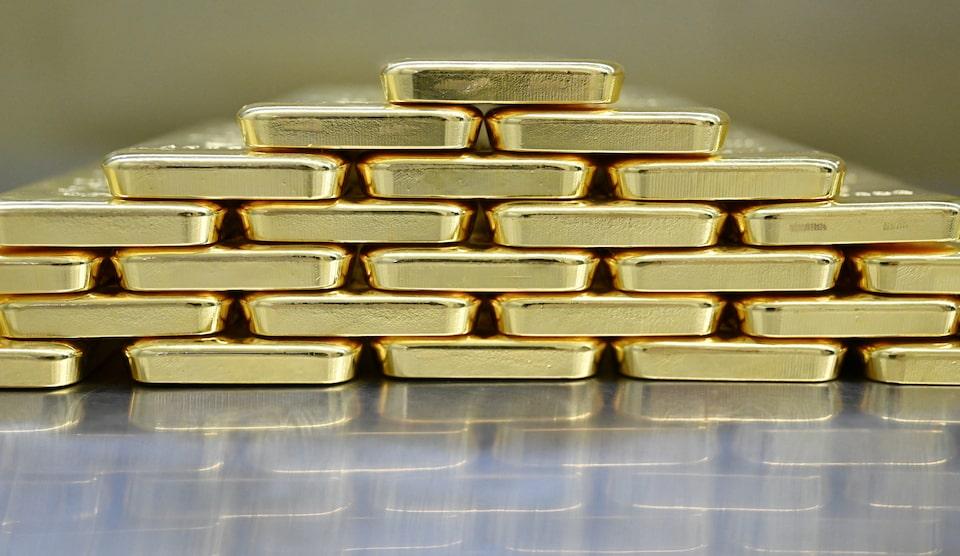
US gold futures jump to an all-time high of $3,534.10 US imposes tariffs on 1-kg gold bars, Financial Times reports Spot gold on track for second straight weekly gain, up about 1% Aug 8 (Reuters) - U.S. gold futures climbed to a record high on Friday after a report that the United States had imposed tariffs on imports of 1-kg gold bars, while spot gold stayed on track for a second straight weekly gain on tariff turmoil and U.S. rate-cut hopes. Spot gold held steady at $3,396.92 per ounce, as of 0734 GMT, after hitting its highest since July 23 earlier in the session. Bullion is up about 1% so far this week. Sign up here. U.S. gold futures for December delivery were up 1.4% at $3,502.90, after hitting an all-time high of $3,534.10. The price spread between New York futures and spot prices widened by more than $100 after the Financial Times reported on Thursday that the United States had imposed tariffs on imports of 1-kg gold bars, citing a letter from Customs and Border Protection. The letter, dated July 31, said 1-kg and 100-ounce gold bars should be classified under a customs code subject to higher tariffs, a move that could impact Switzerland, the world's largest gold refining hub. "This change will not take effect in two weeks or one month, so you cannot send more bars immediately. However, if you send them today, the price will be the Swiss London price plus additional tariffs, that's the new price in the U.S," said UBS commodity analyst Giovanni Staunovo. "This has led to a widening of the U.S. price premium over the London price simply because it costs more." U.S. President Donald Trump's higher tariffs on imports from dozens of countries kicked in on Thursday, leaving major trade partners such as Switzerland, Brazil and India hurriedly searching for a better deal. Gold is often used as a safe store of value during times of political and financial uncertainty. Additionally, weaker U.S. payroll data last week bolstered expectations for a Federal Reserve interest rate cut, with CME Group's FedWatch Tool indicating a 91% probability of a 25-basis-point reduction next month. Elsewhere, spot silver fell 0.3% to $38.41 per ounce, platinum was steady at $1,333.88 and palladium was up 0.4% to $1,155.25. https://www.reuters.com/world/china/us-gold-futures-hit-record-high-after-report-us-tariffs-gold-bars-2025-08-08/
2025-08-08 07:12
Aug 8 (Reuters) - Oil prices fell on Friday, heading for their steepest weekly losses since late June as the latest round of U.S. tariffs weighed on the economic outlook and likely upcoming Trump-Putin talks raised the prospect of an ease in sanctions on Russia. Brent crude futures were down 51 cents to $65.92 a barrel at 0630 GMT, on track to decline more than 4% week-over-week. U.S. West Texas Intermediate crude futures were down 57 cents, or 0.89%, to $63.31 a barrel, set to fall nearly 6% on a weekly basis. Sign up here. Higher U.S. tariffs against a host of trade partners went into effect on Thursday. The tariffs raised concerns of weaker economic activity, which would hit demand for crude oil, ANZ Bank analysts said in a note, and came against the backdrop of an already weaker-than-expected U.S. labour market. A Kremlin announcement on Thursday that Vladimir Putin and Donald Trump would meet in the coming days meanwhile raised expectations of a diplomatic end to the war in Ukraine. That is widely expected to result in eased sanctions on Russia, which could unleash more barrels onto an oversupplied market. Trump earlier this week had threatened to hike tariffs on India if it kept buying Russian oil, which the market viewed as putting further pressure on Russia to reach a deal with the U.S., independent market analyst Tina Teng told Reuters. Trump on Wednesday also said China, the largest buyer of Russian crude oil, could be hit with tariffs similar to those being levied against Indian imports. Oil prices were already reeling from the OPEC+ group's decision last weekend to fully unwind its largest tranche of output cuts in September, months ahead of target. At Thursday's close, WTI futures had dropped for six consecutive sessions, matching a declining streak last recorded in December 2023. If prices settle lower on Friday, it will be the longest streak since August 2021. https://www.reuters.com/business/energy/oil-set-steepest-weekly-losses-since-june-tariffs-trump-putin-talks-2025-08-08/