2025-07-31 10:16
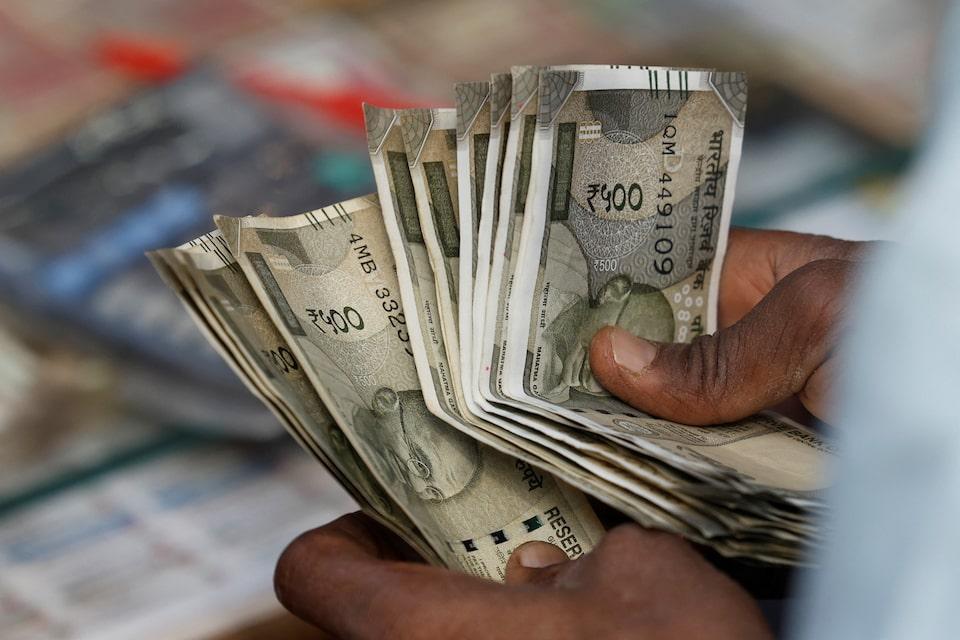
MUMBAI, July 31 (Reuters) - The Indian rupee suffered its worst monthly drop in nearly three years on Thursday, weighed down by U.S. tariff concerns and persistent portfolio outflows, with traders and analysts seeing little relief for the currency in the near term. The rupee fell to an over five month low of 87.74 following U.S. President Donald Trump's threat of a 25% charge on Indian exports, alongside an unspecified penalty, starting August 1. It closed at 87.5950 down 0.2% on the day. Sign up here. The currency was down 2% for the month, its worst fall since September 2022. The Reserve Bank of India likely intervened to support the rupee on Wednesday and Thursday, traders said, but noted that the intervention was not too aggressive. The rupee could risk a fall below its all-time low of 87.95 if there are no positive developments around U.S.-India trade negotiations, traders said. Foreign outflows added to the pressure, with overseas investors net selling Indian stocks worth $2 billon in July. Economists at QuantEco said they expect the rupee to weaken towards 89.50 levels by March on a recovery in dollar sentiment and elevated global geo-economic and geopolitical uncertainties. India's equity benchmarks, the Nifty 50 (.NSEI) , opens new tab and BSESN (.BSESN) , opens new tab, fell as much as 0.9% in early trading, but pared losses to close about 0.3% lower. Meanwhile, Asian currencies fell on Thursday, bogged down by weak Chinese economic data and the approaching August 1 U.S. tariff deadline. The dollar index was flat at 99.8 after rising nearly 1% in the previous session. Later in the day, the focus will turn to U.S. personal consumption expenditure (PCE) inflation data to gauge the path of benchmark policy rates in the world's largest economy. https://www.reuters.com/world/india/rupee-suffers-worst-monthly-drop-since-2022-tariff-blow-portfolio-outflows-2025-07-31/
2025-07-31 09:38
Fed keeps rates steady, traders now doubtful about September cut BOJ less gloomy on economy, supporting rate hike expectations Trade uncertainty stops Bank of Canada giving detailed forecasts LONDON, July 31 (Reuters) - The pace of global rate cuts is slowing as the European Central Bank nears the end of its easing cycle, the U.S. Federal Reserve stays cautious about tariff-driven inflation and investors watch to see whether Britain speeds up from here. The Fed struck a hawkish tone on Wednesday alongside holding rates steady, an approach that lifted the dollar and assuaged fears that President Donald Trump's intense pressure on chair Jerome Powell has eroded central bank independence. Sign up here. Here's where 10 big central banks stand: 1/ SWITZERLAND Bets that the Swiss National Bank will use negative interest rates to tackle the seemingly unstoppable rise of the safe haven franc have faded after it kept benchmark borrowing costs on hold at 0% in June. Traders regard another pause in September as near certain and speculate that the SNB has started intervening to weaken the franc. 2/ CANADA The Bank of Canada held its key policy rate at 2.75% for the third straight meeting on Wednesday, citing lower risks of a severe and escalating global trade war. But it declined to give detailed economic forecasts, citing uncertainty around U.S. trade policy, and said that if the economy weakened further it could cut rates again. The BoC has eased rates by 225 basis points since June 2024, and markets see a reasonable chance of one more cut by year end. 3/ SWEDEN Ahead of Sweden's disappointing second quarter GDP data on Tuesday, the Riksbank cut its key rate to 2% last month and said policy could be eased again this year if inflation remains tame and growth remains weak. 4/ NEW ZEALAND The Reserve Bank of New Zealand, which has cut rates by 225 bps already this cycle, held borrowing costs steady earlier this month but said it expected to loosen monetary policy if price pressures continued to ease as expected. 5/ EURO ZONE The European Central Bank held steady last week after cutting eight times in a year, and many analysts expect it is finished with easing this cycle. The EU-U.S. trade deal took worst-case tariff scenarios off the table, and, alongside the ECB's relatively upbeat assessment of the economic outlook, allayed fears that inflation would fall significantly below its 2% target. The ECB's main policy rate is currently at 2%, down from 4% a year ago, though markets see some chance of one more cut. 6/ UNITED STATES The Federal Reserve stayed on pause on Wednesday and traders responded to Chair Jerome Powell's comments by cutting bets that borrowing costs would begin to fall in September, putting $18 billion worth of bets on dollar weakness in danger. That could stoke the ire of President Donald Trump who has demanded immediate and steep rate relief. Powell said the Fed is focused on controlling inflation - not on government borrowing or home mortgage costs that Trump wants lowered. He added that the risk of rising price pressures from the administration's trade and other policies remains too high for the Fed to begin loosening its "modestly restrictive" grip on the economy until more information is collected. The Fed has been on hold all this year, and markets see less than a 50% chance of a rate cut in September. 7/ BRITAIN The Bank of England meets on Aug 7. Markets expect a 25-bps rate cut even after data this month showed a surprise jump in inflation and a less-dramatic-than-feared cooling in the labour market. Sticky inflation means the BoE has been more cautious than most with easing. Markets price two, 25-bp rate cuts by year-end - including an August move. 8/ AUSTRALIA The Reserve Bank of Australia is cautious too and surprised markets earlier this month by holding rates steady at 3.85%, as it awaited confirmation that inflation is continuing to slow. Wednesday data showing Australian consumer prices grew at the slowest pace in over four years in the June quarter should help, and markets are near certain the RBA will cut its 3.85% cash rate by 25 bps next month, and continue easing to 3.10% by year end. 9/ NORWAY Norway's central bank cut rates by 25 bps to 4.25% last month, its first reduction since 2020 but with only one more fully priced for 2025. The Norges Bank has been the most cautious among developed market central banks, and data this month showing core inflation at 3.1% reinforced this stance. 10/ JAPAN The Bank of Japan, the sole major central bank in hiking mode, kept interest rates steady at 0.5% on Thursday, but revised up its inflation forecasts and offered a less gloomy outlook on the economy than three months ago. Those changes maintained confidence about the BOJ resuming hikes this year. https://www.reuters.com/business/finance/global-markets-cenbank-pix-2025-07-31/
2025-07-31 08:58
July 31 (Reuters) - Qualcomm (QCOM.O) , opens new tab shares fell nearly 5% in early trading on Thursday as the looming loss of Apple (AAPL.O) , opens new tab as its biggest modem customer and higher dependency on premium smartphone chips outweighed its upbeat quarterly forecast. Shares of the mobile chip designer were last down at $152.55. Sign up here. The San Diego-based chip supplier warned investors that Apple's move to depend on in-house modems, starting with the February launch of the iPhone 16e would hit future chip revenue. Qualcomm has intensified its focus on sectors such as data centers and personal computers. Adding to the pressure, U.S. President Donald Trump's renewed tariff threats on semiconductors have emerged as a risk, potentially disrupting supply chains and hurting Qualcomm's handset revenue, analysts said. While smartphones and semiconductor chips have so far been exempt from these levies, Trump recently warned he would "soon announce tariffs on semiconductors," raising concerns of sector-specific duties. CFO Akash Palkhiwala told Reuters that the company has not seen early chip orders yet, suggesting customers aren't rushing to beat possible tariffs. "Tariffs could trim mid-single digits off handset revenue, but Chinese OEMs (original equipment manufacturers) still view (Qualcomm's mobile phone chip) Snapdragon as essential for global 5G and AI-on-device marketing," said Michael Ashley Schulman, CIO at Running Point Capital. Qualcomm, the world's largest supplier of modem chips and seen as a bellwether for smartphones, said chip sales to non-Apple customers have risen more than 15% this fiscal year, driven by premium Android launches. "We see durable share at Samsung and an extended collaboration with Xiaomi as key support in the handset segment as Apple chipset revenue comes out of the model," TD Cowen analysts said. Qualcomm is also expanding in augmented reality. CEO Cristiano Amon said the company now supports 19 augmented reality designs including META's (META.O) , opens new tab Ray-Ban smart glasses and expects that number to grow. Qualcomm forecast fourth-quarter earnings slightly above estimates, with Citi analysts warning that Apple's potential exit continues to weigh on core growth. The company's 12-month forward price-to-earnings ratio is 13.36, trailing Nvidia's (NVDA.O) , opens new tab 34.91, Intel's (INTC.O) , opens new tab 47.14 and Advanced Micro Devices (AMD.O) , opens new tab 35.33, according to data compiled by LSEG. https://www.reuters.com/business/qualcomm-shares-slide-apple-modem-shift-tariffs-raise-growth-concerns-2025-07-31/
2025-07-31 08:45
Microsoft shares jump 8.5% premarket after results Shares rebound 50% from April 2025 lows AI advancements boost stock value post-ChatGPT launch July 31 (Reuters) - Microsoft (MSFT.O) , opens new tab is set to soar past $4 trillion in market valuation for the first time on Thursday, as a blockbuster earnings report helps the tech behemoth become the second company after Nvidia to surpass the milestone. The software company forecast a record $30 billion in capital spending for the current fiscal first quarter and reported booming sales in its Azure cloud computing business on Wednesday. Sign up here. Shares of Microsoft were up 8.5% at $557.03 in early premarket trading, valuing it at $4.14 trillion. Redmond, Washington-headquartered Microsoft first cracked the $1 trillion mark in April 2019. Its move to $3 trillion was more measured than other tech giants, Nvidia (NVDA.O) , opens new tab and Apple (AAPL.O) , opens new tab, with AI bellwether Nvidia tripling its value in just about a year and clinching the $4 trillion milestone before any other company on July 9. Apple was last valued at $3.12 trillion. Lately, breakthroughs in trade talks between the U.S. and its trading partners ahead of President Donald Trump's August 1 tariff deadline have buoyed stocks, propelling the S&P 500 and the Nasdaq to record highs. Microsoft, the second largest U.S. company, has rebounded nearly 50% from its April 2025 lows, when global markets were rattled by Trump's tariff offensive. Microsoft's multibillion-dollar bet on OpenAI is proving to be a game-changer, powering its Office Suite and Azure offerings with cutting-edge AI and fueling the stock to more than double its value since ChatGPT's late-2022 debut. Armed with exclusive access to OpenAI's models, Microsoft has raced to the front of the generative AI pack - supercharging its Azure cloud business, now the company's top revenue driver, and solidifying its dominance in the tech landscape, compared to Google's cloud and Amazon's web services. Wall Street's surging confidence in the company comes on the heels of back-to-back record revenues for the tech giant since September 2022. The stock's rally had also received an extra boost as the tech giant trimmed its workforce and doubled down on AI investments — determined to cement its lead as businesses everywhere race to harness the technology. While sweeping U.S. tariffs had investors bracing for tighter business spending, Microsoft's strong earnings have shown that the company's books are yet to take a hit from the levies. https://www.reuters.com/business/retail-consumer/microsoft-poised-4-trillion-valuation-after-solid-results-2025-07-31/

2025-07-31 07:58
LONDON, July 31 (Reuters) - British power company Drax Group's (DRX.L) , opens new tab first-half adjusted core profit fell by about 11%, hit by a decline in biomass generation and lower UK wholesale power prices, it said on Thursday. Adjusted earnings before interest, tax, depreciation and amortisation (EBITDA) fell to 460 million pounds ($611 million) in the first half, against 515 million pounds in the same period last year. Sign up here. Drax, which has converted coal plants to run on biomass, provides about 6% of Britain’s electricity. ($1 = 0.7535 pounds) https://www.reuters.com/business/energy/uk-power-company-drax-posts-first-half-profit-fall-2025-07-31/
2025-07-31 07:56
Retreat from US assets slows on tariff deals, GDP 'Rest of the world trade' follows bets against the dollar Trend-tracking hedge funds close bets against Treasuries US rebound would weigh on international stocks, gold, EM LONDON, July 31 (Reuters) - Investors' conviction that U.S. President Donald Trump's tariffs and debt spree would spark long-term pain for the dollar and U.S. stocks is crumbling, signaling pain ahead for assets across Europe and emerging markets that were boosted by this view. The dollar is heading for its first monthly gain this year, boosted by robust economic data, fading concern about the outlook for U.S. assets and a growing belief that the Federal Reserve may not cut interest rates again for some time. Sign up here. With artificial intelligence euphoria powering U.S. stock markets to consecutive daily peaks and relentless selling of the greenback going into reverse, European equity outperformance has stalled as the euro slides and a blistering gold rally stalls. "It's one of the biggest positions people have, being negative on the dollar and the U.S.," Pictet Asset Management co-head of multi-asset Shaniel Ramjee said. He was preparing to raise his dollar exposure from what he described as "practically zero", on expectations that U.S. economic trends and company earnings would start outshining Europe. A broad dollar revival, he added, might bring 2025's big market trends to a halt. The so-called "rest of the world trade", where investors have favoured international assets over the U.S., was led by a rush of speculative bets against the U.S. currency that has now slowed, Barclays analysis showed. COMEBACK European stocks (.STOXX) , opens new tab, which posted their best-ever quarter relative to the U.S. in the three months to March, are now merely keeping pace with Wall Street's S&P 500 (.SPX) , opens new tab as both indices clock an approximately 8.4% year-to-date rise. As recently as mid-July, conviction that the dollar would weaken was the most crowded trade among global fund managers, Bank of America research showed. But currency traders who were making short-term bets against the greenback, which this year suffered its worst first-half slump since 1973, are now backing out. The dollar index is trading at two-month highs and is set for a 3% rise in July, the first monthly increase this year. The euro, which scored the best six-month run of its 26-year lifetime in the half-year to June, has fallen below $1.15, heading for its largest monthly drop since May 2023. . "We're seeing a rotation into U.S. equities, a rotation in currency markets and a rotation in (market) momentum," Edmond de Rothschild Asset Management multi-asset head Michael Nizard said. He cited Sunday's framework trade deal between Washington and Brussels as a major reason for the trend, which he did not expect to last until the end of the year, adding that he would buy the euro at around $1.14. TEMPORARY? Monica Defend, head of the investment institute at Europe's largest asset manager Amundi, said she was sticking to a long-term view that the dollar was set to decline because of Trump's borrowing plans and consistent attacks on Federal Reserve independence. But she said she was also prepared to change her view "if growth in the U.S. surprises nicely on the upside," in a persistent trend from here. Sterling has fallen 1.4% against the greenback this week and an index of emerging market equities (.dMIEF00000PUS) , opens new tab has drooped for three days as a stunning year-to-date rally stalls. Gold , the standout trade of 2025, is heading for its first three-week losing streak since November, trading around $3,300 an ounce. Amundi's Defend expected U.S. tech stocks and AI exuberance to keep Wall Street equities outperforming from here. But she also expected U.S. growth to stall once tariffs started raising consumer prices. "The U.S. might continue to be exceptional, probably not on the macro (economic) front, but more on the equity market," she said. Nutshell Asset Management CIO Mark Ellis, whose UK-based fund changes the composition of its portfolios around twice a month, said he was not certain the U.S. market bounce-back could last beyond next week. For 50 years, August and September have been the S&P’s worst months for returns compared to volatility, he said. "Around the end of this week is a good time to take risk off and I'll be more defensive going into historical summer volatility and weakness," he said. Barclays head of European equity strategy Emmanuel Cau, in a July 30 note to clients, issued a different warning. He noted that trend-following hedge funds called CTAs, whose trades are viewed as a barometer of the dominant market mood, had closed out bets against U.S. Treasuries and cut exposure to European stocks. A more persistent dollar bounce-back, he said, would be "a key pain trade" for global investors from here. https://www.reuters.com/business/finance/global-markets-dollar-graphic-2025-07-31/