2025-07-25 04:41
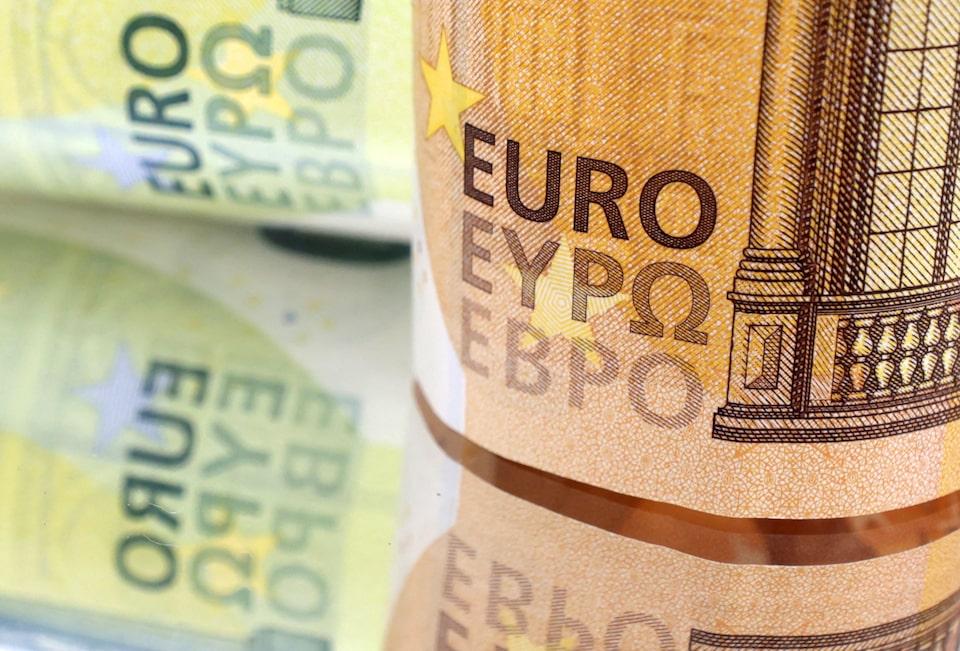
LONDON, July 25 (Reuters) - Europe's smaller companies are emerging as a popular vehicle for investors to help insulate portfolios against both tariffs and a stronger euro, as cheaper credit and the prospect of more government spending bolster confidence in the economic outlook. The domestic-leaning bias of smaller companies makes them less vulnerable to levies on cross-border goods and they are also less exposed to currency swings when the euro strengthens, making euro-zone exports more expensive abroad. Sign up here. The STOXX Europe small- (.SCXP) , opens new tab and mid-cap (.MCXP) , opens new tab indexes have risen 9% and 11% this year, respectively, beating the STOXX Europe large-cap index (.LCXP) , opens new tab, which has risen just 7%. U.S. President Donald Trump has bagged a handful of trade agreements with global partners since unveiling sweeping global levies in April, the most significant of which was a deal with Japan this week. But there is still no deal with the European Union and an August 1 deadline is just days away. Speculation swirled on Wednesday of a 15% rate for the EU, but was quickly dismissed by the White House. "One of the benefits of small-caps is that they are a bit more insulated from a geographical standpoint," said Ingmar Schaefer, a portfolio manager at Van Lanschot Kempen. "Whatever happens with U.S. tariffs, a local company will not be impacted by as much as a global player in the same field." An analysis by Goldman Sachs found that companies in the STOXX large-cap index generate about 35% of their revenue in Europe, compared to 60% of revenue generated by companies in the small- and mid-cap indexes. That has helped to offset a stronger currency. The euro has risen over 12% in 2025 to around $1.17, defying predictions prior to the April 2 "Liberation Day" tariff announcements that it could even reach parity with the dollar. But that was upended by investors turning their back on U.S. assets. Some analysts now expect the euro to hit $1.20, a possible headwind for larger companies due to greater international exposure, but a relative tailwind for smaller companies. "The way people have played Europe in the past is to be apologists for Europe, targeting businesses that have high revenue exposure to the U.S. or the Asian consumer through the luxury sector," said Harry Eastwood, investment director at Artemis Investment Management. "Liberation Day slightly disrupted the global order of trade and small- and mid-caps have become much more interesting, purely from the fact that they're somewhat insulated from that," Eastwood said, adding that his fund was at the upper limit of its small- and mid-caps weighting. DISCOUNT SHRINKS Historically, smaller companies have tended to trade at a premium to large ones, as they generally exhibit higher growth rates. But the situation reversed in 2023 and 2024, as inflation in Europe soared and the European Central Bank raised borrowing costs, leading smaller companies to now trade at a discount to bigger ones. Small-caps traded at a record discount of 11% to larger companies in March this year but that has since shrunk. The STOXX Europe small-cap index currently trades at 13.4 times forward earnings, below the large-cap index's 14.3 times, a discount of 6.5%. "We've been in a situation where most investors have had less confidence in the earnings of small companies compared to large companies which is why they traded at a discount," said David Walton, fund manager at Marlborough. "But in the last month, we've seen a slight increase in confidence in the earnings outlook for small companies which is supporting the rally." European small- and mid-sized companies have registered net inflows for the last 10 weeks straight, the longest such stretch since 2021, according to Lipper fund flows data. Germany, the euro area's biggest economy, has unveiled a massive spending push, while the ECB has begun to lower interest rates. Both could spur the euro zone economy, giving it a much-needed boost after years of subdued growth. Germany's SDAX (.SDAXI) , opens new tab small-cap index, has jumped almost 20% since the federal election in February, while the blue-chip DAX (.GDAXI) , opens new tab has risen 8.4% in the same period. The ECB paused its rate-cutting cycle this week, but the deposit rate is 200 basis points lower than it was in the middle of last year. "When we look at the next 12 months we think there can definitely be a re-rating of small caps vis-à-vis large caps," said Van Lanschot Kempen's Schaefer. https://www.reuters.com/business/finance/investors-bet-europes-smaller-companies-dodge-tariff-fallout-strong-euro-2025-07-25/
2025-07-25 03:18
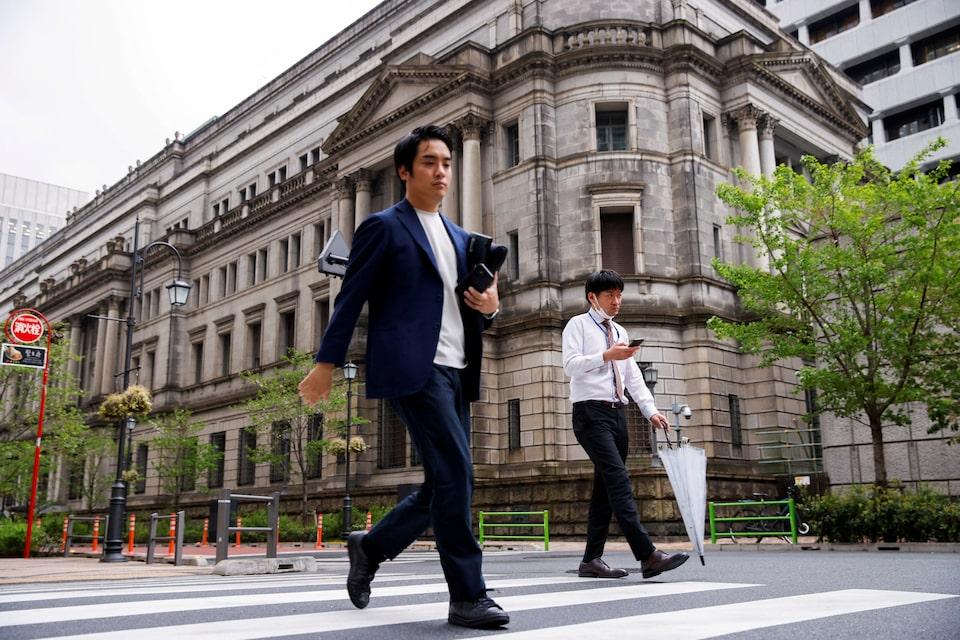
Japan-US trade deal removes hurdle for rate hike by year-end BOJ seen offering less gloomy view on outlook next week Board may tweak risk-balance view on inflation, sources say Prospects of weak data to keep rate-hike timing uncertain October tankan, regional meeting key to BOJ's rate-hike timing TOKYO, July 25 (Reuters) - U.S. President Donald Trump's trade deal with Tokyo opens scope for the Bank of Japan to raise interest rates again this year, sources say, a prospect the central bank may start to telegraph by offering a less gloomy view on the economic outlook. But a near-term rate hike is hardly a done deal with the timing dependent on whether the economy can withstand the impact of U.S. tariffs, said four sources familiar with the BOJ's thinking. Sign up here. "As clouds hanging over U.S. trade policy clear, the BOJ may see scope to raise rates this year," one source said, a view echoed by two other sources. "It's not as if all of the trade-related uncertainty has cleared," a second source said, adding the BOJ must scrutinise data through autumn for clues on how U.S. tariffs affected the economy, a second source said. The world's fourth-largest economy has been hobbled by tepid consumption, rising living costs and a weakened manufacturing sector. A lack of clarity over the outcome of Japan's trade talks with the U.S. has been among factors the BOJ cited in slashing its growth forecasts in May and calling a pause in rate hikes. This week's announcement of Japan's trade deal with the U.S., however, has reduced uncertainty and removed a key hurdle for resuming rate hikes, the sources said. The BOJ may begin dropping hints of a re-start of rate hikes by offering a less gloomy view on the outlook compared with the current one focused on tariff-induced risks, they said. In the first sign of such optimism, BOJ Deputy Governor Shinichi Uchida said on Wednesday the deal heightened the chance of Japan durably hitting the bank's 2% inflation target - a prerequisite for further rate hikes. "The BOJ needs to adjust monetary policy to best balance upside and downside risks," said Uchida, who also highlighted inflationary pressure from rising food costs. Uchida's upbeat comments contrasted with those by Governor Kazuo Ueda in May that uncertainty regarding the BOJ's baseline scenario was "higher than in the past" because of tariff-related risks. In a quarterly report due at its next policy meeting on July 30-31, the BOJ may offer a more sanguine view than before on the impact of U.S. tariffs, the sources said. The board may also revise up this year's inflation forecast and consider tweaking its current view that risks to the price outlook are skewed to the downside, they said. "The trade deal opens the way for the BOJ to raise rates," said JP Morgan Securities economist Ayako Fujita. "It adds reasons for the BOJ to revise up its forecasts," said Fujita, who expects a rate hike in October. While the BOJ is set to keep rates steady next week, markets are pricing in the chance of a near-term hike. Two-year government bond yields , which are most sensitive to rate expectations, hit a nearly four-month high of 0.845% on Thursday. CLOUDS STILL LOOM The BOJ exited a decade-long, massive stimulus last year and raised its short-term policy rate to 0.5% in January on the view Japan was progressing towards durably achieving its price goal. While core inflation has remained above its 2% target for well over three years, the central bank has moved cautiously in hiking rates on concern over hurting a fragile economy. There is no consensus within the board on how soon to hike rates. With real interest rates deeply negative, hawks like Naoki Tamura have warned of the risk of going too slow. But pessimists in the BOJ are not convinced the economy is out of the woods given lingering risks, the sources said. Japan's economy shrank in the first quarter as rising living costs weighed on consumption, stoking fears of recession. The U.S. has yet to clinch trade deals with Japan's big export destinations like China. While exports and output have held up, analysts expect the hit from tariffs to show up more clearly in coming months' data. Even taking into account the trade deal, U.S. tariffs will shave 0.55 percentage point off annual GDP growth, according to estimates by former BOJ board member Takahide Kiuchi. "The economy isn't on a strong footing with consumption flat and the export outlook still gloomy," said a third source. While praising the trade deal as reducing uncertainty, deputy governor Uchida warned it was still not clear how U.S. tariffs could affect the business mood and spending plans. The key would be the BOJ's next "tankan" business survey due in October and a quarterly meeting of its regional branch managers that month, where the bank looks more closely into how firms across the country are weathering the hit from tariffs. The findings will be available by the time the BOJ holds its policy meeting on October 29-30. For now, the market's focus will turn to comments by Ueda, who will brief media after the two-day rate review concluding on July 31. "The outlook report and the governor's news conference will likely signal that the BOJ is moving closer towards raising rates again, albeit cautiously," said Ryutaro Kono, chief Japan economist at BNP Paribas. https://www.reuters.com/business/trade-deal-clears-way-boj-tiptoe-back-rate-hikes-2025-07-25/
2025-07-25 02:52
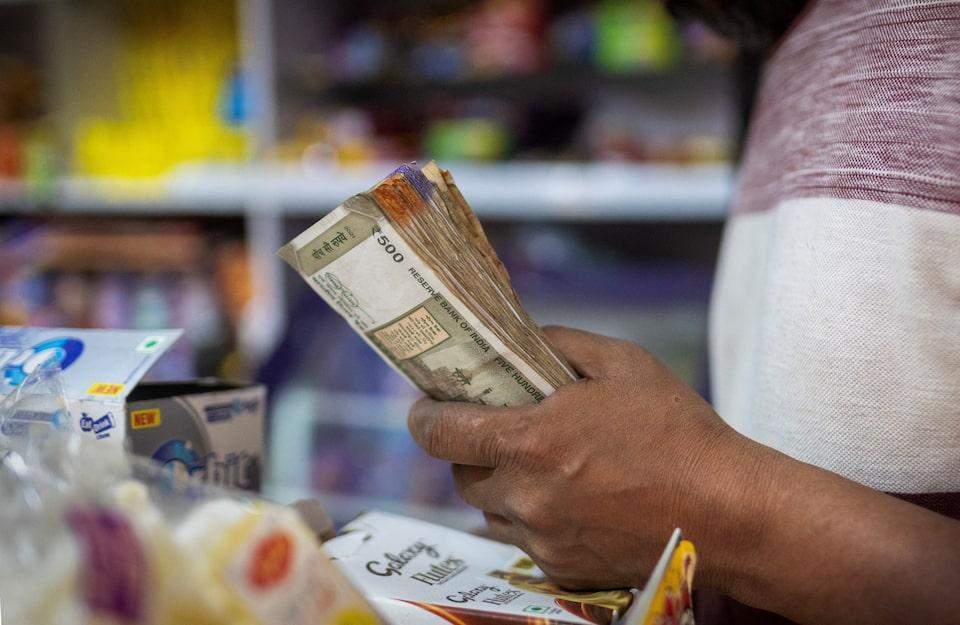
MUMBAI, July 25 (Reuters) - The Indian rupee is expected to open weaker on Friday and trade with a modest depreciation bias amid a dip in its regional peers and lingering pressure from portfolio outflows as investors gird for an upcoming news-heavy week. The 1-month non-deliverable forward indicated the rupee will open around 86.48-86.50 versus the U.S. dollar, compared with 86.4050 in the previous session. Sign up here. Asian currencies were down between 0.1% and 0.3%, while the dollar index ticked up to 97.5, as investors braced for U.S. President Donald Trump's tariff deadline, a Federal Reserve policy decision, and key U.S. economic data releases, all due next week. The rupee is expected to trade with a slight downward bias and could test support near 86.70-86.80 in the near term, a trader at a state-run bank said. While there is "nascent" interbank interest in taking long bets on the rupee, that is largely on the back of the market expecting some positive announcement on U.S.-India trade negotiations, the trader added. While optimism about U.S. trade deals with China and the European Union has picked up after an agreement with Japan, the prospects of a deal for India ahead of the August 1 deadline have dimmed. Britain and India signed a free trade agreement on Thursday, with India's trade minister saying that he remains confident of concluding a trade deal with the U.S. while downplaying the significance of the looming deadline. "Beyond tariffs and the rush to close the art of the deal, one continuing theme that we see in Asia and many countries outside the U.S. is the acceleration in moves to diversify away from or at least hedge with the U.S.," MUFG said in a note. In addition to the wait for a trade agreement with the U.S., foreign portfolio outflows have been a pain point for the rupee with overseas investors pulling out about $500 million from local stocks over July so far. KEY INDICATORS: ** One-month non-deliverable rupee forward at 86.60; onshore one-month forward premium at 12.50 paisa ** Dollar index up 0.1% at 97.58 ** Brent crude futures up 0.5% at $69.5 per barrel ** Ten-year U.S. note yield at 4.4% ** As per NSDL data, foreign investors sold a net $382mln worth of Indian shares on July 23 ** NSDL data shows foreign investors sold a net $41.7mln worth of Indian bonds on July 23 https://www.reuters.com/world/india/dip-asian-currencies-outflows-likely-keep-up-pressure-rupee-2025-07-25/
2025-07-25 02:42
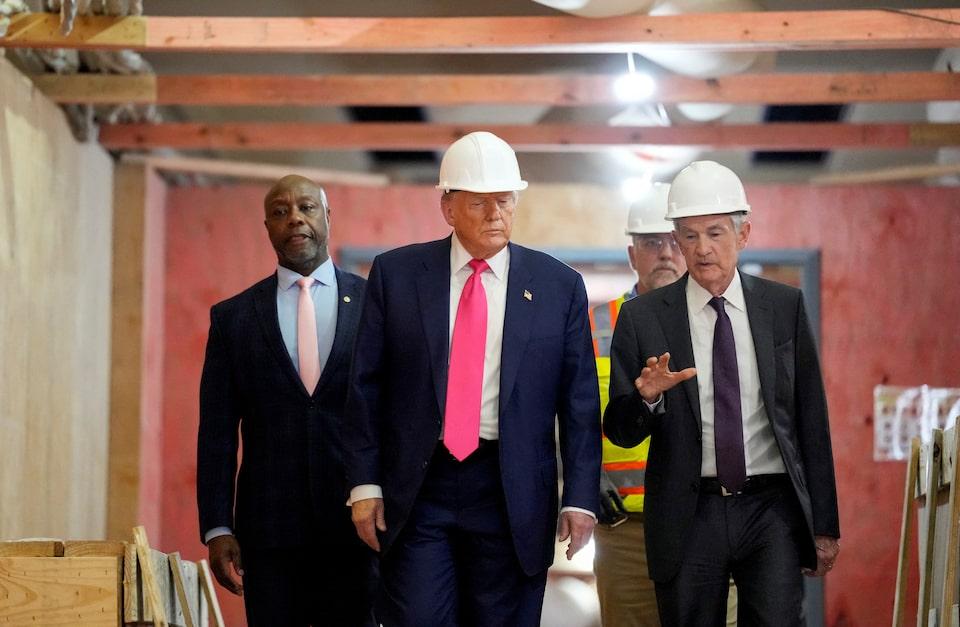
US president wants borrowing costs lowered Trump says he will not fire US central bank chief White House accuses Fed of mismanaging $2.5 billion building project Fed expected to leave policy rates on hold at meeting next week WASHINGTON, July 24 (Reuters) - President Donald Trump locked horns with Federal Reserve Chair Jerome Powell during a rare presidential visit to the U.S. central bank on Thursday, criticizing the cost of renovating two historical buildings at its headquarters and pressing the case for lower interest rates. Trump, who called Powell a "numbskull" earlier this week for failing to heed the White House's demand for a large reduction in borrowing costs, wrapped up his visit to the Fed's $2.5 billion building project in Washington by saying he did not intend to fire Powell, as he has frequently suggested he would. Sign up here. "To do so is a big move and I just don't think it's necessary," Trump told reporters after the visit. In a post on his Truth Social media site, Trump later said of the renovation, "it is what it is and, hopefully, it will be finished ASAP. The cost overruns are substantial but, on the positive side, our Country is doing very well and can afford just about anything." The visibly tense interaction at the Fed's massive construction site marked an escalation of White House pressure on the central bank and Trump's efforts to get Powell to "do the right thing" on rates. It happened less than a week before the central bank's 19 policymakers are due to gather for a two-day rate-setting meeting, where they are widely expected to leave their benchmark interest rate in the 4.25%-4.50% range. The president has repeatedly demanded Powell slash rates by 3 percentage points or more. "I'd love him to lower interest rates," Trump said as he wrapped up the tour, as Powell stood by, his face expressionless. Powell typically spends the Thursday afternoon before a rate-setting meeting doing back-to-back calls with Fed bank presidents as part of his preparations for the session. The encounter between the two men became heated as Trump told reporters the project was now estimated to cost $3.1 billion. "I am not aware of that," Powell said, shaking his head. Trump handed him a piece of paper, which Powell examined. "You just added in a third building," the Fed chief said, noting that the Martin Building had been completed five years ago. White House budget director Russell Vought and Trump's deputy chief of staff, James Blair, who have spearheaded criticism of the renovation as overly costly and ostentatious, later told reporters they still have questions about the project. The two men, who joined Trump during the visit, have suggested poor oversight and potential fraud in connection with it. Senate Banking Committee Chair Tim Scott, a Republican who sent Powell a letter , opens new tab on Wednesday demanding answers to his own questions about the renovation, also took part in the visit. Elevated by Trump to the top Fed job in 2018 and then reappointed by former President Joe Biden four years later, Powell last met with the current president in March when Trump summoned him to the White House to press him to lower rates. The visit on Thursday took place as Trump battles to deflect attention from a political crisis over his administration's refusal to release files related to convicted sex offender Jeffrey Epstein, reversing a campaign promise. Epstein died in 2019. The Fed, in letters to Vought and lawmakers backed up by documents posted on its website, said the project - the first full rehab of the two buildings since they were built nearly a century ago - ran into unexpected challenges including toxic materials abatement and higher-than-estimated costs for materials and labor. Speaking outside of the construction site, Trump said there was "no tension" at his meeting with Powell and that they had a productive conversation about rates. FED INDEPENDENCE Ahead of Trump's visit, Fed staff escorted a small group of reporters around the two construction sites. They wove around cement mixers and construction machines, and spoke over the sound of drills, banging, and saws. Fed staff pointed out security features, including blast-resistant windows, that they said were a significant driver of costs in addition to tariffs and escalations in material and labor costs. The project started in mid-2022 and is on track to be completed by 2027, with the move-in planned for March of 2028. A visit to the roof of the Eccles Building, a point of particular scrutiny by critics like Scott, who has complained about "rooftop garden terraces," revealed an impressive view of the Lincoln Memorial and the National Mall, according to the pool report. Staff explained that rooftop seating, although inexpensive, had been removed because of the appearance of it being an amenity and was one of only two deviations from the original plan. The other was the scrapping of a couple of planned fountains. Market reaction to Trump's visit was subdued. The yield on benchmark 10-year Treasury bonds ticked higher after data showed new jobless claims dropped in the most recent week, signaling a stable labor market not in need of support from a Fed rate cut. The S&P 500 equities index (.SPX) , opens new tab closed largely flat on the day. Trump's criticism of Powell and flirtation with firing him have previously upset financial markets and threatened a key underpinning of the global financial system - that central banks are independent and free from political meddling. His trip contrasts with a handful of other documented presidential visits to the Fed. Then-President Franklin Delano Roosevelt visited the central bank in 1937 to dedicate the newly-built headquarters, one of the two buildings now being renovated. Most recently, former President George W. Bush went there in 2006 to attend the swearing-in of Ben Bernanke as Fed chief. https://www.reuters.com/world/us/trump-presses-powell-cut-rates-during-tense-visit-fed-2025-07-24/
2025-07-25 00:52
HONG KONG/SHANGHAI, July 25 (Reuters) - Hong Kong-based digital asset platform OSL Group (0863.HK) , opens new tab said on Friday it had completed $300 million of equity financing, the latest sign of feverish investor interest in cryptocurrencies. The deal, which the company said was the biggest publicly disclosed equity raise in Asia's digital asset space, comes days before Hong Kong's stablecoin bill takes effect on August 1, and could add fuel to a rally in shares related to virtual assets. OSL shares have surged 120% so far this year. Sign up here. Hong Kong's defacto central bank on Wednesday cautioned against growing frothiness of the market around stablecoins, saying the hype had led to "excessive exuberance". Proceeds from the share sale would be used to support global initiatives including stablecoin development, licensing efforts, and the build-out of a digital payment network, OSL said in a statement. "The funding will accelerate our global build-out — particularly in regulated stablecoin infrastructure and compliant payment rails," said Ivan Wong, chief financial officer of OSL Group. Since transforming last year into a company fully dedicated to digital assets, OSL has secured an exchange licence in Australia and completed acquisitions in Japan and Europe. OSL has also said it would step up investment in the so-called Real-World-Assets business, converting traditional assets into digital tokens. Stablecoins are cryptocurrencies pegged to assets such as fiat currencies. Hong Kong is racing against the U.S. in setting up a licensing framework for stablecoin issuers. https://www.reuters.com/business/finance/hong-kong-based-digital-asset-platform-osl-group-completes-300-million-equity-2025-07-25/

2025-07-25 00:28
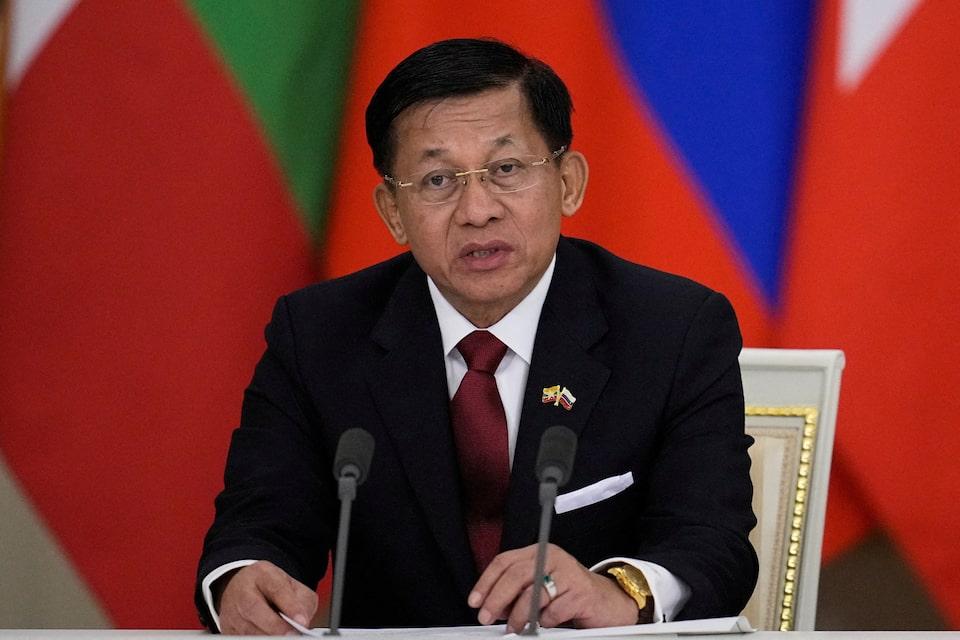
WASHINGTON, July 24 (Reuters) - The United States on Thursday lifted sanctions designations on several allies of Myanmar's ruling generals, two weeks after the head of the ruling junta praised President Donald Trump and called for an easing of sanctions in a letter responding to a tariff warning. A notice from the U.S. Treasury Department said KT Services & Logistics and its founder, Jonathan Myo Kyaw Thaung; the MCM Group and its owner Aung Hlaing Oo; and Suntac Technologies and its owner Sit Taing Aung; and another individual, Tin Latt Min, were being removed from the U.S. sanctions list. Sign up here. KT Services & Logistics and Jonathan Myo Kyaw Thaung were added to the sanctions list in January 2022 under the Biden administration in a step timed to mark the first anniversary of the military seizure of power in Myanmar that plunged the country into chaos. Sit Taing Aung and Aung Hlaing Oo were placed on the sanctions list the same year for operating in Myanmar's defense sector. Tin Latt Min, identified as another close associate of the military rulers, was placed on the list in 2024 to mark the third anniversary of the coup. Treasury did not explain the reason for the move, and the White House did not immediately respond to a request for comment. On July 11, Myanmar's ruling military general, Min Aung Hlaing, asked Trump in a letter for a reduction in the 40% tariff rate on his country's exports to the U.S. and said he was ready to send a negotiation team to Washington if needed. "The senior general acknowledged the president's strong leadership in guiding his country towards national prosperity with the spirit of a true patriot," state media said at the time. In his response to a letter from Trump notifying Myanmar of the tariff to take effect on August 1, Min Aung Hlaing proposed a reduced rate of 10% to 20%, with Myanmar slashing its levy on U.S. imports to a range of zero to 10%. Min Aung Hlaing also asked Trump "to reconsider easing and lifting the economic sanctions imposed on Myanmar, as they hinder the shared interests and prosperity of both countries and their peoples." Myanmar is one of the world's main sources of sought-after rare earth minerals used in high-tech defense and consumer applications. Securing supplies of the minerals is a major focus for the Trump administration in its strategic competition with China, which is responsible for 90% of rare earth processing capacity. Most of Myanmar's rare earth mines are in areas controlled by the Kachin Independence Army (KIA), an ethnic group fighting the junta, and are processed in China. https://www.reuters.com/world/asia-pacific/us-lifts-sanctions-myanmar-junta-allies-after-general-praises-trump-2025-07-25/