2025-07-15 06:37
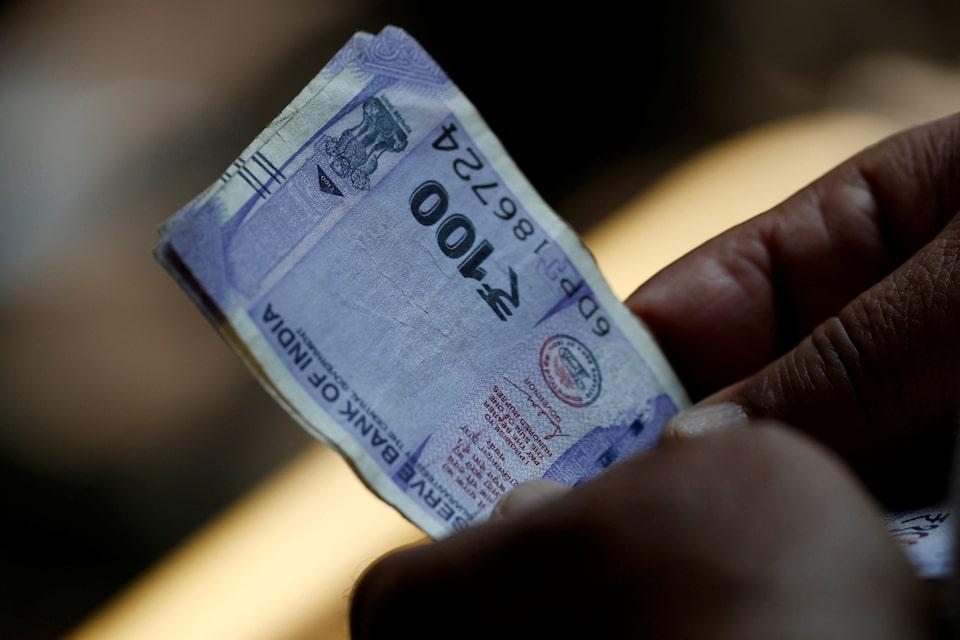
MUMBAI, July 15 (Reuters) - The Indian rupee's narrow range over the past two weeks, alongside established support and resistance levels, has sparked interest in selling short-term volatility, with large corporates and interbank players looking to monetise the relative calm. The rupee was quiet on Tuesday, inching up about 0.1% to 85.90 against the U.S. dollar, after trading in a narrow 12-paisa intraday range on Monday. Sign up here. Over the past two weeks, the rupee's weekly trading band has narrowed to 50–60 paisa, pushing 10-day realised volatility down to 4.3% from over 6.5% late last month. During this stretch, the currency has established a well-defined range, finding support near 86.00 and resistance around 85.20–85.30. This is prompting interest from corporates and interbank to sell short-dated volatility. Two bankers said a prominent Indian conglomerate has been inquiring about selling 1-week to 1-month volatility - a strategy that pays off if the rupee continues to trade within its current range. "Volatility selling is making a comeback in a small way, and it makes sense considering the recent price action. The rupee's range feels pretty well locked in for now, and its reaction to headlines has been fairly limited," said the head of FX and rates at a mid-sized private sector bank. He added the rupee was finding support around the 86 level without visible intervention from the Reserve Bank of India, suggesting the market positioning by itself is keeping the dollar/rupee boxed in. Bankers noted that despite last week's barrage of U.S. tariff headlines, the rupee held firm in the 85.90–86.00 zone, underscoring the strength of the current range. The absence of a U.S.-India trade deal hasn't rattled the currency either. "The U.S.–India trade deal news flow is one to watch,” said Apurva Swarup, vice president at Shinhan Bank India. "Depending on how it evolves, we could see the current range on the rupee widen slightly — although not drastically. The broader tone still feels anchored." https://www.reuters.com/world/india/boxed-in-indian-rupee-revives-appetite-selling-short-term-volatility-2025-07-15/
2025-07-15 06:27
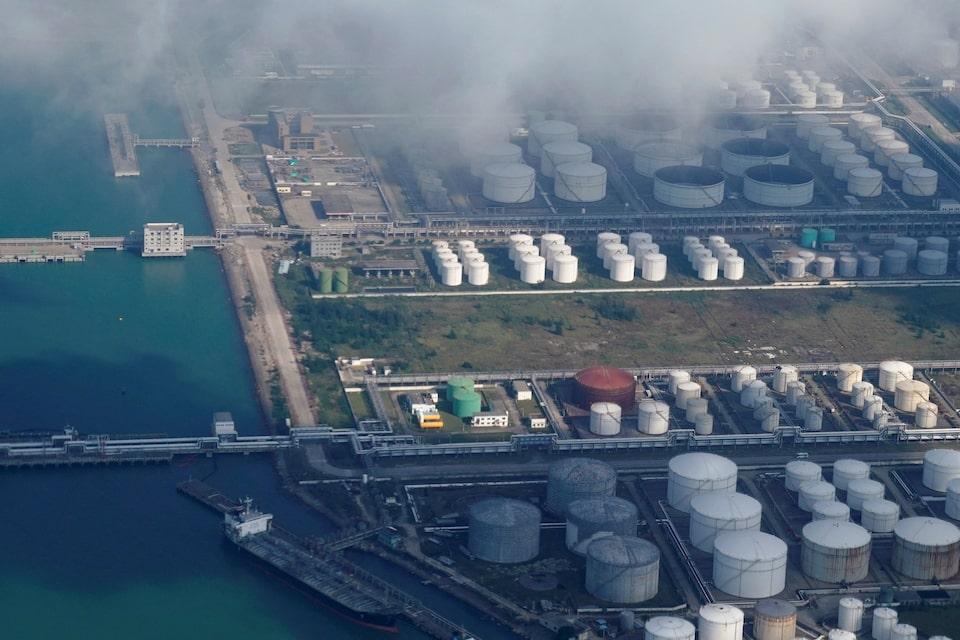
Operating rates at state refineries surpass 80% in late-June - Oilchem Refining output to rise by about 100,000 bpd in July from June, consultancies say Diesel, gasoline stocks at multi-year lows, partly due to teapot output cuts Q3 demand up seasonally but pressure remains SINGAPORE, July 15 (Reuters) - Chinese state-owned refiners are ramping up output after completing maintenance to meet higher third-quarter fuel demand and to rebuild diesel and gasoline stocks which are at multi-year lows, traders and analysts said. The increase in crude processing rates, expected to last through the third quarter, will drive up imports by the world's largest oil importer, although slowing gasoline and diesel consumption is expected to keep a lid on overall demand. Sign up here. Operating rates at state refineries surpassed 80% in the last week of June, up from about 73% a month earlier, the highest for the period in five years, data from consultancy Oilchem showed, as several Sinopec (600028.SS) , opens new tab refineries returned to operation from maintenance in the second quarter. China's overall refining throughput was 15.15 million barrels per day in June, the highest since September 2023, according to Reuters calculations based on official data released on Tuesday. The sharp ramp-up in state refinery operations was driven by low product stocks after two months of heavy maintenance in April and May that supported product profit margins, said Ye Lin, a vice president at Rystad Energy. "Demand for jet fuel and petrochemical feedstocks is growing healthily in China, driving more supply from the state-owned refineries," she added. Refined products output from state refiners Sinopec, PetroChina (601857.SS) , opens new tab, CNOOC (600938.SS) , opens new tab and Sinochem will exceed 10 million bpd in July, 100,000-110,000 bpd higher than June, according to consultancies FGE and JLC. FGE expects their output to hit 10.4 million bpd in July and August. JPMorgan analysts forecast China's refinery runs to increase year-on-year for the third and fourth quarters, following consecutive annual declines in the previous five quarters. Rising state refinery output pushed up diesel and gasoline stocks in the first two weeks of July, but at 14 million and 11 million metric tons, respectively, inventories are at six-year lows, Oilchem data showed. Official data showed China's January-May diesel and gasoline production fell 7% annually. That is partly because independent refineries, known as teapots, have been operating at just 40% to 50% of their capacity this year due to poor margins, and as U.S. sanctions made it harder for some to buy cheap Iranian oil, industry sources said. DEMAND China's oil demand will rise seasonally into September but will be restrained by the country's prolonged property sector downturn, trade tariffs and rising sales of electric cars and trucks, the sources and analysts said. Barclays estimates that China's oil demand grew about 330,000 bpd year-on-year in the first half this year, while full-year growth will ease to 150,000 bpd. For July, China's gasoline consumption has firmed due to the summer travel season, but diesel demand remains weak as extreme weather, such as heatwaves and floods, has delayed construction projects in some regions, sources and analysts said. Rystad's Ye expects teapots to increase runs in August to meet higher fuel demand in September. Diesel and gasoline make up more than 40% of China's oil demand. https://www.reuters.com/business/energy/china-state-refiners-ramp-up-output-rising-demand-stock-rebuild-2025-07-15/
2025-07-15 06:18
Sentiment most bullish since February Cash levels trigger 'sell signal' Fund managers hold biggest euro overweight since 2005 MILAN/LONDON, July 15 (Reuters) - Investor sentiment surged in July to its most bullish since February, driven by the biggest jump in profit optimism in five years and a record surge in risk appetite, Bank of America's latest global fund manager survey showed. Cash levels fell to 3.9% in July, a low that triggered an in-house "sell signal" from the investment bank's strategists. Sign up here. In a note published on Tuesday, BofA said the survey showed sentiment was getting somewhat exuberant, or "toppy", but fund managers' overweight positioning in stocks was not yet at extreme levels and bond market volatility remained low. "Greed (is) always much harder to reverse than fear," the bank's analysts said, adding that investors were more likely to stick to a "summer of hedging and rotation" rather than laying on big short bets or retreating from the market altogether. The S&P 500 (.SPX) , opens new tab has hit record highs this month, while cash has also been pouring into bitcoin , as investors work on the assumption that U.S. President Donald Trump will not make good on his threat to impose hefty tariffs on major trading partners by his new deadline of August 1. Volatility measures for stocks, bonds and currencies remained muted, suggesting there is little sense of panic to hedge or shift positions, as evidenced by the BofA survey, which polled 211 fund managers with $504 billion under management. The bond market has seen pressure particularly in long-dated debt, as investors prepare for a rise in government borrowing and spending. The U.S. Treasuries market has the added pressure from Trump's repeated threats to remove Federal Reserve Chair Jerome Powell, because he believes U.S. rates should be lower. The BofA survey showed 81% forecast one or two rate cuts by year-end. "Asked who is most likely to be the next Fed chairman: 26% said Bessent, 17% Warsh, 14% Waller, 7% Hassett," BofA said, referring to Treasury Secretary Scott Bessent, former Fed Governor Kevin Warsh, current Fed Governor Christopher Waller and White House economic adviser Kevin Hassett, respectively. In currencies, the survey showed fund managers were holding their biggest overweight position in the euro since January 2005. The euro has been a major beneficiary of investor flows out of the U.S. dollar this year, having gained nearly 13% this year to around its highest in almost four years. Those surveyed said they believed the short dollar trade was the most crowded right now, although the proportion of investors willing to hedge dips in the dollar fell to 33% from 39%, which would suggest a smaller number think the U.S. currency has much further to fall. https://www.reuters.com/business/bofa-sees-toppy-sentiment-leading-rotation-not-retreat-2025-07-15/
2025-07-15 05:43
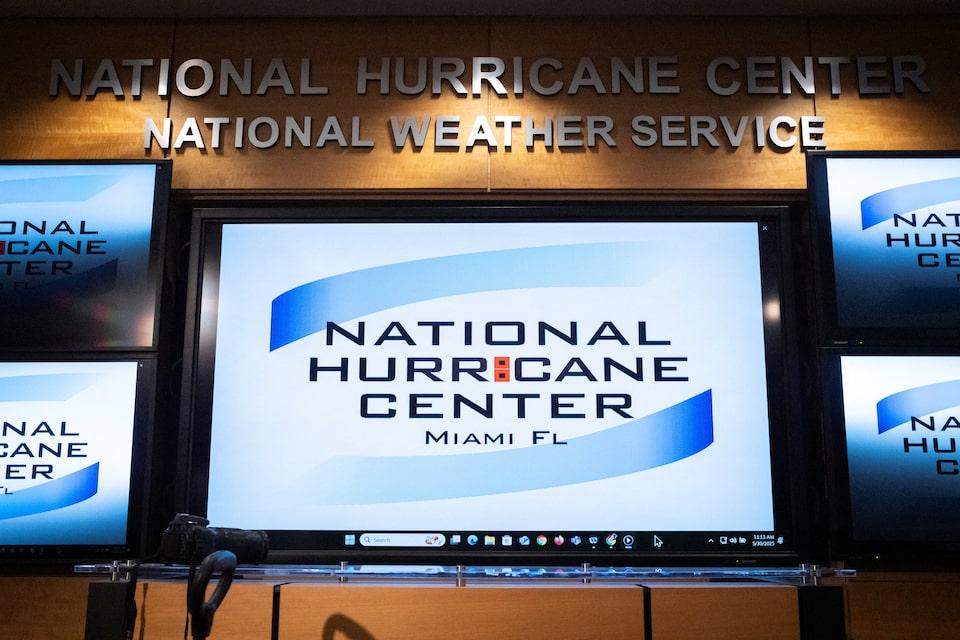
July 15 (Reuters) - A low pressure area located just offshore of the east coast of Florida has a 40% likelihood of evolving into a cyclone within the next 48 hours, the U.S. National Hurricane Center (NHC) said on Tuesday. "This system is forecast to move westward across the Florida Peninsula today and tonight, then reach the northeastern Gulf by the middle part of this week," the NHC said in its latest advisory. Sign up here. https://www.reuters.com/business/environment/nhc-says-40-chance-system-will-form-into-cyclone-near-florida-2025-07-15/
2025-07-15 05:39
MSCI all country index loses ground after hitting record US inflation higher in June but broadly in line with expectations Dollar rises along with US Treasury yields JPMorgan, Citi results beat expectations, but while Citi rallies JPM drops NEW YORK/LONDON, July 15 (Reuters) - MSCI's global equities index lost ground on Tuesday after touching a record high, while U.S. Treasury yields hit their highest level in more than a month, as investors digested a slight rise in U.S. inflation and took a mixed view of quarterly results from big banks. The latest economic data showed that U.S. consumer prices increased 0.3% in June, in line with forecasts, but the largest gain since January. Prices rose across goods from coffee to audio equipment to home furnishings in what economists saw as evidence the Trump administration's increasing import taxes are being passed through to consumers. Sign up here. The U.S. Federal Reserve has been keeping interest rates steady as it waited for data indicating the impact from tariffs. But after Tuesday's data, traders stuck to their bets that the Fed is more likely than not to cut rates in September, continuing to price around a 60% chance of a move after the data. "You do see tariffs starting to leak into the data. The question is, does it leak even more so in the future and cause inflation to rise," and keep the Fed on hold with rate cuts, said Brent Schutte, chief investment officer of Northwestern Mutual Wealth Management Company. And with the potential for the Trump administration to raise tariffs further in the coming months, the worry is that inflation rises further, according to Schutte. "The more that we layer on, potentially the more impact it has overall," he said. Investors will be carefully monitoring producer price data due on Wednesday, and retail sales data due to be released on Thursday, for signs of an impact from tariffs, according to Schutte. On Tuesday afternoon, however, Boston Federal Reserve President Susan Collins said she is in no rush to change the U.S. central bank's benchmark interest rate amid economic uncertainty, as data suggest that while import tariffs will drive up , it is possible the overall impact may not be as bad as once feared. On Wall Street the Dow Jones Industrial Average (.DJI) , opens new tab fell 436.36 points, or 0.98%, to 44,023.29, the S&P 500 (.SPX) , opens new tab fell 24.80 points, or 0.40%, to 6,243.76 and the Nasdaq Composite (.IXIC) , opens new tab rose 37.47 points, or 0.18%, to 20,677.80. Tech-heavy Nasdaq was boosted by chip stocks including heavyweight Nvidia (NVDA.O) , opens new tab which rallied 4% on Tuesday after the AI chip leader it will resume sales of its H20 chips to China. But MSCI's gauge of stocks across the globe (.MIWD00000PUS) , opens new tab fell 3.21 points, or 0.35%, to 920.25. In Europe, the STOXX 600 (.STOXX) , opens new tab index closed down 0.37%. Also on Tuesday, investors processed the second-quarter earnings season kick-off. Results from JPMorgan Chase (JPM.N) , opens new tab and Citigroup (C.N) , opens new tab beat expectations, but were met with a mixed response. JPMorgan ended down 0.74%, while Citi shares rallied 3.7%. Wells Fargo(WFC.N) , opens new tab shares ended down 5.5% as it cut its 2025 net interest income guidance even as it beat second-quarter profit expectations. S&P 500 profits are expected to rise 5.8% year-over-year, according to LSEG data. The outlook has dimmed since the early April forecast of 10.2% growth, before President Donald Trump launched his trade war. TRADE WAR STILL IN FOCUS U.S. Treasury yields rose after initially slipping following the inflation data, with 30-year yields edging above 5% and hitting their highest level since May 29. The yield on benchmark U.S. 10-year notes rose 6 basis points to 4.487%, from 4.427% late on Monday. The benchmark yield had hit its highest level since June 11. The 30-year bond yield rose 4.3 basis points to 5.0156%. And the 2-year note yield, which typically moves in step with interest rate expectations for the Federal Reserve, rose 5.6 basis points to 3.955%, from 3.898% late on Monday. Trade was also still a major focus after Trump threatened over the weekend to impose 30% duties on the European Union and Mexico from August 1 - above the 20% on the EU he had initially proposed in April. However, Trump said on Monday he was open to further negotiations. Along with tariffs and inflation, investors were focused on the U.S. fiscal and debt outlook as well as the pressure from Trump on Fed Chair Jerome Powell to cut rates, according to Steve Englander, head of global G10 FX research and North America macro strategy at Standard Chartered Bank's New York branch. “There are a lot of balls in the air. It's just that it's unclear how heavy each one of them is, and which one is going to have the biggest impact when it lands,” Englander said. Meanwhile in currencies, the dollar reached a 15-week high against the Japanese yen , strengthening 0.78% to 148.85 yen. The dollar index , which measures the greenback against a basket of currencies including the yen and the euro, rose 0.52% to 98.63. The euro was down 0.52% at $1.1602 while sterling weakened 0.34% to $1.3379. Bitcoin fell 3.05% to $116,556.37 after hitting a record in Monday's session. The cryptocurrency was already lower when the fate of long-awaited legislation in the U.S. Congress was cast into doubt as a procedural vote to consider the measures, aimed at providing clarity to the digital asset industry, was shot down by lawmakers from both parties. Oil prices were lower on Tuesday after Trump's for Russia to end the war in Ukraine and avoid sanctions eased concerns about any immediate supply disruptions. U.S. crude settled down 0.69% or 46 cents at $66.52 a barrel while Brent settled at $68.71 per barrel, down 0.72% or 50 cents on the day. Gold prices inched lower on Tuesday as market participants awaited tariff updates, while the inflation report showed a widely expected increase in U.S. consumer prices in June. Spot gold fell 0.46% to $3,328.07 an ounce. U.S. gold futures fell 0.64% to $3,330.10 an ounce. https://www.reuters.com/world/china/global-markets-wrapup-1-2025-07-15/
2025-07-15 05:01
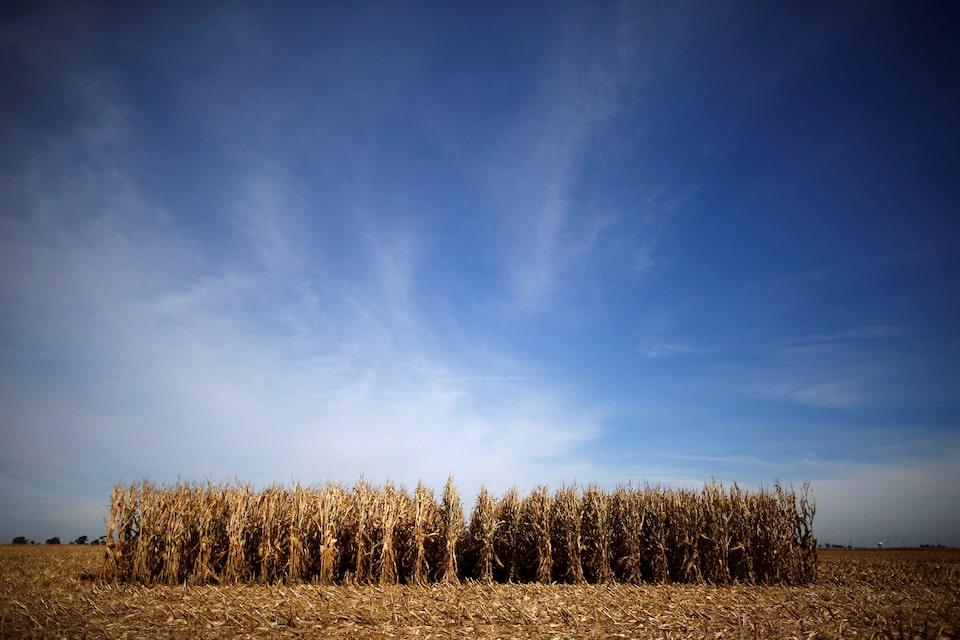
NAPERVILLE, Illinois, July 14 (Reuters) - While the United States appears well on its way to a record corn crop, the top exporter is not completely immune to yield barriers from here, particularly when it comes to temperatures over the next several weeks. However, Crop Watch observations thus far demonstrate that risks have already emerged for soybeans. Many of the later-planted fields are still trying to establish footing, and all 11 Crop Watch fields are vulnerable to next month’s weather conditions. Sign up here. Weather complaints among the Crop Watch producers have been nearly nonexistent for the past few weeks, and that mostly held true last week. More than 4 inches (10.2 centimeters) of rain fell in Nebraska and western Iowa, keeping soils overly saturated. That storm in western Iowa snapped 30% of corn plants in the Crop Watch field, reducing yield potential. Events like these can chip away at the national yield if they persist, especially as the corn moves toward maturity. A poll I posted on X , opens new tab on Friday suggested that the corn market is trading a yield around 184 bushels per acre, well above USDA's trendline of 181, which would be a record. The difference between those two yields is 260 million bushels, impactful for the balance sheet. Another very small concern would be the cooler temperatures expected for this week, especially in northern areas. Heat is needed to push both crops along at this point, especially in North Dakota where corn and beans got a late, wet start. However, producers are combating yield risks despite low commodity prices. They are putting money into this year’s crop, such as applying fungicides and herbicides, especially with yield prospects looking as strong as they do. STEADY SCORES Average Crop Watch corn yield potential held at 4.07 this week, with slight bumps in western Illinois and South Dakota offsetting the western Iowa decline. Average soybean yield held at 3.48 with a boost in North Dakota balancing a reduction in Kansas. That corn score is on the upper end of ones seen at this point in previous years, but bean yields are relatively low. Average Crop Watch corn conditions held at 4.11 this week, with bumps in North Dakota and Nebraska offsetting the decline in western Iowa. That snapped a six-week streak of weekly corn health improvements, though no decline has been seen yet this year. Average soybean conditions dropped slightly to 3.5 from 3.52 a week ago. Scores dropped in Kansas, but slight improvements were recorded in southeastern Illinois and both Dakotas. The 11 Crop Watch producers have been assigning condition scores to their fields each week on a 1-to-5 scale, similar to the U.S. Department of Agriculture’s system where 1 is very poor, 3 is average and 5 is excellent. Last week they added yield scores, also on a 1-to-5 scale. These reflect producers’ best guesses of current yield potential where 3 is around farm average, 4 is solidly above average and 5 is among the best crops ever. Condition and yield scores may differ since conditions are a visual assessment that do not incorporate yield assumptions. The week ahead is set to feature adequate moisture for most of the Corn Belt, accompanied by mild-to-cool temperatures. This should be favorable for the Crop Watch corn fields, which are approaching the halfway point on pollination. Producers would be concerned if overnight temperatures turned too warm later this month and into August as this can limit grain-filling on the corn. A very extreme version of that was observed in 2010, where early forecasts for record corn yields were slashed in the subsequent months. Current long-range forecasts suggest that warmer-than-average temperatures could prevail in late July and early August for the central, southern and eastern Corn Belt, while the north and far west could be in for a cooler run. Karen Braun is a market analyst for Reuters. Views expressed above are her own. Enjoying this column? Check out Reuters Open Interest (ROI) , opens new tab, your essential new source for global financial commentary. ROI delivers thought-provoking, data-driven analysis of everything from swap rates to soybeans. Markets are moving faster than ever. ROI , opens new tab can help you keep up. Follow ROI on LinkedIn , opens new tab and X. , opens new tab https://www.reuters.com/markets/commodities/crop-watch-yield-threats-still-possible-despite-near-ideal-season-2025-07-14/