2025-07-02 11:48
BENGALURU, July 2 (Reuters) - The U.S. dollar will remain weak over the coming months, a Reuters poll of FX analysts forecast, caught in a tangle of mounting U.S. debt concerns, erratic tariff policies and rising interest rate cut expectations. Growing unease over President Donald Trump’s on-again off-again tariffs, and a tax-cut and spending bill that is expected to add $3.3 trillion to the national debt, have led to a scurry of investor outflows from dollar-denominated assets in recent months. Sign up here. A surge in the "term premium" - compensation investors demand to hold longer-term debt - has also contributed to a nearly 11% dollar decline against a basket of major currencies this year (.DXY) , opens new tab and to a three-and-a-half-year low against the euro and sterling last week. Recent data from the Commodity Futures Trading Commission also showed the short-dollar trade was at a near two-year high, suggesting further weakness may be in the offing. Asked how that positioning would change by end-July, more than 80% of FX analysts in a June 27-July 2 Reuters poll, 42 of 52, said it would broadly hold or net-shorts would increase. A majority of these same FX analysts surveyed by Reuters in April and again in May had already concluded the reserve currency’s "safe haven" shine had partly eroded. "We are expecting a weaker U.S. dollar in the coming months," said Jennifer Lee, senior economist at BMO Capital Markets. "The recent budget, the inflationary impact tariffs are going to have and what that means for the Federal Reserve, and the pointed comments President Trump is using against Fed Chair Jerome Powell - all of that doesn't bode well for the overall U.S. economic outlook at least over the rest of the year." Trump has repeatedly demanded immediate and deep rate cuts. Powell, whose term ends in May 2026, reiterated on Tuesday the central bank's plan was to "wait and learn more" about the impact of tariffs on inflation before lowering interest rates. TARIFF NEGOTIATIONS Asked what would be the main driver for the U.S. dollar over the coming month, nearly 37% of respondents, 22 of 60, said "tariff negotiations". Attention will now turn to Trump's next move after the July 9 expiry of a 90-day pause on sweeping tariffs he announced in early April. Eighteen respondents said "interest rate differentials", which have not been important in recent months - with the euro surging while the European Central Bank was cutting rates and the Fed on hold all year. Thirteen said "portfolio diversification", supporting findings from a June survey where a near-90% majority of FX strategists said demand for dollar assets would decline. Seven chose "debate over Fed independence". The euro, up nearly 14% so far this year and on course for its best annual performance against the greenback since 2017, was forecast to hold steady at $1.18 in six months and climb about 2% to $1.20 in a year, survey medians from 70 strategists showed. Nearly 70% of FX analysts in the latest survey upgraded their euro-dollar forecasts from last month, leading to the highest medians since September 2021. But most of those forecasts were formulated in the past week, during which the common currency gained nearly 3%, suggesting they will soon be upgraded. "We continue to watch this slower burn story of real money and... a consistent selling of the dollar, particularly from European real money," said Alex Cohen, FX strategist at Bank of America. "That just speaks to more structural reasons for the dollar to continue to grind lower in the coming months." (Other stories from the July foreign exchange poll) https://www.reuters.com/business/us-dollar-stay-under-pressure-tariff-debt-rate-cut-expectations-2025-07-02/
2025-07-02 11:39
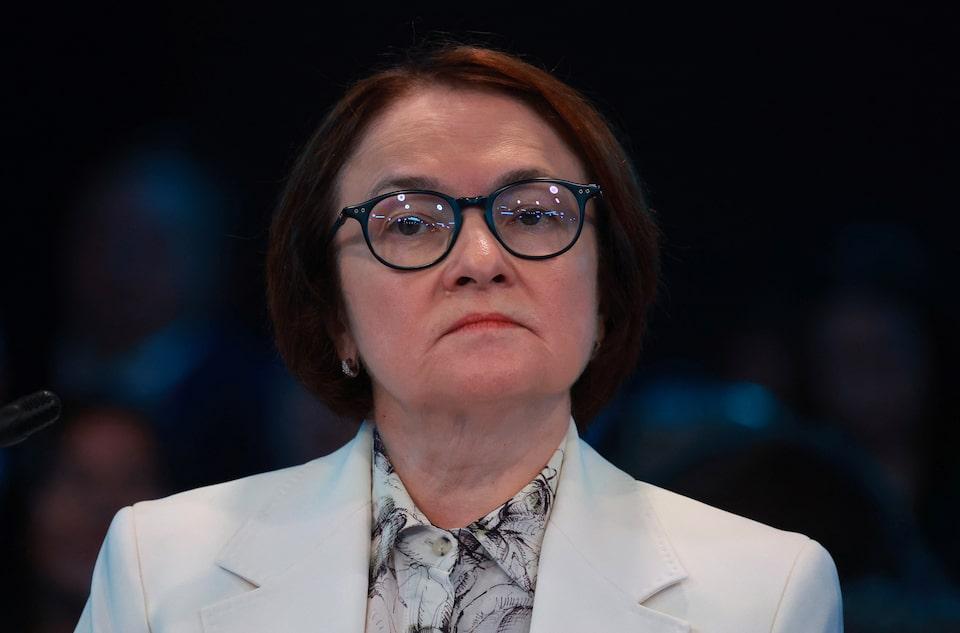
Russian economy adapted to sanctions, central bank's head says Russian inflation is slowing down New structural shift lies ahead, Nabiullina warns ST PETERSBURG, Russia, July 2 (Reuters) - The Russian economy has adapted to Western sanctions and inflation is now slowing, but turbulent times and major technological shifts lie ahead, central bank governor Elvira Nabiullina said on Wednesday. Despite the sanctions, the Russian economy grew by 4.3% last year but is set to slow sharply in 2025, with many officials and economists saying that the current model has exhausted its growth potential. Sign up here. "We have adapted to some external challenges (but) no, we are facing very turbulent times ahead," said Nabiullina, who is widely credited with steering the Russian economy through the Ukraine military conflict and resulting sanctions. "But I am confident that this also presents new opportunities for development and for increasing labour productivity in conditions of expensive labour. We base our efforts on this," she told a banking conference. She stressed that the high cost of labour - spurred by the military spending that has led to a wage growth spiral in many sectors, as well as by curbs on immigration - would remain for a long time. Nabiullina said the economy should in future rely entirely on domestic sources of financing as cheap funding from abroad, abundant before the Ukraine conflict, is no longer available. "In my view, structural adaptation to external constraints has been completed. We have demonstrated our ability to adapt to these challenges, but now we are facing structural shifts of an entirely new kind, primarily technological ones," she said. "They may have even more far-reaching consequences than what we experienced over the past two years," Nabiullina said, mentioning artificial intelligence applications in the economy as one such challenge. INFLATION SLOWING The central bank, which has faced heavy criticism over its tight monetary policy, began cutting its key interest rate last month as prices started to come down, helped by the rouble's strength. Nabiullina said inflation is now slowing faster than the central bank expected, and there are signs of easing in the severity of labour market shortages. She said that if economic indicators pointed to a more significant slowdown than anticipated, the central bank would have room for bolder interest rate cuts. She dismissed statements by critics of the bank, who want deeper cuts, that the cooling of the economy was excessive. Nabiullina also rejected statements from many businessman and bankers that the rouble is now overvalued and should weaken to please exporting companies, which saw their revenues shrink as the rouble rallied by over 40% against the dollar this year. "A weak exchange rate is often a sign of vulnerability, a result of chronically high inflation and a lack of confidence in one’s own currency. It is hardly something to strive for," she said. https://www.reuters.com/business/finance/russian-central-bank-governor-says-inflation-is-slowing-faster-than-expected-2025-07-02/
2025-07-02 11:31
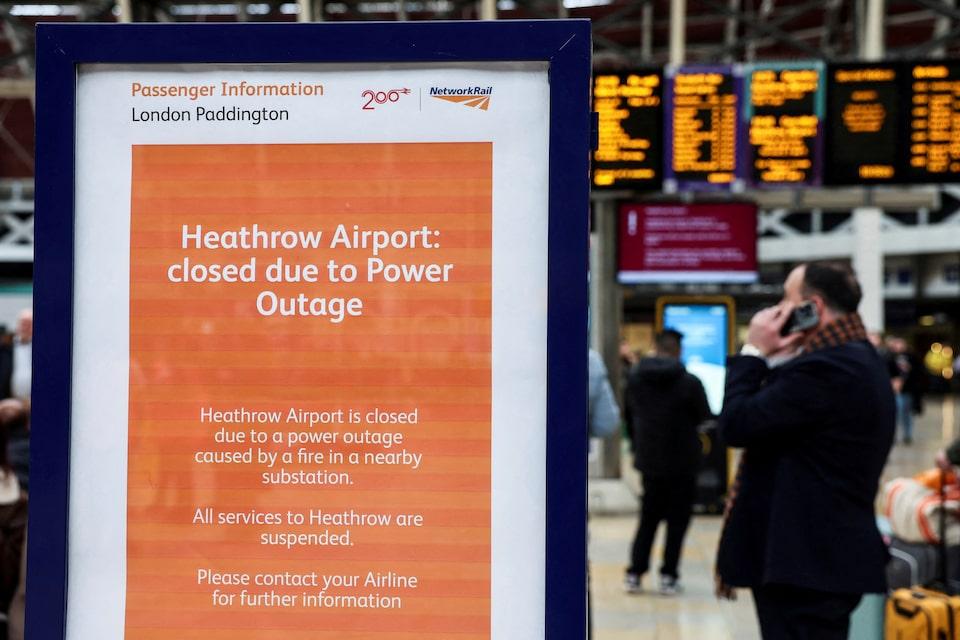
Fault behind fire found in 2018 but went unaddressed - report Energy minister says report is 'deeply concerning' Regulator opens probe into National Grid, says fault preventable Also plans audit of NG assets to see if incident was one-off LONDON, July 2 (Reuters) - A fire that shut London's Heathrow airport in March, stranding thousands of people, was caused by the UK power grid's failure to maintain an electricity substation, an official report said on Wednesday, prompting the energy watchdog to open a probe. The closure of Heathrow, Europe's busiest airport, cost airlines tens of millions of pounds. It also raised questions about the resilience of Britain's infrastructure. Sign up here. Energy minister Ed Miliband called the report "deeply concerning," after it concluded that the issue which caused the fire was identified seven years ago but went unaddressed by power grid operator National Grid (NG.L) , opens new tab. Energy regulator Ofgem said it was "a preventable, technical fault". The report follows a review of the March 21 incident by the National Energy System Operator, which manages the electricity network and was separated from National Grid last year. As a result of the report, Ofgem launched an enforcement investigation into National Grid Electricity Transmission (NGET), which owns and maintains the high-voltage electricity transmission network in England and Wales. FULL AUDIT The report said a "catastrophic failure" on one of the transformer's high voltage bushings at NGET's 275 kilovolt substation caused the transformer to catch fire, most likely due to moisture entering the bushing, sparking an electrical fault. Despite detecting an elevated moisture reading in one of the bushings in 2018, which indicates an imminent fault that requires the component to be replaced, the company did not fix the issue, the report said. The controls in place were not effective and failed to identify that no action had been taken, including during an opportunity in 2022 when NGET decided to defer basic maintenance, letting the issue go unaddressed, it added. A National Grid spokesperson said that the company had a comprehensive asset inspection and maintenance programme in place and that it had taken further action since the fire. "There are important lessons to be learnt about cross-sector resilience and the need for increased coordination," the spokesperson said. Ofgem plans to review whether National Grid complied with the relevant legislation and licence conditions relating to the development and maintenance of its electricity system close to Heathrow. The regulator will also commission an independent audit into National Grid assets to review whether the failings were a one-off or systemic, it said. In an emailed response to the report, Heathrow blamed the incident on a "combination of outdated regulation, inadequate safety mechanisms, and National Grid’s failure to maintain its infrastructure". Its own review found in May that the airport had responded well to the power outage, saying alternative choices would not have materially changed the outcome on the day. https://www.reuters.com/business/energy/fire-that-led-heathrow-shutdown-caused-by-substation-component-failure-energy-2025-07-02/
2025-07-02 11:26
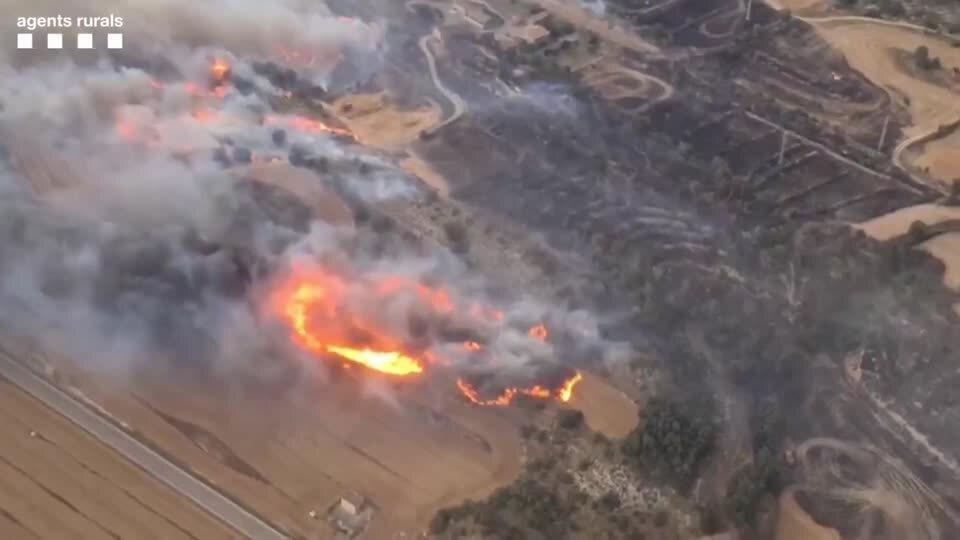
France reports two deaths in heatwave, 300 taken to hospital Italy issues red alerts in 18 cities Swiss reactor shut down due to high river-water temperatures Two die in wildfire in Spain's Catalonia a day ago LONDON, July 2 (Reuters) - Wildfires have killed two people in Spain and two others have died in France because of a heatwave that has gripped Europe and forced the closure of a nuclear reactor at a Swiss power plant. With scorching temperatures again on Wednesday, Spanish officials said a wildfire in Catalonia had killed two people a day earlier and France's energy minister reported two deaths with a direct link to the heatwave, with 300 others taken to hospital. Sign up here. Italy issued red alerts for 18 cities because of the extreme heat and Turkey has been tackling wildfires in what meteorologists say is an "exceptional" heatwave because it has come so early in Europe's summer. The blaze in Torrefeta in the Catalonia region of Spain destroyed several farms and affected an area stretching for about 40 km (25 miles), official said. It was largely contained though more wind and thunder storms were expected on Wednesday. "The fire was extremely violent and erratic due to storms and strong winds, generating a convection cloud that complicated extinguishing efforts," the fire service said. Authorities in the Spanish city of Barcelona said on Tuesday they were also looking into whether the death of a street sweeper at the weekend was heat-related. Spain experienced its hottest June on record this year, and France had its hottest June since 2003, Energy Minister Agnes Pannier-Runacher said. Weather forecaster Meteo France said red alerts remained for several areas of central France, but that heat was easing in the west, though intense thunderstorms with possible heavy bursts of rainfall were expected in many parts of the east. Temperature highs were expected around 39 Celsius (102.2°F), with up to 34 C in Paris, and 36 C to 38 C in Strasbourg, Lyon, Grenoble and Avignon. In Italy, Florence was expected to bear the brunt of the heat with a top temperature of 39 C during the day. Red alerts were issued in 18 cities, including Milan and Rome. There was a risk of violent and sudden rain and storms, particularly along the central Appennine mountain region and Sardinia and Sicily. Swiss utility Axpo shut down one reactor unit at the Beznau nuclear power plant and halved output at another on Tuesday because of the high temperature of river water. Water is used for cooling and other purposes at nuclear power plants, and restrictions were expected to continue as temperatures are monitored. Scientists say greenhouse gas emissions from burning fossil fuels are a cause of climate change, with deforestation and industrial practices being other contributing factors. Last year was the planet's hottest on record. https://www.reuters.com/sustainability/climate-energy/two-die-spain-wildfire-two-deaths-france-european-heatwave-2025-07-02/
2025-07-02 11:11
BERLIN, July 2 (Reuters) - Germany's cabinet on Wednesday gave its backing to a deal with the Netherlands to support gas extraction from a cross-border reservoir in the North Sea, the economy ministry said, as Berlin seeks to boost domestic gas production. Following the turmoil of the Ukraine war and Germany's decision to halt Russian imports, the government has focused on finding alternatives, including trying to increase domestic gas exploration and extraction. Sign up here. Natural gas production in Germany has been declining for decades. At around 4.8 billion cubic meters in 2022, it accounted for only 5.5% of Germany's annual use. Dutch energy company One-Dyas, which is leading the project, estimates it will be able to extract between 4.5 and 13 billion cubic meters of gas from the "N05-A" field over several years. This would represent roughly 6% to 16% of the approximately 80 billion cubic meters consumed by Germany in 2024. For extraction to happen, several layers of approval are needed in Germany and it is unclear how long that would take. The Dutch authorities have already agreed the necessary legislation. The outline agreement backed on Wednesday in Germany lays out how the cross-border gas reserves will be assessed and divided, as well as taxes and royalties and cooperation between authorities in the two countries. The western state of Lower Saxony, where the fields are located on the German side, will make its own decisions on whether to approve specific applications for gas production, the ministry said, adding the agreement does not grant production permission. The project was put on hold under the previous Green-led economy ministry and faces legal challenges by environmental groups that say it poses risks to the UNESCO Wadden Sea World Heritage Site. "The German government is handing Borkum and the Wadden Sea over to fossil fuel industrialisation," Sascha Mueller-Kraenner, DUH environmental group director, said, adding that this would have devastating consequences for biodiversity in the North Sea. https://www.reuters.com/sustainability/boards-policy-regulation/germany-backs-cross-border-gas-agreement-with-netherlands-2025-07-02/
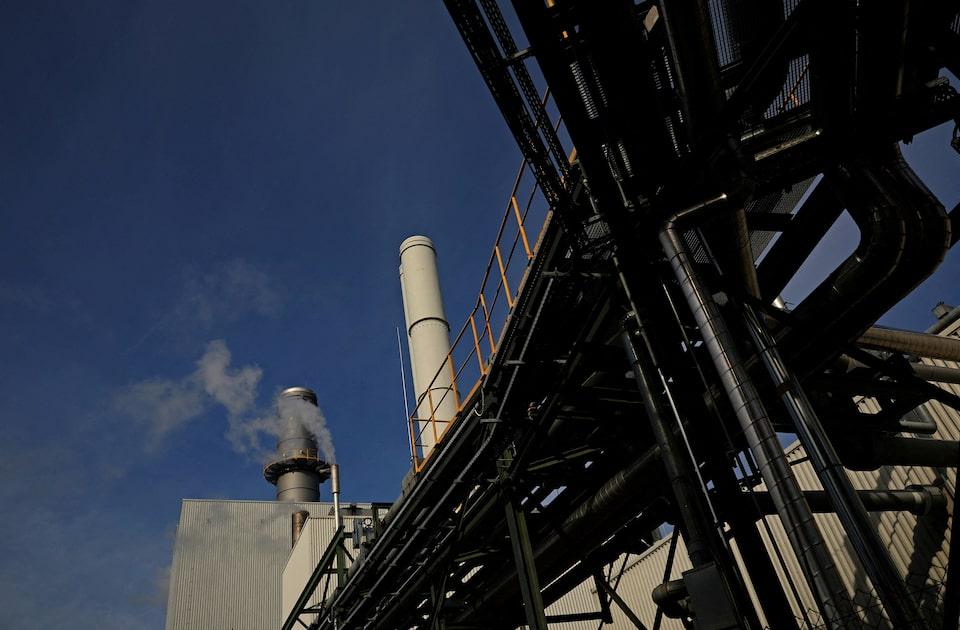
2025-07-02 11:08
OSLO, July 2 (Reuters) - DNO (DNO.OL) , opens new tab has sold its entire gas production over a four-year period from the Norwegian continental shelf to French utility Engie (ENGIE.PA) , opens new tab for an undisclosed sum, the Norwegian company said on Wednesday. It said the deal had been facilitated by a loan from a U.S. bank as U.S. lenders step up funding to the fossil fuel industry, adding it was in discussions over a similar offtake agreement and related financing facility for its North Sea oil production. Sign up here. The offtake agreement takes effect from October 1 and covers DNO's increased gas production after its acquisition of assets from Sval Energi in March, DNO said in a statement. Sval's acquisition quadrupled DNO's North Sea production to about 80,000 barrels of oil equivalent per day, about half of it natural gas. Engie did not immediately respond to a request for comment. While DNO did not disclose the volume of the four-year contract with Engie, last year DNO and Sval Energi produced 1.82 bcm of gas from the Norwegian continental shelf. DNO has entered into a financing facility with an unnamed U.S. bank for up to $500 million, which will be used to repay Sval Energi's debts and for general corporate purposes. "We have received strong interest by buyers to prepurchase our enlarged North Sea production," DNO's Executive Chairman Bijan Mossavar-Rahmani said in a statement. https://www.reuters.com/business/energy/dno-sells-four-years-norwegian-gas-output-engie-2025-07-02/