2025-06-24 05:36
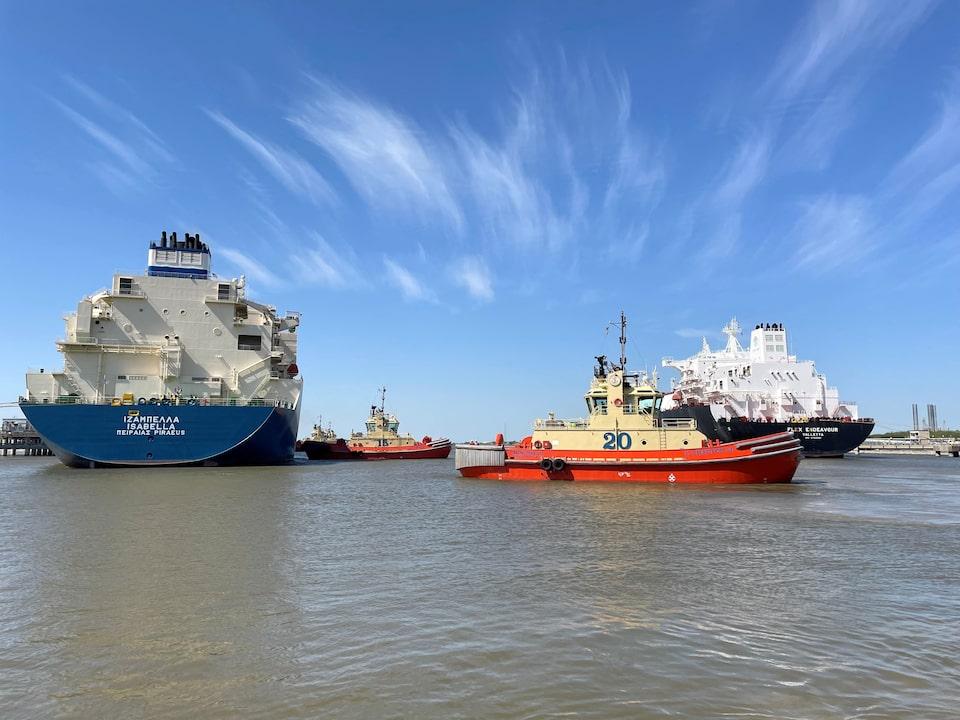
LNG Atlantic, Pacific freight rates hit highest since Oct 2024, Spark data shows Europe and Asia are now equally profitable for US cargo deliveries, analyst says Mideast tensions push shipping, insurance costs higher, trade sources say SINGAPORE/LONDON, June 24 (Reuters) - Shipping costs for liquefied natural gas cargoes have rallied to their highest in about eight months with vessel availability tightened by a shift in more ships heading to Asia at the same time as conflict has escalated in the Middle East. The Atlantic freight rate for vessels with two-stroke engines capable of carrying 174,000 cubic meters of LNG, the most common type in the market, was assessed at $51,750 per day on Monday, its highest level since October 3, according to pricing agency Spark Commodities. Sign up here. The Pacific freight rate for the same class of ship also surged, with Spark assessing it at $36,750/day on Monday, the highest level since October 25. "This rise in global LNG freight rates has been largely due to tight vessel availability, which in turn has been caused by a shift in pricing signals for U.S. cargoes," said Spark Commodities analyst Qasim Afghan. "This has been further exacerbated by market sentiment around the developing situation in the Middle East," he said. A recent tender by Egypt to buy up to 160 LNG cargoes through 2026 also drove up demand for vessels. In February, LNG shipping rates fell to five-year lows as the global fleet expanded and higher delivered prices in Europe incentivised U.S. cargoes to remain in the Atlantic versus travelling to Asia. The shorter average journey times increased tanker availability. In the past two weeks however, it has become equally profitable to deliver LNG to both Europe and Asia, so spot cargoes are now incentivised to travel to Asia via the Cape of Good Hope, increasing average voyage times and reducing vessels available for charter, Afghan said. MIDEAST TENSIONS The Israel-Iran conflict, in which both countries have been firing missiles at each other, has raised fears Tehran may close the Strait of Hormuz in further retaliation. As a result, shipowners are holding off chartering vessels, which is reducing tanker availability and pushing up prices, said a trade source, who declined to be identified as he was not authorised to speak to the media. Insurance costs for LNG tankers going through the Strait of Hormuz have also increased, said three trade sources, with one adding that the war risk premium has surged by up to five times since the start of the Israel-Iran conflict. Around 20% of global oil and gas demand flows through the Strait of Hormuz, situated between Iran and Oman. Qatar, one of the world's top LNG exporters, sends almost all of its supplies via the strait. https://www.reuters.com/business/energy/lng-freight-rates-hit-8-mth-top-tight-tanker-availability-mideast-conflict-2025-06-24/
2025-06-24 04:42
A look at the day ahead in European and global markets from Stella Qiu U.S. President Donald Trump surprised markets by announcing late on Monday that Israel and Iran had agreed to a complete ceasefire, potentially ending a 12-day conflict. In his own words, the ceasefire would last "forever". Sign up here. Investors are surely hoping it is real and will hold. It was only days ago that the U.S. launched strikes on Iran that risked drawing it into another costly foreign war. Oil prices duly slumped almost 3% on Tuesday, on top of an almost 9% tumble overnight as the immediate threat to the vital Strait of Hormuz shipping lane appeared to have lessened. U.S. crude futures are back at $66.80 per barrel, about the lowest since June 11 before Israel's attacks on Iran began. That is a relief for global inflation, which will make central bank efforts to tame inflation a little easier. But the situation is still very fluid. Missiles were still being launched from Iran towards Israel. Israeli media said a building had been struck and three people were killed in the missile strike on Beersheba. An Iranian official earlier confirmed that Tehran had agreed to a ceasefire, but the country's foreign minister said there would be no cessation of hostilities unless Israel stopped its attacks. Risk assets rallied nonetheless - S&P 500 futures rose 0.5% and Nasdaq futures were 0.7% higher. European stock markets are bracing for a strong rebound, with EUROSTOXX 50 futures up 1.2%. The MSCI's broadest index of Asia-Pacific shares outside Japan (.MIAPJ0000PUS) , opens new tab gained 2.1% while Japan's Nikkei (.N225) , opens new tab rallied 1.1%. South Korean shares (.KS11) , opens new tab hit their highest since September 2021. The beleaguered dollar, which had found some safe-haven bids from the Middle East conflict, was on the back foot again and fell 0.5% to 145.45 yen , having come off a six-week top of 148 yen overnight. With the Israel-Iran conflict potentially easing, investor focus shifts to Federal Reserve Chair Jerome Powell's upcoming appearance before Congress. The Fed has not made a move on interest rates this year due to the inflationary impact of Trump's tariffs. But some Fed officials are breaking ranks with Powell, whose hawkish view on rates has drawn Trump's ire. Fed's Michelle Bowman said overnight that she was open to cutting rates in July, while Governor Christopher Waller said he would also consider a rate cut next month. More Fed officials will be speaking tonight, with New York Fed President John Williams giving keynote remarks in New York and Cleveland Fed President Beth Hammack due to speak on monetary policy in London. In Europe, central bankers are busy too. Bank of England Governor Andrew Bailey will make public appearances in London and a few ECB officials will be giving speeches. Key developments that could influence markets on Tuesday: -- Fed Chair Jerome Powell appears before Congress, along with public appearances by other Fed officials including New York Fed President John Williams, Cleveland Fed President Beth Hammack and Boston Fed President Susan Collins. -- NATO annual summit begins in the Hague -- Bank of England Governor Andrew Bailey and chief economist Huw Pill appear at a conference on Britain's return to the gold standard in 1925. -- Germany IFO business survey -- U.S. Conference Board consumer confidence -- Canadian CPI for May https://www.reuters.com/world/china/global-markets-view-europe-2025-06-24/
2025-06-24 04:35
Mimura engaged in U.S. tariff talks including forex dialogue Communication style sharply different from predecessors Currency comments usually short TOKYO, June 24 (Reuters) - Japan reappointed top foreign exchange diplomat Atsushi Mimura for a second year, the finance ministry said on Tuesday, cementing his role in the country's current U.S. tariff negotiations. "We sought his reappointment taking into account his engagement and current circumstances," Finance Minister Katsunobu Kato told reporters. Sign up here. Kato noted Mimura has been engaged in trade talks with the U.S. and discussions on foreign exchange with U.S. Treasury Secretary Scott Bessent. The 58-year-old Mimura will remain vice finance minister for international affairs - a post that oversees Japan's currency policy and coordinates economic policy with other countries. The reappointment is effective July 1. While the finance ministry conducts a regular personnel reshuffle in July every year, it is common for top foreign exchange diplomats to have their terms extended beyond a year. Mimura's predecessor Masato Kanda, currently president of the Asian Development Bank, stayed in the post for three years as he combated the yen's relentless falls against the dollar with record foreign exchange intervention. TO THE POINT The Japanese currency has recovered some ground since Mimura took the post, trading around 145 per dollar now compared with the 38-year low of 161.96 a year ago. But the weak yen remains a headache for Japanese policymakers as it accelerates inflation by pushing up import costs. In contrast to his predecessors, Mimura's communication style is generally considered to be more succinct, often delivering very brief currency-related commentary that relies more on nuanced changes in language. For example, during the yen's sharp fall beyond 150 in November last year, he said the government was closely watching currency developments with the "utmost urgency," escalating his commentary from "high urgency" previously. "Being always vocal is one style of communication, but not speaking may also be another way of communication," Mimura told Reuters last year. "We must avoid creating unnecessary market speculation or uncertainties, but communication can be done both by speaking and not speaking." https://www.reuters.com/business/japans-top-fx-diplomat-mimura-serve-post-second-year-2025-06-24/

2025-06-24 02:57
MUMBAI, June 24 (Reuters) - The Indian rupee is poised to climb at open on Tuesday as the plunge in crude oil on fading Middle East geopolitical risks improves the outlook for the South Asian nation's trade balance and assets. The 1-month non-deliverable forward indicated an open in the 86.10 to 86.15 range, versus 86.75 in the previous session. Sign up here. Brent prices fell 2% in Asia after U.S. President Donald Trump said Iran and Israel had agreed to a ceasefire. Brent had already slid 7% on Monday when Iran made a token retaliation against a U.S. base. "With Trump having lent a hand in brokering a peaceful resolution, the prospect of a prolonged conflict with U.S. involvement has been re-priced," clearing the way to add risk, Chris Weston, head of research at broker Pepperstone, said. U.S. equities rose Monday and futures indicated a further rally. The dollar index softened and Asian equities and currencies advanced. "It is expected that the big opening dip (on USD/INR) will run into buy orders. I do not think 86 will be taken out, though I reckon that positions are on the lighter side and interbank will be on the hunt to put in shorts," a currency trader at a Mumbai-based bank said. Brent crude is now trading below $70 a barrel — near levels seen before Israel’s first strike on Iran. The rupee was at 85.60 prior to that escalation. There is "definitely" more room for the rupee to rally, a treasury official at a bank said. It's just that large drops on USD/INR tend to "struggle to hold on". Meanwhile, Federal Reserve vice-chair Michelle Bowman said the first interest rate cut this year could come as soon as July, further undermining the dollar and boosting risk. KEY INDICATORS: ** One-month non-deliverable rupee forward at 86.25-86.30; onshore one-month forward premium at 10.25 paise ** Dollar index down at 98.17 ** Brent crude futures down 2.1% at $69.88 per barrel ** Ten-year U.S. note yield at 4.35% ** As per NSDL data, foreign investors bought a net $1,093.6 mln worth of Indian shares on June 22 ** NSDL data shows foreign investors sold a net $18.8 mln worth of Indian bonds on June 22 https://www.reuters.com/world/india/rupee-set-rally-crude-dives-israel-iran-de-escalation-2025-06-24/
2025-06-24 01:47
NEW YORK, June 24 (Reuters) - Goldman Sachs (GS.N) , opens new tab has appointed Aekloveya Shyam as head of mergers & acquisitions (M&A) in the Global Real Estate Group, according to an internal memo seen by Reuters. Shyam previously served as a managing director in the Healthcare Group within Investment Banking, where he participated in several multi-billion dollar transactions across the U.S., Europe and Asia. Sign up here. Shyam will focus on strategic transactions and advisory services, reporting to Mike Graziano and Andy Jonas, co-heads of the global Real state group. He joined Goldman in 2011 as an associate, and was named managing director in 2019. A Goldman spokesperson has confirmed the content of the memo. https://www.reuters.com/business/finance/goldman-names-aek-shyam-head-ma-global-real-estate-group-2025-06-24/
2025-06-24 00:30
ORLANDO, Florida, June 23 (Reuters) - With the dollar poised for its worst first-half performance since 1986, the selling may seem to be coming from everyone, everywhere, across every asset class. To some extent, that's true. Investors globally appear to be gradually reducing their exposure to dollar-denominated assets, driving the greenback down to its lowest level against a basket of major currencies in three and a half years. But some pressure points are greater than others. Sign up here. Unsurprisingly, non-U.S. investors are responsible for the bulk of the selling, with equity-related selling pressure concentrated among European investors and fixed income-based selling mostly coming from Asia. According to Bank of America's FX strategy team, European "real money" investors - institutions like pension funds and insurance companies - are the main drivers of the dollar's selloff in the second quarter, slashing their dollar positioning to the lowest since 2022 in a matter of weeks. But the story might not be so straightforward. While European investors increasing their dollar hedge ratios have garnered much attention recently, research shows that most of the dollar's average daily declines in the last few months have come in Asian trading hours, suggesting Asian holders of U.S. bonds may also be increasing their dollar hedges. So which is the bigger drag on the dollar: equity-led geographic diversification or fixed income selling? And where is the selling mostly coming from: Europe or Asia? OVER-EXPOSED At first glance, one might pin the blame on equities, as foreign holdings of U.S. stocks are larger than their U.S. debt assets in nominal terms. But percentage-wise, overseas investors' footprint in the U.S. fixed income markets is larger. Foreigners own just over $31 trillion of U.S. securities, with $17.6 trillion in equities and $13.6 trillion of bond holdings, according to the Bank for International Settlements. That represents around 18% of the overall U.S. equity market, compared with 21% of the U.S. agency and corporate bond market and a third of the U.S. Treasury market. Analysts at UBS estimate that euro zone investors account for 25% of the foreign-owned U.S. equity universe, having loaded up on U.S. stocks in recent years. This makes the dollar particularly vulnerable if Wall Street continues to underperform European and Asian markets, they reckon. Breaking down these exposures even further, they find that foreign investors' total net unhedged dollar asset exposure is $23.5 trillion. Of this, investors in G10 countries hold $13.4 trillion, with $9.3 trillion in equities and $4.1 trillion in fixed income. These are vast numbers, and it wouldn't require much of a switch to trigger large cross-border flows. UBS calculates that a hypothetical 5% reduction in G10 countries' dollar position would equate to around $670 billion of dollar selling. Most G10 countries, of course, are in Europe, so the bulk of that selling would come from there. PRICE-SENSITIVE While European investors have mostly been unloading equities thus far, it's good to remember that the region's investors significantly increased their exposure to U.S. bonds over the last decade too, particularly the 2014-2022 years when the European Central Bank's main interest rates were negative. UBS analysts estimate euro zone investors bought $3.4 trillion in foreign debt since 2014. So even a modest rebalancing away from U.S. bonds could have a meaningful impact on prices. Ultimately though, Asian investors still appear to wield more muscle in the U.S. bond market, owning around a third of foreign-held U.S. Treasuries and agency debt. And that figure is probably much higher given that euro zone, Caribbean and UK holdings include assets held on behalf of Asian countries, notably China. Up until this point, there has been no wholesale dumping of U.S. assets, and neither is there likely to be. But it is notable that U.S. assets are increasingly being held by private sector investors, who have replaced central banks as the main buyers of U.S. assets in recent years. The private sector is typically considered more price-sensitive than the official sector. That means these positions may prove less sticky than in the past, especially if the idea of waning "U.S. exceptionalism" truly takes root. (The opinions expressed here are those of the author, a columnist for Reuters) Enjoying this column? Check out Reuters Open Interest (ROI), your essential new source for global financial commentary. ROI delivers thought-provoking, data-driven analysis. Markets are moving faster than ever. ROI can help you keep up. Follow ROI on LinkedIn and X. https://www.reuters.com/markets/currencies/whos-selling-breaking-down-dollars-breakdown-mcgeever-2025-06-23/