2025-06-10 21:07
ORLANDO, Florida, June 10 (Reuters) - TRADING DAY Making sense of the forces driving global markets Sign up here. By Jamie McGeever, Markets Columnist I'm excited to announce that I'm now part of Reuters Open Interest (ROI), an essential new source for data-driven, expert commentary on market and economic trends. You can find ROI on the Reuters website, and you can follow us on LinkedIn and X. Global markets remain buoyant, awaiting the outcome of U.S.-China trade talks in London and U.S. inflation figures on Wednesday, both of which could have a bearing on guidance from the Federal Reserve next week and investor sentiment more broadly. In my column today I look at how the Trump administration's crackdown on immigration could cause labor market distortions and headaches for Fed officials. More on that below, but first, a roundup of the main market moves. If you have more time to read, here are a few articles I recommend to help you make sense of what happened in markets today. Today's Key Market Moves Buoyancy trumping uncertainty On the day The World Bank slashed global growth forecasts, warning of the "significant headwind" from tariffs and heightened uncertainty, global stocks clocked their fifth consecutive all-time high. Britain's benchmark FTSE 100 is a whisker from reaching new peaks and Germany's DAX hit an all-time high last week, while on Wall Street the Nasdaq and S&P 500 are within a couple of percentage points of new record levels also. Yet the reasons for equity investors to be fearful right now are plentiful - worries over growth, inflation, tariffs, long-term interest rates, U.S. debt and deficits, and the fact that China, the world's second-largest economy, is still mired in a low growth and deflationary funk. Something not quite adding up, right? Perhaps. On the other hand, the fiscal taps are being turned on in China and Germany, British finance minister Rachel Reeves outlines her multi-year 2 trillion pounds ($2.7 trillion) spending plan on Wednesday, and U.S. President Donald Trump's 'big beautiful bill' currently going through Congress is front-loaded with fiscal stimulus too. None of that is really fresh news but the upshot is a lot of liquidity coursing through the global economy. Right now it is something investors appear willing to accept even if the price is increased debt, and for the U.S. and UK in particular, worse public finances. Big corporate deals are being struck, like the OpenAI and Google cloud service tie-up and Meta Platforms reportedly paying $15 billion for a 49% stake in AI startup Scale AI, and implied equity and bond volatility is low. After a period of fretting more about deficits and spiking bond yields, investors may now be viewing the future with their glass half full. Fiscal stimulus is coming and interest rates around the world are being cut. The monetary outliers are Japan and the U.S., but the Bank of Japan could be near the end of its tightening cycle and the Fed may be about to begin easing later this year. On top of this, there's a general belief that Trump will back down from his hardline stance on tariffs and that a palatable deal with China will be reached, the so-called 'TACO' - Trump Always Chickens Out - trade. Fresh news on that front, at least, should be forthcoming on Wednesday. Trump immigration crackdown creates jobs distortions, Fed headaches Seismic shifts in immigration are distorting the U.S. employment picture, making it harder for investors and policymakers to know exactly how much the labor market is actually slowing. Assuming the Trump administration makes good on its pledge to reduce immigration, either by stopping the flow of people coming into the country or by deporting many already here, the labor supply will shrink. The long-term impact of lower immigration is generally agreed to be negative, as new workers are needed to replace retirees, fill job vacancies and drive economic growth. Over time, fewer new workers will likely mean lower growth. But in the short term, a smaller pool of workers results in a tighter labor market, which keeps a lid on the unemployment rate, albeit artificially and probably temporarily. This may already be playing out. Figures released last week showed that employment in May fell by 696,000 jobs. That's the biggest single monthly decline since the historic losses seen during the pandemic in early 2020. Some economists argue that the recent drop is a consequence of Trump's immigration crackdown. Nonfarm payrolls rose 139,000. Meanwhile, the unemployment rate held steady at 4.2%, which though higher than it was two years ago, is still historically low by any measure. All else being equal, this points to a tight labor market, which should put upward pressure on wages and perhaps even warrant a more hawkish policy stance from the Federal Reserve. But that is almost certainly a misreading. When labor supply and the labor force participation rate fall, this brings down a country's so-called 'breakeven' job growth. That's the number of net new jobs the economy needs to keep up with growth in the working-age population and maintain a steady unemployment rate. That figure is falling, and if the Trump administration toughens up its anti-immigration policies further, this decline is likely to accelerate. LOWER FOR LONGER According to economists at Morgan Stanley, breakeven employment growth averaged 210,000 jobs a month last year, and is averaging 170,000 so far this year. They reckon it will fall to 90,000 by the end of this year and 80,000 next year. Ryan Sweet, chief U.S. economist at Oxford Economics, goes further, estimating that the breakeven rate is "quickly approaching" 50,000 jobs a month due to weakening labor supply growth, primarily because of reduced immigration. "The unemployment rate can remain low, but for the wrong reasons," Sweet says. If these projections prove accurate, monthly employment and job growth could continue to slow without raising the unemployment rate. The contradictory signals this sends could create confusion for both investors and policymakers. In his press conference after the most recent Fed policy meeting, Chair Jerome Powell repeatedly told reporters that the labor market is "solid". The unemployment rate "remains low," and the labor market is "at or near maximum employment." If these headline indicators are the gauge, Powell is absolutely correct. But he also stressed that policymakers are looking at the "whole huge array" of labor market indicators for a truer guide. One of those inputs in the months ahead will no doubt be net immigration. And that could generate significant uncertainty, as there are huge gray areas and wide margins of error when trying to estimate net immigration and its impact on the labor market. In January, the non-partisan Congressional Budget Office projected net immigration of 2 million people this year and 1.5 million next year, down from an estimated 3.3 million in 2023. With Trump seemingly hardening his stance on immigration, those projections could turn out to be far too high. Morgan Stanley's economists just slashed their immigration forecasts to 800,000 this year and 500,000 next year. If these figures turn out to be closer to reality, we could soon be looking at a "tight" labor market with monthly payrolls gains of well under 100,000. Pity the poor Fed Chair who has to communicate policy in that environment. What could move markets tomorrow? Opinions expressed are those of the author. They do not reflect the views of Reuters News, which, under the Trust Principles , opens new tab, is committed to integrity, independence, and freedom from bias. https://www.reuters.com/world/china/global-markets-trading-day-graphic-pix-2025-06-10/

2025-06-10 20:56
HOUSTON, June 10 (Reuters) - U.S. liquefied natural gas developer Commonwealth LNG is close to signing a deal with Japan's biggest power generator, JERA, to supply it with 1 million metric tons per annum (mtpa) of LNG from its proposed export facility in Louisiana, two sources told Reuters. The deal would run for 20 years and bring Commonwealth LNG to 8 mtpa committed under long-term contracts. The company has said publicly that it wants to get contracts for at least 8 mtpa of its 9.5 mtpa LNG export terminal capacity to give the project the financial go ahead. Sign up here. The U.S. is the largest exporter of LNG in the world and based on projects under construction and those expected to get the financial go ahead this year, the country could triple its export capacity by 2030. "They have agreed to terms on the deal and should be signing it soon," one of the sources familiar with the negotiations told Reuters. Commonwealth LNG did not respond to a request for comment. JERA declined to comment. Commonwealth was one of the projects impacted by a pause on new LNG export licenses imposed by former President Joe Biden pending a study on the economic and environmental impact of further U.S. LNG expansion. That freeze was lifted by the Trump administration, which has promised to unleash American energy. In February Commonwealth received a conditional non-free trade agreement (non-FTA) export authorization from the Department of Energy. Commonwealth said it expects to reach a final investment decision in September 2025 for the project, with first LNG production expected in the first quarter of 2029. In May JERA announced that it had signed an agreement with NextDecade to purchase 2 mtpa of LNG from its Rio Grande project's fifth liquefaction facility. https://www.reuters.com/business/energy/jera-close-signing-deal-1-mtpa-lng-commonwealth-sources-say-2025-06-10/

2025-06-10 20:42
OPEC forecasts 24% rise in energy needs by 2050 OPEC warns of risks from inadequate investment in oil and gas OPEC secretary general criticizes net-zero targets as 'unrealistic' CALGARY, June 10 (Reuters) - Oil demand growth will remain robust over the next two and a half decades as the world population grows, OPEC Secretary General Haitham Al Ghais said on Tuesday. The organization expects a 24% increase in the world's energy needs between now and 2050, with oil demand surpassing 120 million barrels per day over that time period. Sign up here. That estimate is in line with the group's 2024 World Oil Outlook. "There is no peak in oil demand on the horizon," Al Ghais said, speaking at the Global Energy Show in Calgary, Alberta. He said OPEC admired what Canada's oil industry has done to increase its oil output in recent years. Canada achieved record oil production in 2024, as the completion of the Trans Mountain pipeline expansion boosted the ability of oil companies to get their product to market. Danielle Smith, premier of Canada's main oil-producing province of Alberta, has spoken of her desire to double the province's oil and gas output by 2050. Al Ghais said OPEC has been consistent in warning of the dangers of inadequate global investment in oil and gas, given its forecast for demand growth. He said failing to invest enough capital to meet projected demand growth risks undermining energy security and causing volatility for both producers and consumers, and added OPEC believes there is a need for US$17.4 trillion in capital investment in the global energy sector over the next 25 years. OPEC+ is unwinding its output cuts at a faster pace than originally anticipated, lifting production by 411,000 barrels per day for May, June and July. The increases, along with concerns that U.S. President Donald Trump's trade war will weaken the global economy, have pressured oil prices in recent months. Global Brent futures settled at $66.87 a barrel on Tuesday. The U.S. Energy Information Administration (EIA) on Tuesday said it expected Brent oil prices to fall near $60 a barrel by the end of the year and average $59 a barrel next year, hitting U.S. oil production. Al Ghais on Tuesday also said OPEC welcomed recent pushback against what he referred to as unrealistic climate goals that are overly focused on meeting specific deadlines. He said there is a need for countries to reduce emissions but stressed that should not mean picking and choosing between energy sources. He said instead governments and companies should be looking for ways to reduce emissions from oil and gas through technologies such as carbon capture and storage. https://www.reuters.com/business/energy/oil-demand-growth-continue-no-peak-sight-opec-secretary-general-says-2025-06-10/

2025-06-10 20:41
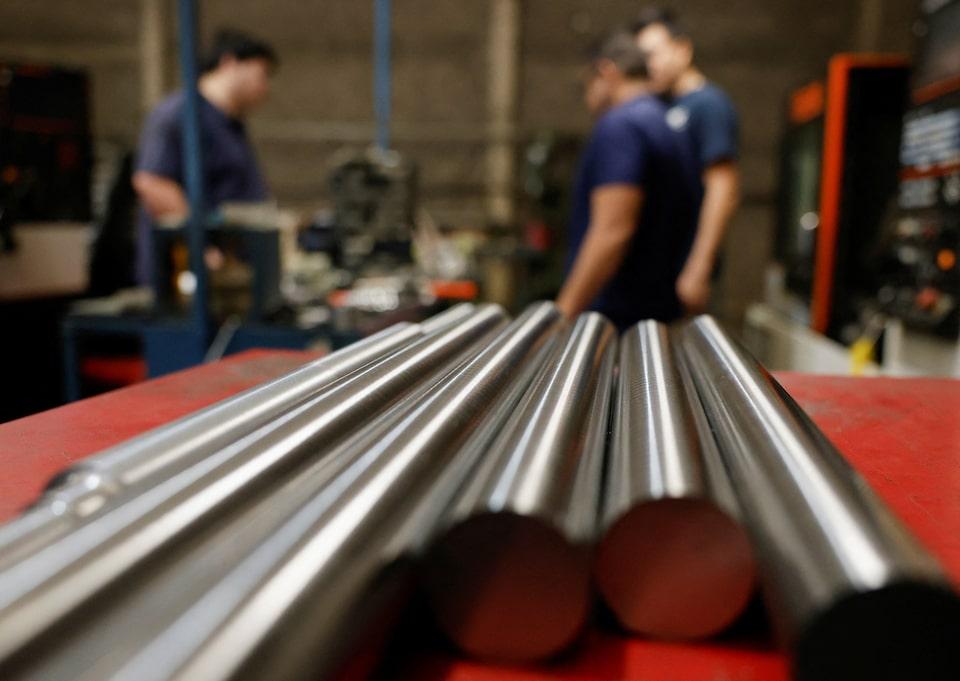
Deal could give Mexico a fixed quota with no tariff or lower tariff, sources say Volumes exceeding quota could face 50% tariff Mexico presses for exemption from Trump's steel tariff June 10 (Reuters) - The United States and Mexico are negotiating a deal to reduce or eliminate President Donald Trump's 50% steel tariffs on imports up to a certain volume, industry and trade sources said on Tuesday. An industry source familiar with the talks said that a likely outcome would include a quota arrangement, under which a specified volume from Mexico could enter duty free or at a reduced rate and any imports above that level would be charged the full 50% tariff. Sign up here. It was unclear whether the deal would eliminate tariffs altogether for in-quota steel import volumes from Mexico or reduce them to a lower level, the source said. The specific volume level of the quota also was not yet determined. Bloomberg News first reported the negotiations over tariff reductions for Mexican steel, quoting people familiar with the matter as saying that the two sides were close to a deal. The report said that terms of the agreement had not been finalized but would allow U.S. companies to import Mexican steel tariff-free as long as total shipments are kept below a level based on historical trade volumes. A White House spokesperson declined comment, while a spokesperson for the Commerce Department which administers Trump's "Section 232" national security tariffs on steel and aluminum did not respond to a request for comment. Mexico was the third largest source of U.S. steel imports in 2024 at 3.52 million net tons, down 16% from 4.18 million in 2024, according to U.S. Census Bureau data compiled by the American Iron and Steel Institute. Canada was the largest foreign steel supplier at 6.56 million net tons in 2024, followed by Brazil at 4.5 million. When Trump first imposed 25% steel tariffs in 2018, Mexico and Canada were granted exemptions with special procedures aimed at curbing any import surges beyond historical volumes. But these measures stopped short of a formal quota arrangement such as that for Brazil. Trump canceled all steel and aluminum quotas, exemptions and exclusions in April to strengthen the metals tariffs, raising the effective rate. A second trade source told Reuters that industry officials were pressing for a clearly defined steel quota arrangement for Mexico, given past import surges from Mexico. U.S. officials have long sought to curb the transshipment of steel products from third countries such as China via Mexico to the United States. Mexican Economy Minister Marcelo Ebrard told reporters at a morning event that the government had argued to U.S. officials that the tariffs were unjustified, noting the United States runs a trade surplus with Mexico in steel and aluminum. "Putting a tariff on a product where you have a surplus is quite debatable because the objective of the tariff is to reduce the deficit," he added. Ebrard said countries like the UK had been exempted from similar measures and urged the U.S. to do the same with Mexico. He warned the tariffs would hurt jobs and supply chains in both countries due to their economic integration. https://www.reuters.com/world/americas/us-mexico-close-deal-that-would-cut-steel-tariffs-bloomberg-reports-2025-06-10/
2025-06-10 20:33
TSX ends up 0.2% at 26,426.31 Stops just short of record closing high Energy rises 1.3%, with Cenvous up 2.4% Materials is only major sector to end lower June 10 (Reuters) - Canada's main stock index rose on Tuesday, led by energy and consumer-related stocks, as investors welcomed recent signs of economic resilience and potential progress in U.S.-China trade talks . The S&P/TSX composite index (.GSPTSE) , opens new tab ended up 50.51 points, or 0.2%, at 26,426.31, stopping just short of the record closing high it posted on Friday. Sign up here. "Markets are enjoying the moment," said Angelo Kourkafas, senior investment strategist at Edward Jones, adding that economies, particularly in the U.S., remain resilient, corporate profits are rising and global trade tensions are easing. U.S. Commerce Secretary Howard Lutnick said trade talks with Chinese officials were going well and he hoped they would end on Tuesday night, but said they could run into Wednesday. The energy sector rose 1.3% even as the price of oil gave back some recent gains, settling 0.5% lower at $64.98 a barrel. Cenovus Energy (CVE.TO) , opens new tab is in the process of ramping up production at its Christina Lake oil sands site in Alberta after shutting output due to wildfire risk in early June, its CEO confirmed. Shares of Cenovus ended 2.4% higher. Consumer staples added 1.7% and consumer discretionary was up 1%. The materials sector was the only one of 10 major sectors to lose ground, falling 1.2% as the price of gold steadied and copper prices dipped. https://www.reuters.com/markets/europe/tsx-futures-rise-crude-prices-climb-us-china-talks-focus-2025-06-10/

2025-06-10 20:33
Canada aims to diversify exports amid US trade tensions Carney government seeks projects to boost Canada's energy status CALGARY, June 10 (Reuters) - The U.S. relies on Canadian oil imports, despite comments to the contrary by U.S. President Donald Trump, Cenovus Energy (CVE.TO) , opens new tab CEO said on Tuesday. Trump has threatened on-again, off-again tariffs on Canada's oil, of which nearly 4 million barrels per day are exported to the United States. Canada is the world's fourth-largest oil producer, and fifth-largest natural gas producer. Sign up here. Trump has previously said the U.S. does not need to import goods, including oil and gas, from Canada. Canada's Prime Minister Mark Carney, who won a minority government in April on a wave of anti-Trump voter sentiment, has said the country's old relationship with the U.S. based on steadily increasing economic integration is over. Jon McKenzie, who heads oil sands company Cenovus and chairs the Canadian Association of Petroleum Producers industry group, said trade tensions between the two nations have highlighted the need for Canada to diversify its exports. But he said that need does not take away from the fact the two countries' energy systems are inextricably linked. "What hasn't changed is energy economics and energy physics. The reality is we are hardwired into the U.S. system," McKenzie said at an energy conference in Calgary, Alberta. Canada depends on U.S. refiners to buy the vast majority of its exported oil, while landlocked U.S. refineries in the Midwest are configured to process the grade of crude that Canada produces. McKenzie said Canada has the opportunity to grow its oil output in the coming decades, and added the country's new government needs to recognize Canada's co-dependence with the U.S. and seek to improve that relationship. "We need to make sure that we don't act viscerally when we're threatened, and that we act intelligently in our long-term interest," he said. As part of its response to the U.S. tariff threat, Carney has pledged to identify and fast-track projects of national interest aimed at helping Canada become what he calls a conventional and clean energy superpower. McKenzie said the oil and gas sector does not want the federal government to pick winners and losers by deciding which projects to fast-track. He said the industry instead wants to see broad regulatory reform that will remove barriers to investing in oil and gas projects. https://www.reuters.com/business/energy/us-still-dependent-canadian-oil-despite-trumps-claims-cenovus-ceo-says-2025-06-10/