2025-06-10 06:13
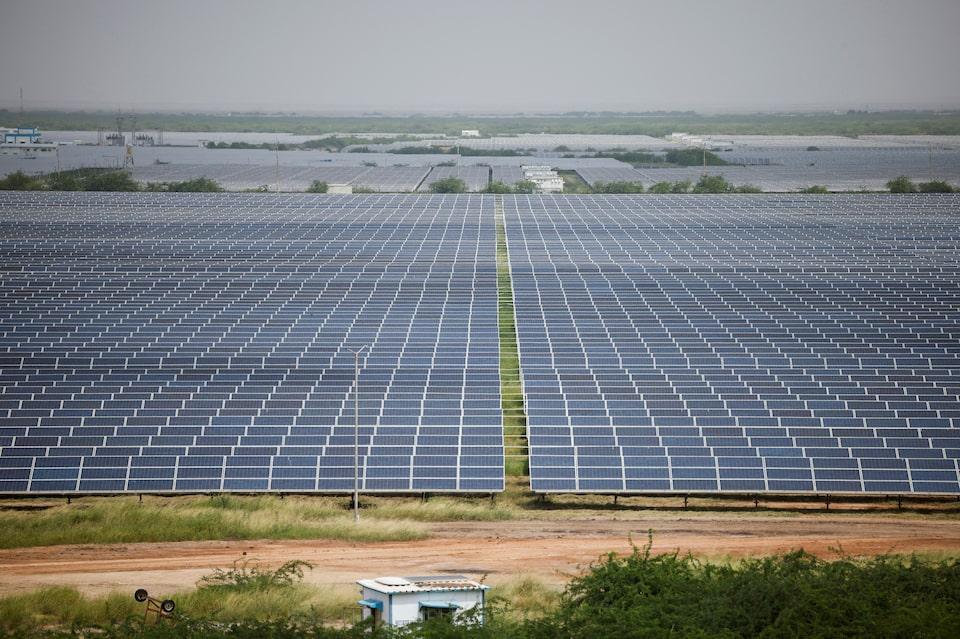
LITTLETON, Colorado, June 10 (Reuters) - Surging electricity output from solar farms has led to a rare decline in fossil fuel power production in India so far in 2025, and is setting the stage for a potential drop in annual coal-fired power output in the world's second-largest coal consumer. A record 32.4% jump in solar generation during January to April from the year before has helped utilities to lift overall electricity supplies while keeping coal-fired generation flat and cutting natural gas-fired output by 27%, Ember data shows. Sign up here. With January through April typically marking the peak in India's annual coal generation, continued high solar power production through the coming months may allow utilities to cut full-year coal use in 2025 for the first time since 2020. SOLAR SHINES India's electricity generation from solar farms was a record 57.8 terawatt hours (TWh) during January to April, according to Ember. That total was nearly a third more than during the same months in 2024, and came on the back of a roughly 30% climb in installed solar generation capacity over the past year. Higher solar generation levels in turn lifted solar power's share of India's electricity generation mix to a record 10% during March and April, compared to an average of 7% for 2024. Overall clean power generation in India climbed by 23% during January to April from the same months last year, and helped clean power sources score a record 23.3% share of India's total electricity production so far this year. FOSSIL CUTS With supplies of clean electricity at record highs, India's utilities were able to trim generation from fossil fuel-fired power plants by around 0.5% so far in 2025 compared to January to April of 2024. That fossil use reduction is modest compared to the more than 20% annual expansion in clean power supplies. But given the rapid pace of energy demand growth in India, it is rare for utilities to post anything other than strong yearly expansions in fossil fuel power deployment. Indeed, the last time fossil fuel power production declined during January to April from the year before was in 2020, when India's economy was struck by COVID-19 lockdowns. Going forward, fossil fuels will remain the main pillar of India's power generation system, and will supply around 75% of the country's electricity. What's more, coal will remain by far the dominant single power source in the country. However, with clean power supplies growing at an average pace of around 10% a year since 2020, India's overall electricity generation system will continue to get incrementally cleaner. And as clean power supply growth can often exceed overall electricity demand growth, power producers may have scope to cut back on fossil output during periods of softer power demand. SEASONAL PEAKS & TROUGHS One of those softer demand periods may lie ahead, as India's utilities have cut fossil fuel production during the May through August period from the levels of the opening four months of the year in five of the past six years. A key driver of this fossil fuel downturn is the seasonal swell in hydro power production from May onwards, due to India's monsoon rains which replenish the country's dams and reservoirs. Between 2019 and 2024, the higher mid-year precipitation levels resulted in a more than doubling in monthly hydro electricity supplies between May and August. Forecasts for the 2025 monsoon are calling for above-average rains, with rain totals expected to be around 6% above the long-term average. On top of that, utilities can expect additional clean power supplies from solar farms over the summer, which continue to expand in generation capacity every month. That combination of higher hydro output alongside record solar generation could entice India's utilities to make further curbs to coal generation over the coming months, and set the stage for a rare year-over-year reduction in overall coal use. The opinions expressed here are those of the author, a columnist for Reuters. Enjoying this column? Check out Reuters Open Interest (ROI), your essential new source for global financial commentary. ROI delivers thought-provoking, data-driven analysis of everything from swap rates to soybeans. Markets are moving faster than ever. ROI can help you keep up. Follow ROI on LinkedIn , opens new tab and X , opens new tab. https://www.reuters.com/markets/commodities/indias-solar-boom-keeps-coal-use-check-so-far-2025-maguire-2025-06-10/
2025-06-10 06:04
Wall Street stocks post modest gains Investors await details from US-China trade talks Dollar steadies; oil dips World Bank slashes global growth forecast BOSTON/LONDON, June 10 (Reuters) - Global stocks and the dollar were positive but muted on Tuesday as trade talks between the United States and China continued through a second day, giving investors some reason to believe tensions between the world's two largest economies may be easing. U.S. Commerce Secretary Howard Lutnick said discussions between the two sides in London were going "really well" but may run into Wednesday. Sign up here. Any progress in the negotiations is likely to provide relief to markets given Trump's often-shifting tariff announcements and swings in Sino-U.S. ties have undermined the two economies, disrupted supply chains and threatened to hobble global growth. The World Bank on Tuesday slashed its global growth forecast for 2025 by 0.4 percentage points to 2.3%, saying that higher tariffs and heightened uncertainty posed a significant headwind for nearly all economies. On Wall Street, the Dow Jones Industrial Average (.DJI) , opens new tab rose 0.25%, while the S&P 500 (.SPX) , opens new tab and the Nasdaq Composite (.IXIC) , opens new tab both added about 0.6%. Shares of Wall Street's most valuable companies were mixed. Tesla TSLA.O , opens new tab added more than 5%, while Microsoft MSFT.O , opens new tab slipped 0.4%. Alphabet rallied 1.4% after Reuters OpenAI plans to add Alphabet's Google cloud service to meet its growing needs for computing capacity. World stocks, as reflected by the MSCI All-Country World index (.MIWD00000PUS) , opens new tab, traded near record highs, up 0.4%, while the dollar steadied against a range of currencies. "While market participants are clearly taking a glass half-full view of the outlook, both on trade policy and more broadly, we don't think that should be interpreted as a view that tariffs will be fully unwound," said Jonas Goltermann, deputy chief markets economist at Capital Economics. Goltermann anticipates U.S. duties on Chinese goods to settle at around 40%, while most analysts have said the universal 10% levy on imports into the United States is here to stay. In Europe, the STOXX 600 (.STOXX) , opens new tab was little changed, constrained by UBS (UBSG.S) , opens new tab, whose shares dropped nearly 5% as investors worried about the impact of new government proposals to force the Swiss bank to hold $26 billion in extra capital. In Tokyo, Finance Minister Katsunobu Kato said policymakers were looking at measures to promote domestic ownership of Japanese government bonds, a day after Reuters reported that Japan is considering buying back some super-long government bonds issued in the past at low interest rates. Japanese government 30-year yields were virtually flat at 2.92%, having retreated from late May's record high of 3.18%. The yen fell about 0.2% to 144.9 versus the dollar, while the euro was little changed at $1.142. The pound dropped about 0.3% to $1.35 after weak UK employment data. QUALITY NOT SIZE Trump's fluid trade policies and worries over Washington's growing debt pile have dented investor confidence in U.S. assets, in turn undermining the dollar, which has already fallen more than 8% this year . "It's not that the Americans are blowing up their fiscal situation because the deficit is going to remain more or less stable. But the quality of the deficit has degenerated," Samy Chaar, an economist at Lombard Odier, said. "If you invest, and spend on productive investments, you'll get macro payoffs, because you're going to develop an industry, you're going to strengthen your economy, you're going to create jobs, you have a payoff. If you spend by basically reducing revenues because you cut taxes on people who don't need the money, they won't be consuming more, or investing more, so the macro payoff is more limited," he said. U.S. Treasuries were little changed, with the 10-year yielding around 4.47%, down 1 basis points on the day. U.S. Treasury auctions of notes and bonds this week are even more in focus than usual as tests of market sentiment on U.S. assets. Data on U.S. consumer inflation for May due out on Wednesday could show the impact of tariffs on goods prices. The producer price index report will be released a day later. "May's U.S. CPI and PPI data will be scrutinised for signs of lingering inflationary pressures," said Convera's FX and macro strategist Kevin Ford. "If core CPI remains elevated, expectations for rate cuts could be pushed beyond the June 18 FOMC meeting." Traders expect the Federal Reserve to leave rates unchanged at its policy meeting next week. Just 44 bps worth of easing have been priced in by December . In commodity markets, oil prices held near a seven-week high on Tuesday as the market awaited direction from trade talks between the U.S. and China. Brent crude futures LCOc1 , opens new tab slid 17 cents, or 0.3%, to settle at $66.87 a barrel, while U.S. West Texas Intermediate crude CLc1 , opens new tab fell 31 cents, or 0.5%, to settle at $64.98. Spot gold dipped 0.03% to $3,326 an ounce. https://www.reuters.com/world/china/global-markets-wrapup-1-2025-06-10/
2025-06-10 05:26
US-China trade talks extend into second day US CPI data due on Wednesday Gold's uptick lacks bullish conviction, analyst says June 10 (Reuters) - Gold prices edged higher on Tuesday, while investors awaited more clarity on U.S.-China trade talks and looked forward to key U.S. inflation data due this week for clues on the Federal Reserve's future interest rate decisions. Spot gold was up 0.3% at $3,336.33 an ounce, as of 1224 GMT, after falling to a low of $3,301.54 earlier in the session. U.S. gold futures were up 0.1% at $3,357.20. Sign up here. "Gold found some floor amid dip-buying, though the uptick lacked bullish conviction. Fiscal concerns and Fed rate cut bets are the catalyst for a recovery in the prices," said Jigar Trivedi, senior commodity analyst at Reliance Securities. Top officials from the world's two largest economies sought to defuse a bitter dispute that has widened from tariffs to restrictions over rare earths, with trade talks extending to a second day in London. The U.S. and China imposed reciprocal tariffs in April, which ignited trade war concerns. But last month, both countries agreed to a temporary pause in tariffs against each other, offering some relief to financial markets. Investors now await the Consumer Price Index data on Wednesday to analyse the Fed's policy path. The CPI report will be one of the last key pieces of data before the Fed's June 17-18 meeting, where it is widely expected to hold rates. Spot silver was steady at $36.72 per ounce, hovering near a more than 13-year high. Platinum eased 0.1% to $1,218.85, after hitting its highest level since May 2021. Palladium lost 1.4% to $1,059.02. "Overall, the lack of excitement for recent macro data has allowed silver and platinum to steel the limelight, both trading sharply higher in recent sessions before some emerging signs of profit-taking in today's session so far," said Ole Hansen, head of commodity strategy at Saxo Bank. https://www.reuters.com/world/china/gold-falls-traders-watch-us-china-trade-talks-london-2025-06-10/
2025-06-10 05:24
MUMBAI, June 10 (Reuters) - The Indian rupee was marginally higher in early trading on Monday, sidestepping modest declines in most regional currencies on the back of dollar-selling interest from foreign and state-run banks, traders said. On the day, the rupee was last quoted at 85.55, up marginally from its close of 85.62 in the previous session. Sign up here. Asian currencies were mostly rangebound as well, with traders awaiting the outcome of the ongoing U.S.-China trade talks in London. U.S. President Donald Trump on Monday put a positive spin on the talks, saying they were going well and he was "only getting good reports" from his team of officials. Trade talks between Indian and U.S. officials are also ongoing, with both sides seeking consensus on tariff cuts in the farming and auto sectors. The two countries aim to finalise an interim deal before the July 9 deadline. For the local economy, the Reserve Bank of India is "likely to play a key role in delivering policy support, with fiscal policy more focused on capex execution," BofA Global research said in a note. The rupee's range-bound price action over the last one month, meanwhile, has cooled its volatility expectations across tenors. The 1-month implied volatility eased to about 4.7%, and the 1-year gauge dipped to about 4.6%. The gauges had spiked sharply in early May as a conflict between India and Pakistan flared up, but have since cooled as the rupee settled into an 85-86 range over the past month. "As markets await the outcome of the U.S.-China trade talks, the rupee has gone into a shell within the broad range of 85-86, with daily inflows and outflows deciding the movement on either side," said Anil Bhansali, head of treasury at Finrex Treasury Advisors. https://www.reuters.com/world/india/rupee-treads-water-with-asian-peers-volatility-curve-shifts-lower-2025-06-10/
2025-06-10 05:07
LAUNCESTON, Australia, June 10 (Reuters) - Asian countries aren't rushing to buy U.S. energy commodities, even though lifting imports of crude oil, liquefied natural gas and coal will help meet President Donald Trump's demand for lower trade surpluses. While rare earths may be the immediate talking point in the current talks between the Trump administration and China, the real action behind any deal will be in the big three energy commodities. Sign up here. The same is true for other Asian economies seeking to curry favour with Trump and get a better deal than the hefty tariffs imposed on many in his so-called "Liberation Day" measures announced on April 2, and subsequently paused for 90 days. But in the four full months since Trump returned to the White House, Asia's imports of U.S. energy commodities have actually fallen from the same period last year. Imports of crude oil from February to May declined to 1.53 million barrels per day (bpd) from 1.55 million bpd in the same period in 2024, according to data from commodity analysts Kpler. Asia's imports of U.S. LNG were 4.78 million metric tons in the February to May period, down 40% from the 8.04 million tons in the same four months last year. Arrivals of all grades of coal were 13.79 million tons in the four-month period, down from 14.19 million tons from February to May last year. What these numbers show is that Asia, the world's top commodity importing region, isn't increasing its purchases of U.S. commodities. What the numbers don't show is that within the broader picture there are some dynamics at work that show that some Asian countries may be in the early stages of trying to ramp up imports of U.S. energy. India is buying more from the United States, with Kpler estimating imports of 253,000 bpd of crude oil in the four months from February to May, up from 175,000 bpd over the same period last year. June crude arrivals are forecast by Kpler to be 439,000 bpd, which would be the second-highest monthly total on record. While U.S. oil is still less than 10% of India's total imports, the fact that it is rising in what is a competitive market for pricing may indicate a desire to do more trade with the United States. India has also been buying more U.S. coal, with Kpler data showing imports of 3.1 million tons in May, the highest on record. India's imports of U.S. coal were 8.82 million tons in the four months from February to May, up 12% from the 7.85 million tons for the same period last year. Similar to crude, U.S. coal is a small percentage of India's total coal imports, but the rising imports are worth noting given U.S. coal has a more costly freight component than its competitors from Indonesia, Australia and South Africa. JAPAN, SOUTH KOREA Outside of India, other Asian coal importers haven't been increasing shipments from the United States, with second-biggest buyer Japan importing 1.75 million tons in the February to May period, down from 2.15 million tons for the same months in 2024. Japan has also been buying less U.S. LNG, with only 1.04 million tons arriving from February to May, down from 1.75 million tons for the same period in 2024. The drop in shipments of U.S. LNG to Asia is most likely price-related as higher spot prices have seen cargoes move to Europe, which is using LNG to refill natural gas storages depleted during the northern winter. The loss of China as a market for U.S. LNG amid the ongoing tariff war has also hurt U.S. volumes to Asia, with Kpler showing no cargoes arrived in the world's biggest buyer of the super-chilled fuel in March, April and May. China's imports of U.S. coal have also dropped to almost zero, with only one cargo of around 35,000 tons arriving in May, according to Kpler, while no crude was imported in May. Outside of India, the only other major importer in Asia that has increased its purchases of U.S. energy is South Korea, with imports of crude rising to the second-highest on record in May at 593,000 bpd. South Korea has also lifted its imports of U.S. LNG in recent months, with May's 560,000 tons the highest since October last year, with Kpler forecasting another increase in June to 570,000 tons. However, the overall picture is that Asia's commodity importers are largely holding back on increasing imports of U.S. energy. It may be the case that they are still planning on using imports as leverage in talks with the Trump administration, or it may also be the case that the delivered prices of U.S. crude, coal and LNG are not competitive. But for now buying more U.S. energy in order to lower trade surpluses is not yet a thing in Asia. Enjoying this column? Check out Reuters Open Interest (ROI), your essential new source for global financial commentary. ROI delivers thought-provoking, data-driven analysis of everything from swap rates to soybeans. Markets are moving faster than ever. ROI can help you keep up. Follow ROI on LinkedIn , opens new tab and X , opens new tab. The views expressed here are those of the author, a columnist for Reuters. https://www.reuters.com/markets/commodities/no-rush-us-energy-asias-imports-slip-under-trump-russell-2025-06-10/

2025-06-10 04:59
Rare earths, chips deal in focus on trade talks Sterling weakens after soft labor market data US inflation due on Wednesday, focus on tariff impact Yen steady as Ueda suggests BoJ may stay on pause NEW YORK, June 10 (Reuters) - The dollar gained on Tuesday, helped by comments from U.S. officials that trade negotiations between Beijing and Washington were going well, although there was no clear consensus of a deal as the talks continued for a second day. U.S. Commerce Secretary Howard Lutnick repeated President Donald Trump's upbeat tone on the trade discussions with top Chinese economic officials, but provided no details. Sign up here. Sterling, on the other hand, slid against the greenback as British jobs data pointed to a weaker labor market. Officials from the world's two largest economies were meeting in London to try to defuse a dispute that has widened from tariffs to restrictions over rare earths. Marc Chandler, chief market strategist at Bannockburn Forex in New York, said it was not only tariffs at stake in these negotiations but also export controls, and "that's going to be the basis for the quid pro quo." Chandler said there are the makings of a deal: U.S. semiconductor chips for China's magnets and rare earths. But what should be noted, he said, is the asymmetry. "China can replace the chips that the U.S. exports easier than we can replace their magnets and processed earths." Trump and his Chinese counterpart Xi Jinping spoke by phone last week at a crucial time for both economies as signs of strain emerged from the former's cascade of tariff orders since January. "Should the talks actually produce a substantial deal, traders would deem that to be very good news, and risk-reducing," wrote Thierry Wizman, global FX and rates strategist at Macquarie in New York. "But we would expect that the U.S. would rally, in keeping with the recent pattern of seeing the U.S. dollar act as a risk currency. However, we would also expect that rally to be short-lived." In afternoon trading, the dollar was up 0.2% against the yen at 144.92 yen , having lost about 8.5% against the Japanese currency this year. The yen has been supported overall by safe-haven flows during the market tumult unleashed by Trump's tariffs. The Bank of Japan is also expected to maintain borrowing costs at current levels at next week's policy meeting. Its governor, Kazuo Ueda, suggested on Tuesday that the timing of the next interest rate hike could be pushed back. Risks to Japan's export-heavy economy from Trump's tariffs have pushed back market bets on the timing of the next rate hike, and investors are on the lookout for clues from Ueda on how soon rate increases could resume. British wages rose by a slower-than-forecast 5.2% in the three months to April, pushing sterling down 0.4% against the dollar to $1.3496. The BoE is due to meet next week and is expected to keep the interest rate unchanged. Money market traders are pricing in about 48 basis points of cuts by year-end, up from about 39 bps before the data. The dollar index , which measures the U.S. currency against six others, edged higher to 99.087. It is down more than 8% this year as investors, worried about the impact of tariffs and trade tensions on the U.S. economy and growth, sold some U.S. assets and looked for alternatives. The euro, on the other hand, was flat at $1.1420 , while the Australian dollar , often seen as a proxy for risk sentiment, was also little changed at US$0.6519. Investor focus this week will be on the U.S. consumer price index report for May due on Wednesday. The report could give insight into the impact of tariffs, with investors wary of any flare-ups in inflation ahead of the Federal Reserve's policy meeting next week. The U.S. central bank is also expected to hold rates steady next week, with traders pricing in nearly two 25 basis-point cuts by the end of the year. https://www.reuters.com/world/china/dollar-steady-traders-await-details-us-china-talks-2025-06-10/