2025-06-09 06:31
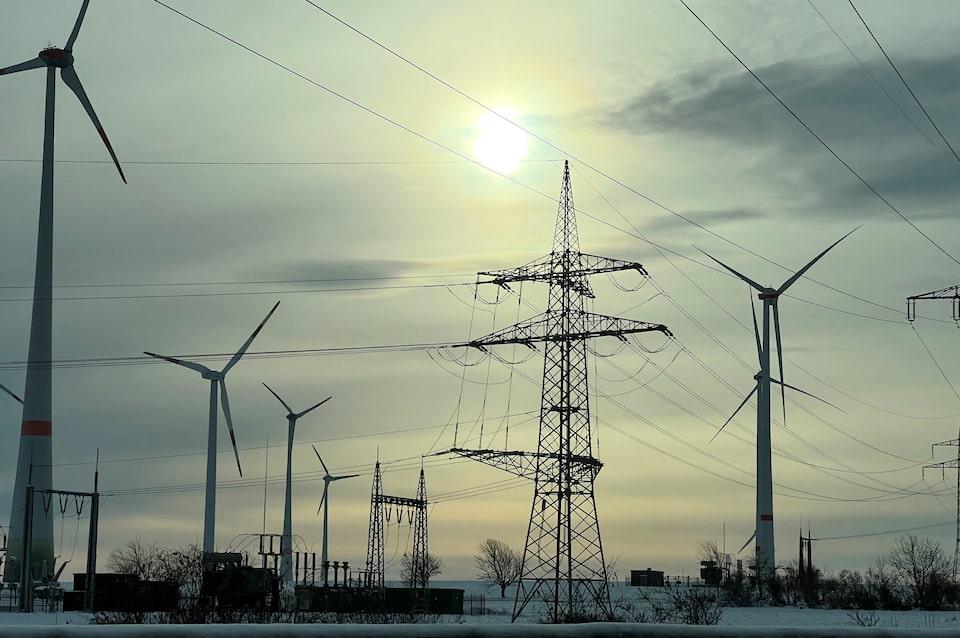
EU share of renewables in power generation rose to 47% in 2024 EU requires $1.4 trillion in grid investment by 2040, report says Ratio of investments in renewables and grids has dropped in recent years, IEA says LONDON, June 9 - Europe's ambition to develop cheap, clean energy has recently received a harsh reality check, as power failures and a string of cancelled renewables projects made it clear that the road to inexpensive power will carry a very high price tag. European investments in renewable energy have risen sharply over the past decade as governments have begun implementing policies to reduce greenhouse gas emissions – an effort that sped up after Russia's invasion of Ukraine created an energy price shock. Sign up here. The share of renewables in the EU's power sector rose to 47% in 2024 from 34% in 2019, with a record 168 gigawatts (GW) of solar and 44 GW of wind power capacities installed between 2022 and 2024 alone, according to EU data. In Britain, renewable generation exceeded 50% for the first time in 2024, data showed. But investment in grid infrastructure, including pylons, cables, transformers and battery storage technology, has barely kept up with the rapid change in the power generation mix. Between 40% and 55% of low-voltage lines will exceed the age of 40 by 2030, while their length increased only by 0.8% between 2021 and 2022, according to a European Commission report. The Commission last week issued guidance for developing electricity networks in which it estimated the bloc will require 730 billion euro of investments in power distribution and another 477 billion euro in transmission grid developments by 2040. The underinvestment in grid infrastructure has created strain in many systems, a risk that was laid bare on April 28, with the catastrophic blackout in the Iberian Peninsula. Regulators are still investigating exactly what triggered the collapse of the power systems in Spain and Portugal. But what is known for sure is that the outage was preceded by the disconnection of two solar farms in southern Spain. The Spanish system is heavily reliant on renewables, but the issue was not the energy source itself. Rather, the problem was that the grid system had not been updated to account for the fact that solar-powered plants, unlike those using fossil fuels, do not generate inertia – the kinetic energy created by the rotation of spinning generators – which can help stabilize a grid in the event of power disturbances. To overcome this challenge, operators would need to invest in technologies such as synchronous condensers or batteries that kick in within milliseconds in the event of an outage to offer backup. The Iberian debacle puts a spotlight on the fact that more investment is needed in the mundane, but vital, elements of grid infrastructure. BAD ECONOMICS Another reality check for Europe has been the realization that offshore wind – once heralded as a potential renewables game changer – simply has lousy economics today. Danish offshore wind giant Orsted on May 7 cancelled a major project off the eastern coast of Britain, Hornsey 4, dealing a blow to the country's ambitions to develop 50 GW of clean power capacity by 2050. The recent rise in material costs forced the cancellation, according to Orsted, which had already sunk 5.5 billion Danish crowns ($840.5 million) into the project. And then on May 16, the Dutch government postponed tenders for two offshore wind farms with a total capacity of 2 GW due to a lack of interest from potential bidders. Several companies said they saw no viable business case for the projects, which offered developers no government subsidies. These two cases suggest that capital-intensive projects like offshore wind simply won't make economic sense without more ambitious government policy initiatives. SHORT-TERM THINKING The challenge is not unique to Europe. While worldwide investment in clean technology has risen, the headline figures mask a less rosy picture. The International Energy Agency (IEA) said in a report published on June 5 that global investment in power grids reached a record $390 billion in 2024 and is set to surpass $400 billion in 2025, 20% higher than a decade ago. But spending on power grid upgrades has not kept up. In 2016, about 60 cents were invested in grids for every dollar spent on new generation capacity. That ratio has dropped to less than 40 cents as the costs of renewables has declined, according to the IEA. This imbalance is unsustainable as ageing Western power systems – especially those in Europe – will increasingly experience problems unless trillions are spent in grid upgrades. The investment shortfall partly reflects a fundamental time horizon mismatch. Governments face public pressure every time energy bills – or taxes – rise, so they will struggle to convey to voters the long-term benefits of spending billions in tax dollars to support building modern, low-carbon power systems. But energy companies and utilities seeking to invest in renewables and grids will need long-term policy certainty, and given the challenging economics for many renewables projects, they will often also require generous subsidies. To be sure, the long-term costs of inaction to mitigate climate change will be far higher, and the EU is already spending over 100 billion euros annually on fossil fuels subsidies. But long-term thinking is not an easy sell for politicians in a time of growing populism, nationalism and polarization. Ultimately, if European governments want their populations to have cheap, green energy, they will need to accept the reality that getting there will be more expensive and more government-driven than previously advertised. Enjoying this column? Check out Reuters Open Interest (ROI) , opens new tab, your essential new source for global financial commentary. ROI delivers thought-provoking, data-driven analysis. Markets are moving faster than ever. ROI , opens new tab can help you keep up. Follow ROI on LinkedIn , opens new tab and X. , opens new tab https://www.reuters.com/business/energy/path-cheap-power-will-be-very-expensive-2025-06-09/
2025-06-09 06:20
SINGAPORE/HONG KONG, June 9 (Reuters) - U.S. President Donald Trump's erratic policies are rattling a currency peg that has withstood the test of time and is seen as an anchor for China and Asia. The Hong Kong dollar has whipsawed from one end of its narrow trading band to the other versus the greenback in just a month. Sign up here. While the latest volatility is not seen as a threat to the four-decade-old peg, the it has had a dramatic impact on interest rates, providing a challenging environment for businesses and investors in the financial hub. The stress on one of the world's best-known currency pegs underscores how volatility in the U.S. dollar under Trump is disrupting even the most stable corners of the market. Interest rates in Hong Kong have tended to move in lockstep with the United States, keeping the Hong Kong dollar - which trades between 7.75 and 7.85 per U.S. dollar - relatively stable. But they have decoupled over the past month as global investors cooled on U.S. assets and fretted about Washington's growing debt pile, while massive capital entered Hong Kong as foreigners flocked to blockbuster share offerings. Chinese investors have also ploughed record amounts of money into Hong Kong-listed stocks. "The pace and speed of inflow was quite surprising," said Raymond Yeung, ANZ's chief economist for Greater China. The volatility forced the Hong Kong Monetary Authority (HKMA), the city's de-facto central bank, to intervene in the foreign exchange market four times in May as the Hong Kong dollar bumped up against the strong end of its trading band. That caused borrowing costs in Hong Kong to plunge to record lows, tempting speculators to short-sell the currency and drive it swiftly to 7.85, the weak end of the band. As Hong Kong rates fell, the gap between U.S. three-month rates and the benchmark in Hong Kong hit a record high last week, based on LSEG data stretching back to 2020. Spreads across other tenors similarly widened. Analysts say it is normal to see an occasional deviation in rates between the Hong Kong dollar and U.S. dollar, but the abrupt moves seen in recent weeks are worrisome for businesses and investors - especially given disruptions to global trade and other uncertainty. "If the gap closes abruptly, then firms and households and the financial system in Hong Kong might suffer from a large interest rate shock, which is not good for financial stability," ANZ's Yeung said. Hong Kong officials have sought to reassure markets that the peg is here to stay, and that despite the increased volatility, there are some benefits to the current low level of rates. The city's leader John Lee told SCMP in an interview published on Monday that the city will maintain its currency's peg to the dollar. HKMA chief Eddie Yue noted the impact of lower interest rates on individuals and corporates would vary, depending on their relative positions in bank deposits and borrowings. "However, looking at it through a macroeconomic lens, lower interest rates should be beneficial to the current economic environment of Hong Kong," he said in a blog post. Lower mortgage rates seem to have helped the economy's flagging property market, with home prices edging up in April to end four months of decline. The government too has used the opportunity to access cheaper borrowing for longer. It issued 30-year bonds, its longest tenor debt, for the first time last month. "It's a good time for Hong Kong to lock in the low funding," said Lei Zhu, head of Asian fixed income at Fidelity International. https://www.reuters.com/business/finance/when-pegs-fly-trump-induced-turbulence-hits-hong-kong-dollar-interest-rates-2025-06-09/
2025-06-09 05:57
US, China in trade talks in London Last week's better than expected US jobs report provides relief Japan tariff negotiator to visit US late this week, report says China's May exports slow, deflation deepens as tariffs bite NEW YORK, June 9 (Reuters) - The U.S. dollar weakened against most major currencies on Monday, moving in narrow ranges, as market participants consolidated gains racked up following Friday's better-than-expected U.S. employment report and shifted their focus to pivotal U.S.-China trade talks in London. The meeting of top officials from both countries intends to address disagreements around a preliminary pact struck last month in Geneva, briefly cooling tensions between the world's two largest economies. Negotiations could last up to two days. Sign up here. The talks come at a crucial time for both sides, with China grappling with deflation and trade uncertainty dampening sentiment among U.S. businesses and consumers, prompting investors to reassess the dollar's safe-haven status. Customs data showed China's export growth slowed to a three-month low in May as U.S. tariffs slammed shipments, while factory-gate deflation saw its worst level in two years. China's exports to the U.S. plunged 34.5% year-on-year in May value terms, the sharpest drop since February 2020, when the outbreak of the COVID-19 pandemic upended global trade. In afternoon trading, the dollar was down about 0.2% against the Japanese currency at 144.55 yen after two consecutive weeks of gains. Japan is considering buying back some super-long government bonds issued in the past at low interest rates, two sources with direct knowledge of the plan said on Monday, underscoring its focus on reining in any abrupt rises in bond yields. "The dollar is retreating and momentum is fading...putting downward pressure on trading ranges and measures of implied volatility," said Karl Schamotta, chief market strategist, at Corpay in Toronto. "Investors believe that positive headlines emanating from the U.S.-China trade talks are largely priced in across the major currency pairs, Wednesday's inflation numbers are expected to come in soft, and even Thursday's 30-year Treasury auction is seen meeting with solid investor demand." The euro , meanwhile, rose 0.3% versus the greenback to $1.1427, as markets continued to price in the European Central Bank's monetary policy outlook issued last week, which indicated it may be close to ending its easing cycle. Sterling also gained versus the greenback, adding 0.3% to $1.362. "The situation is looking more like (in) the second half of the year, the Fed will need to get dovish and help the financial environment," said Juan Perez, director of trading at Monex USA in Washington. "Ultimately, if the U.S. is going to be struggling, there is no clear reason to have any long-term faith in the dollar." The dollar index, a gauge of the greenback's value against six major currencies, dipped 0.2% to 98.942 . Elsewhere, China's offshore yuan was last at 7.18 per dollar, little changed on the day. New Zealand's dollar rose 0.6% to US$0.6054, while the Australian dollar was last up 0.4% at US$0.6522 in light volumes. Also on the trade front was a report that said Japan's chief trade negotiator Ryosei Akazawa is planning a sixth round of talks in Washington. Later in the week, an inflation report out of the U.S. for May will be the focus, as investors and Federal Reserve policymakers look for the impact of trade restrictive policies on the economy. "With the labor market looking resilient but not overheated, it should help keep services inflation within a reasonable range," wrote BeiChen Lin, senior investment strategist at Russell Investments in emailed comments. "For now, medium-term inflation expectations still look well-anchored. So even if there is a near-term boost to prices from trade policy, as long as the Fed believes these effects to be non-persistent, we could still see rate cuts this year." Fed officials have signalled that they are in no rush to cut interest rates and signs of economic resilience will likely cement their stance. Interest rate futures showed that investors are anticipating that the U.S. central bank may cut borrowing costs by 25 basis points (bps) later this year, with the earliest likely in October, according to data compiled by LSEG calculations . Rate futures have priced in just 47 bps of cuts in 2025. https://www.reuters.com/world/china/dollar-steadies-after-rally-focus-shifts-us-china-trade-talks-2025-06-09/
2025-06-09 05:56
US and China set for trade talks in London US dollar down 0.2% against a basket of peers Platinum hits four-year high June 9 (Reuters) - Gold prices rose on Monday, supported by a weaker U.S. dollar ahead of U.S.-China trade talks aimed at resolving tensions, while platinum extended gains for a sixth straight session to scale a four-year peak. Spot gold rose 0.3% to $3,317.97 an ounce, as of 1124 GMT, after dropping earlier in the session to $3,293.29, its lowest level since June 2. Sign up here. U.S. gold futures fell 0.2% to $3,338.70. The dollar (.DXY) , opens new tab fell 0.2% against a basket of peers, making bullion cheaper for holders of other currencies. Investors recognise that drivers of gold, including trade and geopolitical tensions, debt concerns and weak economic growth, remain in place and should continue to support the metal in the months ahead, said Giovanni Staunovo, an analyst at UBS. U.S. and Chinese officials will sit down in London on Monday for talks aimed at defusing the trade dispute between the two superpowers. Stronger-than-expected U.S. non-farm payrolls data have led investors to scale back expectations for Federal Reserve rate cuts this year from two to one in October. Market attention will turn to U.S. CPI data, due on Wednesday, for further clues on the Fed's monetary policy path. Gold, considered a safe-haven asset during political and economic uncertainty, tends to thrive in a low-rate environment. Meanwhile, China's central bank added gold to its reserves in May for the seventh straight month, official data showed. Spot platinum rose 2.7% to $1,200.95, its highest level since May 2021. "It (platinum's rally) is supported by a combination of tight supply expectations, improving industrial sentiment, and technical follow-through from the broader precious metals rally," said Alexander Zumpfe, a precious metals trader at Heraeus Metals Germany. Spot silver was up 0.9% to $36.27 per ounce, while palladium rose 2.5% to $1,072.96. https://www.reuters.com/world/china/gold-drops-us-china-trade-deal-hopes-ease-safe-haven-demand-2025-06-09/

2025-06-09 05:43
US-China talks aim to ease trade tensions Dollar slips amid caution around trade talks S&P 500, Nasdaq close higher, Dow ends flat NEW YORK, June 9 (Reuters) - Global stocks climbed on Monday while the dollar retreated as talks began in London between the United States and China, aimed at cooling a trade dispute between the world's two largest economies. The dispute has expanded beyond tit-for-tat tariffs to restrictions over rare earths, threatening to cripple supply chains and slow global growth. Sign up here. U.S. President Donald Trump said his administration was doing well and that he was getting good reports as U.S. officials hold the talks with China in London. “The market deems any dialogue with Beijing as progress, whether or not it leads to tangible results. The market is just going to take the administration's word for it, until proven otherwise,” said Jake Dollarhide, CEO of Longbow Asset Management in Tulsa, Oklahoma. On Wall Street, the S&P and Nasdaq closed higher, with the Dow ending flat as declines in Travelers (TRV.N) , opens new tab and McDonald's (MCD.N) , opens new tab, the latter of which was downgraded by Morgan Stanley to an "equal-weight" rating, curbed gains. The Dow Jones Industrial Average (.DJI) , opens new tab fell 1.11 points, or flat, to 42,761.76, the S&P 500 (.SPX) , opens new tab rose 5.52 points, or 0.09%, to 6,005.88 and the Nasdaq Composite (.IXIC) , opens new tab rose 61.28 points, or 0.31%, to 19,591.24. Small-cap stocks outperformed, with the S&P 600 (.SPCY) , opens new tab index up 0.9%. MSCI's gauge of stocks across the globe (.MIWD00000PUS) , opens new tab advanced 1.94 points, or 0.22%, to 893.90 and was on track for its second straight session of gains. It has risen in five of the last six sessions. In Europe, the pan-European STOXX 600 (.STOXX) , opens new tab index closed down 0.07% to snap a four-session winning streak, its longest run of consecutive gains in three weeks. The U.S. dollar slipped against most major currencies, as optimism over a better-than-expected U.S. employment report on Friday was offset by caution ahead of the trade talks. U.S. Treasury Secretary Scott Bessent, Commerce Secretary Howard Lutnick and Trade Representative Jamieson Greer are representing Washington in the talks in London, Trump said in a social media post. China's foreign ministry said Vice Premier He Lifeng was in Britain for the first meeting of the China-U.S. economic and trade consultation mechanism. U.S. economic data showed wholesale inventories increased in April amid stockpiling of prescription medication in anticipation of tariffs from the Trump administration. Investors are also awaiting U.S. inflation data on Wednesday that may adjust expectations for the timing of any rate cuts by the Federal Reserve. Analysts at Morgan Stanley said they see May as the starting point for a string of increasingly strong core inflation prints, with the push from tariffs peaking in the third quarter and beginning to fade in the fourth quarter. The market does not see the Fed likely to cut before its September meeting, currently pricing in a 62% chance for a cut of at least 25 basis points, according to LSEG data. Fed officials are in a blackout period ahead of the June 18 policy decision. The dollar index , which measures the greenback against a basket of currencies, lost 0.14% to 98.97, with the euro up 0.25% at $1.1423. Longer-dated U.S. Treasury yields were lower at the start of the week, reversing after Friday's jobs report pushed yields higher. The yield on benchmark U.S. 10-year notes declined 2.8 basis points to 4.482%. Investors will monitor auctions of three-, 10- and 30-year U.S. notes and bonds this week for signs of investor demand. U.S. crude settled up 1.1% to $65.29 a barrel and Brent settled at $67.04 per barrel, up 0.86% on the day on hopes a trade deal could spur the global economic outlook along with a softer dollar. https://www.reuters.com/world/china/global-markets-wrapup-1-2025-06-09/
2025-06-09 05:40
MUMBAI, June 9 (Reuters) - The Indian rupee was nearly unchanged on Monday, tracking muted moves in Asian currencies, while dollar-rupee forward premiums eased after stronger-than-expected U.S. labour market data dented hopes of rate cuts by the Federal Reserve. The rupee was at 85.6175 against the U.S. dollar as of 11:00 a.m. IST, little changed from its close at 85.6250 in the previous session. Sign up here. The dollar index was hovering just shy of the 99 handle after rising nearly 0.5% on Friday, boosted by upbeat U.S. jobs data which gave investors some relief following bleak U.S. economic data last week. "The most likely near-term catalyst for USD upside lies in the ongoing U.S. data resilience or even a reacceleration, even if temporary," BofA Global Research said a note. The jobs data also pegged back hopes of Fed rate cuts, with interest rate futures now pricing in 60% odds of a reduction in or before September, compared to nearly 75% before the report was released, according to the CME Group's FedWatch Tool. The scaling back of expectations pushed up near-tenor U.S. bond yields, weighing on dollar-rupee forward premiums, with the 1-year implied yield declining to 1.78%, its lowest level since July 2024. Meanwhile, the BSE Sensex (.BSESN) , opens new tab and Nifty 50 (.NSEI) , opens new tab - India's benchmark equity indexes - rose 0.5% each on the day, tracking gains in regional equities. The focus on Monday will be on talks aimed at mending a trade rift between the United States and China. The discussions are expected to focus on critical minerals, whose production is dominated by China. In April, China had decided to suspend exports of a wide range of rare earths and related magnets. The curbs have upended supply chains crucial to automakers, aerospace manufacturers, semiconductor companies and military contractors. https://www.reuters.com/world/india/rupee-nearly-flat-tracking-subdued-asia-fx-forward-premiums-retreat-2025-06-09/