2025-06-03 06:50
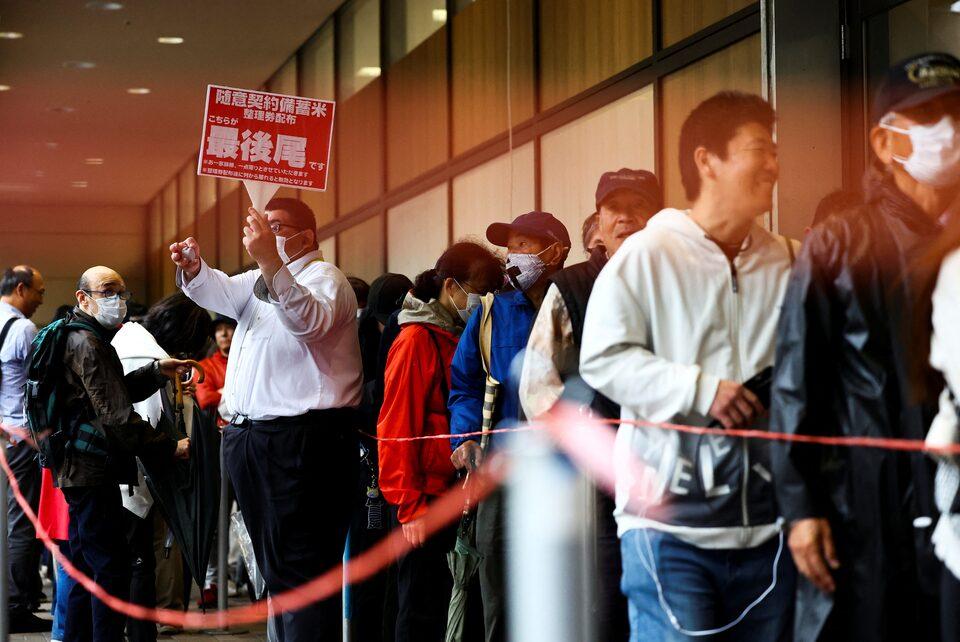
Queues form at retailers for limited bags of cheap rice Private rice imports skyrocket despite tariffs Farm minister worried about surging rice imports Government may buy back previously released stockpiled rice TOKYO, June 3 (Reuters) - Japan's farm minister said on Tuesday the government stood ready to offer more stockpiled rice as consumers formed long queues to snatch up cheap, emergency-use grain made available through some retailers since the weekend. In an abrupt change of policy, the government last week began selling stockpiled rice directly to retailers, aiming to get a 5 kg bag to consumers for around 2,000 yen ($14) - less than half of average prices. Sign up here. Those products started hitting some store shelves at the weekend, when hundreds of people waited in line for hours at retailers such as Ito-Yokado and Aeon (8267.T) , opens new tab despite being allowed just one bag per household. The doubling in rice prices since last year, partly due to extreme heat impacting production, has become a major concern for voters and policymakers ahead of two key elections - for the Tokyo metropolitan assembly on June 22 and parliament's upper house in July. "I never thought the price of stockpiled rice would fall this low," said 75-year-old Kazumi Uchida as she waited in line at an Ito-Yokado store in Tokyo on a rainy Saturday. "I'm almost out of rice and was shifting to eat more bread and noodles." Average supermarket prices fell for the first time in three weeks in the seven days to May 25, but only by 25 yen to average 4,260 yen/5 kg, showing limited impact from the release of stockpiled rice under the previous auction system involving several layers of wholesalers. Farm Minister Shinjiro Koizumi, who scrapped that system upon taking his post on May 21, said the government could also consider buying back rice from wholesalers that had participated in those auctions since March, potentially bringing more of the staple grain to market at lower prices. He repeated that the government stood ready to release all of its stockpile if necessary. "If we let rice prices remain high, (store) shelves will be filled with imported rice," he said. It remains to be seen how the artificially cheap stockpiled rice would affect the price of single-origin "brand" rice and other products. Rice production is expected to rise for the 2025 harvest year. As homegrown rice prices soared, demand for cheaper, foreign-made rice has also surged, even after the hefty levy Japan imposes to protect producers of its staple rice, beyond the tariff-free "minimum access" quota. Private rice imports, while still tiny, quadrupled in the first 11 months of fiscal 2024 to just under 1,500 metric tons. Japan's fiscal year runs from April to March. Official data for the past few months is not yet available, but the Japan Agricultural News reported that private imports surged to more than 6,800 tons in April alone. ($1 = 143.2100 yen) https://www.reuters.com/markets/commodities/japanese-consumers-scramble-grab-cheap-rice-government-ready-release-more-2025-06-03/
2025-06-03 06:36
June 3 (Reuters) - Deutsche Bank has raised its year-end target for the S&P 500 (.SPX) , opens new tab to 6,550 from 6,150, citing lower tariff-related earnings drag and a resilient economy, in a move that comes amid a broader wave of target upgrades by major Wall Street brokerages. This follows similar moves by Goldman Sachs and UBS Global Wealth Management, which raised their forecasts in May, with RBC Capital Markets joining the trend on Monday. Sign up here. "We now see the tariff drag at only about one-third of what we previously penciled in," Deutsche Bank strategists led by Binky Chadha wrote in a note on Monday. The new target is 10.35% above the S&P 500 index's last close of 5,935.94. The S&P 500 posted its strongest monthly gain since November 2023 in May, boosted by U.S. President Donald Trump's softer stance on tariffs, strong corporate earnings, and tame inflation data that helped markets recover from April's decline. Still, the European brokerage warned that the rally could be volatile, with potential pullbacks driven by renewed trade tensions. "We expect the rally to be punctuated by sharp pullbacks on repeated cycles of escalation and de-escalation on trade policy", the brokerage said. Deutsche also increased the estimate for the index's earnings per share to $267 from $240. https://www.reuters.com/business/finance/deutsche-bank-lifts-sp-500-year-end-target-amid-wall-street-upgrade-wave-2025-06-03/

2025-06-03 06:36
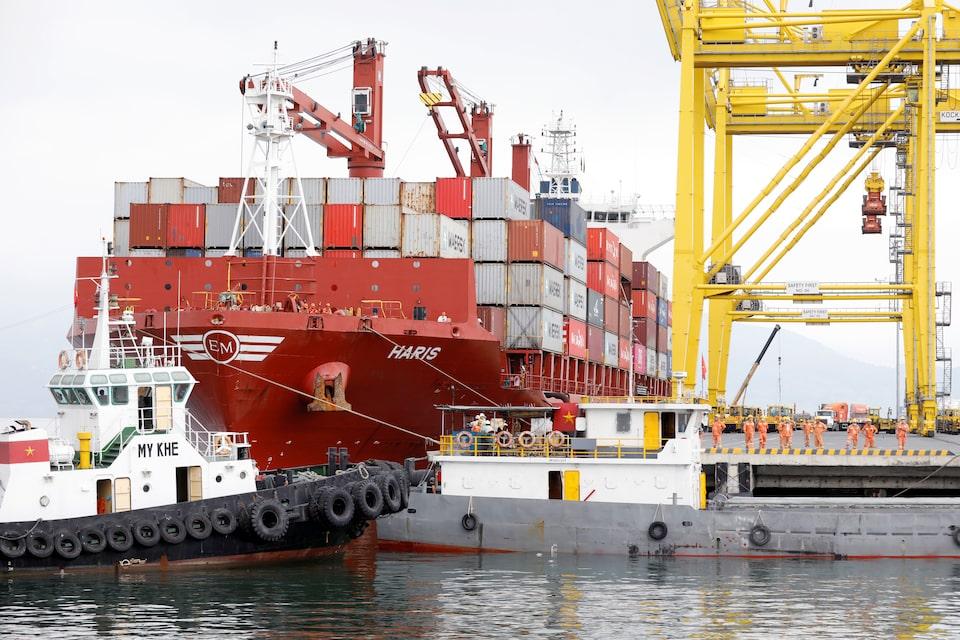
HANOI, June 3 (Reuters) - Vietnamese firms will sign memorandums of understanding with U.S. partners to buy $2 billion worth of American farm produce, the agriculture ministry said on Tuesday, part of efforts to seal a new trade deal between the two countries. Vietnam has been slapped with 46% "reciprocal" tariffs by the Trump administration. Though they have been paused until July, if they come into effect they could seriously undermine a growth model that relies on exports to the United States, its top market. Sign up here. The new deals, signed during a visit to the United States by a delegation of 50 Vietnamese companies led by agriculture minister Do Duc Duy, include 5 MoUs to buy $800 million of products from Iowa over three years, the agriculture ministry said. The Iowa MoUs involve purchases of corn, wheat, dried distillers grains and soybean meal, it added. Vietnam and the Trump administration have been holding negotiations on a trade agreement, with Vietnam pledging to allow more U.S. imports to narrow the trade gap between the two countries. The United States registered a trade deficit of $123 billion with Vietnam last year. Vietnam last year bought $3.4 billion worth of U.S. farm produce, and exported $13.68 billion of its own agricultural products to the United States, Vietnam News Agency reported. Vietnam has also pledged to buy other American products, including Boeing planes and liquefied natural gas. It has also promised to crack down on counterfeits and digital piracy after the U.S. accused the country of being a major hub for these illegal activities. https://www.reuters.com/world/asia-pacific/vietnam-firms-sign-mous-buy-2-bln-us-farm-produce-2025-06-03/
2025-06-03 06:32
June 3 (Reuters) - Japanese equity funds logged their largest weekly outflows in nearly 18 years in the week to May 28, as investors either booked profits following a rally fueled by the then-easing U.S.-China trade tensions or turned cautious on earnings potential. According to LSEG Lipper data, Japanese equity funds recorded net outflows of $7.49 billion, marking the largest weekly withdrawal since July 4, 2007. Sign up here. Daisuke Motori, director of manager research at Morningstar Japan, said the outflows from Japanese equity funds in May reflected a familiar pattern, with investors buying during April's dip and selling into the May rebound. Some of the flows could also be due to rebalancing by Japan's massive life insurance and pension firms as they sell rising stocks and buy bonds to maintain asset ratios, analysts said. Another headwind has been the yen, which has appreciated 10% against the U.S. dollar so far this year, potentially eroding export profitability. LSEG data shows analysts have downgraded forward 12-month earnings estimates for Japanese firms by 1.8% over the past 30 days. "Corporate governance is improving, but we think this is unlikely to be a near-term catalyst," said Herald van der Linde, head of equity strategy at Asia Pacific. He noted that while reforms were underway, their impact on profits would take time - return on equity (ROE) in Japan still lagged other major markets. Domestic investors drove almost the entirety of outflows, Lipper data showed, with $7.55 billion pulled from local funds. In contrast, foreign funds recorded $59 million in net inflows. The Daiwa iFreeETF TOPIX (1305.T) , opens new tab, Nikko Listed Index Fund TOPIX (1308.T) , opens new tab, and Nomura NF TOPIX ETF (1306.T) , opens new tab recorded the largest outflows during the week, with redemptions of $2 billion, $1.92 billion, and $1.61 billion, respectively. https://www.reuters.com/business/japanese-equity-funds-log-sharpest-weekly-outflows-since-2007-2025-06-03/

2025-06-03 06:19
US pushes countries for best trade offers by Wednesday Trump and Xi will likely speak this week, White House says OECD trims global outlook as Trump trade war hits US growth June 3 (Reuters) - Gold pulled back on Tuesday after nearing a four-week high earlier in the session, as a rebound in the dollar and profit-taking added pressure, while investors remained cautious amid ever-changing U.S. trade policies. Spot gold fell 0.7% to $3,356.75 an ounce as of 1125 GMT, after hitting its highest since May 8 earlier in the session. U.S. gold futures eased 0.5% to $3,381.30. Sign up here. The dollar (.DXY) , opens new tab rose from an over-a-month low hit earlier in the session, making gold costlier for foreign buyers. "Today, the dollar trades a tad stronger ahead of key US economic data and these developments are the main reason why we are seeing some light profit following yesterday’s strong gain," said Ole Hansen, head of commodity strategy at Saxo Bank. Investors will be closely watching a likely call this week between U.S. President Donald Trump and Chinese leader Xi Jinping, just days after Trump accused China of breaching an agreement to reduce tariffs and trade restrictions. The European Commission said on Monday it would push the U.S. to reduce or eliminate tariffs, despite Trump's plan to double steel and aluminium duties to 50%. Meanwhile, the Trump administration is urging countries to submit their best trade offers by Wednesday, aiming to accelerate talks ahead of a five-week deadline, according to a draft letter seen by Reuters. The OECD said on Tuesday the global economy was on course to slow from 3.3% last year to 2.9% in 2025 and 2026, trimming March estimates for growth of 3.1% this year and 3.0% next year. Investors' focus this week will also be on U.S. non-farm payrolls due on Friday and speeches from a slew of Federal Reserve policymakers for clues on the interest rate trajectory. Zero-yielding bullion tends to do well in a low-interest rate environment. Spot silver fell 1.5% to $34.26 an ounce, platinum lost 0.6% to $1,056.70, while palladium was up 0.5% at $993.63. https://www.reuters.com/world/india/gold-retreats-near-four-week-peak-dollar-ticks-up-2025-06-03/

2025-06-03 06:17
LITTLETON, Colorado, June 3 (Reuters) - Eastern Europe is often overlooked in discussions about solar power generation in Europe, where the likes of Germany and Spain dominate the growth in deployed solar electricity production. But solar capacity across the nine largest solar producers in Eastern Europe has grown at over twice the pace of Europe as a whole over the past five years, and has helped Eastern Europe double its share of regional solar production since 2019. Sign up here. At least six Eastern European nations will generate over 20% of their total monthly utility-supplied electricity from solar farms this summer, when regional solar radiation levels hit their annual peak. In many of these countries, the rapid solar growth is displacing or curtailing output from coal and natural gas power plants, and is leading to a steeper fall in power sector emissions in Eastern Europe than across the overall continent. Continued growth in solar capacity is expected across Eastern Europe over the medium term as nations there try to curb reliance on imported fossil fuels. This in turn should further elevate the area's importance in driving Europe's broader energy transition momentum. REGIONAL LEADERS Nine nations across Eastern Europe are driving the region's solar expansion, according to data from energy think tank Ember. In descending order of embedded utility-scale solar capacity at the end of 2024, those nations are: Poland (20.2 gigawatts of capacity); Hungary (7.7 GW); Romania (4.7 GW); Czech Republic (4.2 GW); Bulgaria (4 GW); Lithuania (2.6 GW); Estonia (1.3 GW); Slovakia (1 GW) and Latvia (0.5 GW). Combined solar capacity of those countries was roughly 46 GW at the end of 2024, or roughly 13% of Europe's total 361 GW of solar capacity, data from think tank Ember shows. That collective solar capacity footprint compares to just 9 GW in the same countries in 2019, and so represents a more than 450% jump in utility solar capacity in those countries in just the past five years. Over the same period, solar capacity across Europe as a whole increased by a more modest 145%, and included an 89% rise in German solar capacity and a 246% climb in solar capacity in Spain. OUTPUT IMPACT The volume of utility-scale electricity production from solar farms has surged across Eastern Europe in response to the higher capacity footprint. In 2019, total solar electricity output across the nine top solar producers in Eastern Europe was around 9 terawatt hours, but was nearly 42 TWh in 2024. That nearly fivefold rise in Eastern European solar output contrasted with just over a doubling in solar output for Europe as a whole over the same period, from around 153 TWh to 361 TWh in 2024. The share of solar power within Eastern Europe's combined electricity generation mix has also sharply climbed since 2019, and exceeds the solar share of electricity production within Europe overall. Solar accounted for just 2% of Eastern Europe's electricity supplies in 2019, but topped 10% for the first time in 2024. For Europe as a whole, solar accounted for a 7% share in 2024, up from a 3% share in 2019. GROWTH MARKETS Several Eastern European nations generated over 20% of total monthly electricity supplies from solar farms during the peak summer months of 2024, and are primed to generate even larger solar shares this summer following further capacity growth. Lithuania, Hungary and Estonia all generated more than a third of their total monthly utility-supplied electricity from solar farms during June through August in 2024, Ember data shows. Bulgaria, Latvia and Poland generated 20% or more of their electricity from solar farms. This summer, following the build-out of further capacity across all of Europe, solar's share of the generation mix looks set to swell further - especially in Poland where installed capacity has grown by more than 25% since early 2024. This expanded solar footprint will not only help push Poland's total solar electricity output to a new record this year, but will also serve to further reduce the country's overall power emissions. Coal remains Poland's primary power source, but a near doubling in clean electricity output since 2019 - largely due to a nearly 2,000% rise in solar generation - has helped the country's utilities cut coal power output by 26% in that period. Lower coal-fired generation has in turn cut Poland's power sector emissions from fossil fuel use by 23% or by 22 million metric tons of CO2 since 2019. As Poland is Eastern Europe's largest polluter, the drop in the country's discharge has helped lower regional pollution, too, by 26% since 2019 to 163 million tons of CO2 in 2024. This year, thanks to further increases in solar generation and additional cuts to coal power production, overall emissions across Eastern Europe could fall further and play a key role in advancing Europe-wide energy transition efforts. The opinions expressed here are those of the author, a columnist for Reuters. https://www.reuters.com/markets/commodities/eastern-europes-stealthy-surge-solar-generation-maguire-2025-06-03/