2025-05-29 00:46
U.S. appeals court reinstate tariffs Wall Street stocks finish higher Dollar loses ground against safe havens Oil prices settle lower, gold rises NEW YORK, May 29 (Reuters) - Global stocks rose while the U.S. dollar weakened on Thursday as markets digested an ongoing court battle over President Donald Trump's so-called "Liberation Day" tariffs. The U.S. Court of International Trade issued a ruling late on Wednesday that Trump overstepped his authority by imposing across-the-board duties on imports from trading partners. Sign up here. The decision triggered a court battle that would likely weigh on markets, after the Trump administration swiftly appealed the ruling and an appeals court temporarily reinstated the tariffs. On Wall Street, all three indexes finished higher after losing ground in the previous session, indicating that markets largely view the decision in a positive light. Nvidia (.NVDA.O) , opens new tab ended up 3% after reporting earnings that beat expectations after markets closed on Wednesday. The Dow Jones Industrial Average (.DJI) , opens new tab rose 0.28% to 42,215.73, the S&P 500 (.SPX) , opens new tab rose 0.40% to 5,912.17 and the Nasdaq Composite (.IXIC) , opens new tab rose 0.39% to 19,175.87 Europe's STOXX 600 index (.STOXX) , opens new tab finished down 0.19%, after rising earlier in the session. MSCI's broadest index of Asia-Pacific shares outside Japan (.MIAPJ0000PUS) , opens new tab had closed up 0.77% overnight. MSCI's gauge of stocks across the globe (.MIWD00000PUS) , opens new tab rose 0.44% to 880.26. "I think markets are just going to continue to be caught in this pinball machine of court decisions, executive orders and judicial reviews," said Mark Spindel, chief investment officer at Potomac River Capital in Washington. "This is what happens when you don't follow a more sticky legislative process when developing policy. The result of using executive orders is that you're at the mercy of a court that is ruling on, circumscribing, or endorsing those orders. Markets are caught in the middle of all this, and the result is chaos and uncertainty.” The U.S. dollar had initially risen against safe-haven currencies following news of the federal court decision late on Wednesday, but it has since pared those gains and was down on the session. Data showed that labor market conditions continue to ease, as the number of Americans seeking unemployment benefits increased more than expected last week. The dollar weakened 0.48% to 144.13 against the Japanese yen and was down 0.51% to 0.823 against the Swiss franc . The euro was up 0.64% at $1.1364. The dollar index , which measures the greenback against a basket of currencies including the yen and the euro, fell 1.03% to 99.36. U.S. Treasury yields, which have been under pressure with investors unnerved by Trump's hefty tax and spend bill, initially rose on Thursday but retreated. The yield on benchmark U.S. 10-year notes fell 4.7 basis points to 4.432%. The 30-year bond yield fell 5.2 basis points to 4.9264%. Oil prices fell, retreating from earlier gains, with markets eyeing possible U.S. sanctions on Russian crude flows. Brent crude futures settled down 1.2% to $64.15 a barrel. U.S. West Texas Intermediate crude fell 1.5% to $60.94 a barrel. Gold prices rose in volatile trading partly aided by the softer jobs data. Spot gold rose 0.8% to $3,315.73 an ounce. U.S. gold futures were settled 0.6% higher at $3,343.90. https://www.reuters.com/world/china/global-markets-wrapup-1-2025-05-29/

2025-05-29 00:38
Tariff concerns weigh on US currency Jobless claims rise in latest week Fiscal issues remain in focus as Congress works on tax and spending bill NEW YORK, May 29 (Reuters) - The dollar fell on Thursday as investors prepared for U.S. President Donald Trump to battle a U.S. trade court ruling on Wednesday that blocked most of his proposed tariffs. A federal appeals court late on Thursday, however, reinstated Trump's levies on imports. The order from the United States Court of Appeals for the Federal Circuit in Washington provided no opinion or reasoning but directed the plaintiffs in the case to respond by June 5 and the administration by June 9. Sign up here. The greenback showed little reaction to the news. Senior Trump administration officials earlier downplayed the ruling's impact, expressing confidence it would be overturned on appeal and insisting other legal avenues are available in the interim. "Markets were quick to realize that the ruling was sort of narrow, meaning it was only focused on one aspect of the tariff plan here - emergency authorization," said Brad Bechtel, global head of FX at Jefferies in New York. "There were still plenty of other avenues for Trump." The dollar had rallied on the ruling. The U.S. currency has weakened on concerns that tariffs will slow the economy and reignite inflation, while the erratic implementation of Trump's policies is seen as denting the appeal of U.S. assets to foreign investors. "The deeper issue remains a persistent lack of clarity surrounding trade policy," said Uto Shinohara, senior investment strategist at Mesirow Currency Management in Chicago. The Federal Reserve has kept interest rates on hold on concerns about higher inflation as Fed officials wait to see how the trade policies will affect the U.S. economy. Trump, in a private meeting at the White House on Thursday, told Fed Chair Jerome Powell he was making a "mistake" by not lowering interest rates. "This is not likely to be the end of tariff policy, and in some respects, if the administration wins its appeal or opts for alternative legal paths to tariff implementation, they could aim for the tariff agenda as a whole to be more entrenched than it was previously," Goldman Sachs' forex analysts said in a report on Thursday. U.S. economic pessimism declined earlier this week after Trump on the weekend delayed a plan to impose 50% tariffs on European Union imports. The euro was last up 0.73% at $1.1374 after falling to $1.1209, the lowest since May 19. Against the Japanese yen , the dollar weakened 0.57% to 143.99. It earlier reached 146.28, the highest since May 15. The dollar fell 0.59% to 0.822 Swiss franc . The greenback also weakened on news that the number of Americans filing new applications for jobless benefits rose more than expected last week, and the unemployment rate appeared to have picked up in May, suggesting increasing layoffs as tariffs cloud the economic outlook. Investors are also watching the progress of a tax cut and spending bill that is working its way through the U.S. Congress and which is expected to add trillions in U.S. debt over the coming decade. Some Republicans have criticized it for not having enough spending cuts. Trump's budget chief said on Wednesday the White House intends to send Congress a package next week to formalize cuts made by billionaire Elon Musk's team targeting federal government spending. Longer-dated U.S. Treasury yields rose last week and demand for the Treasury's 20-year bond auction was soft due to rising concerns about the deteriorating U.S. fiscal outlook. The yen also weakened against the dollar earlier this week on reports that Japan will consider trimming issuance of super-long bonds in the wake of recent sharp yield increases in the country. https://www.reuters.com/world/africa/dollar-rallies-after-us-court-blocks-trumps-tariffs-2025-05-29/
2025-05-28 23:55
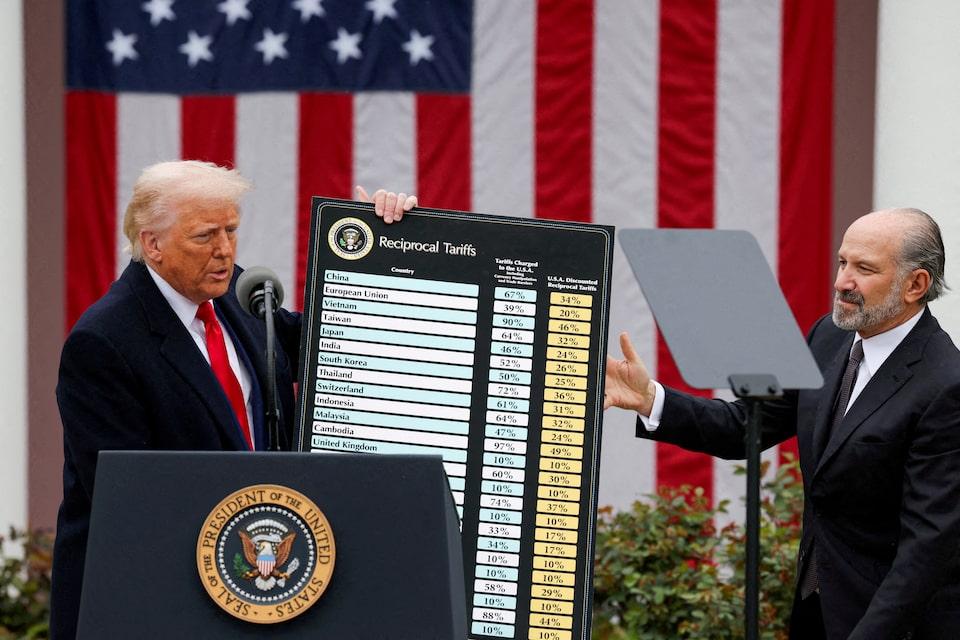
Court cites that Constitution grants Congress power to regulate international commerce Markets cheer ruling, dollar and global stocks rally Trump administration files notice of appeal, questions authority of the court Tariffs on autos, steel and aluminum remain in place NEW YORK, May 28 (Reuters) - A U.S. trade court blocked most of President Donald Trump's tariffs in a sweeping ruling on Wednesday that found the president overstepped his authority by imposing across-the-board duties on imports from U.S. trading partners. The Court of International Trade said the U.S. Constitution gives Congress exclusive authority to regulate commerce with other countries that is not overridden by the president's emergency powers to safeguard the U.S. economy. Sign up here. "The court does not pass upon the wisdom or likely effectiveness of the President's use of tariffs as leverage," a three-judge panel said in the decision to issue a permanent injunction on the blanket tariff orders issued by Trump since January. "That use is impermissible not because it is unwise or ineffective, but because [federal law] does not allow it." Financial markets cheered the ruling. The U.S. dollar rallied following the court's order, surging against currencies such as the euro, yen and the Swiss franc in particular. Wall Street futures rose and equities across Asia also jumped. The judges also ordered the Trump administration to issue new orders reflecting the permanent injunction within 10 days. The Trump administration minutes later filed a notice of appeal and questioned the authority of the court. The court invalidated with immediate effect all of Trump's orders on tariffs since January that were rooted in the International Emergency Economic Powers Act (IEEPA), a law meant to address "unusual and extraordinary" threats during a national emergency. The court was not asked to address some industry-specific tariffs Trump has issued on automobiles, steel and aluminum, using a different statute. The decisions of the Manhattan-based Court of International Trade, which hears disputes involving international trade and customs laws, can be appealed to the U.S. Court of Appeals for the Federal Circuit in Washington, D.C., and ultimately the U.S. Supreme Court. TRADE TURMOIL Trump has made charging U.S. importers tariffs on goods from foreign countries the central policy of his ongoing trade wars, which have severely disrupted global trade flows and roiled financial markets. Companies of all sizes have been whipsawed by Trump's swift imposition of tariffs and sudden reversals as they seek to manage supply chains, production, staffing and prices. A White House spokesperson on Wednesday said U.S. trade deficits with other countries constituted "a national emergency that has decimated American communities, left our workers behind, and weakened our defense industrial base – facts that the court did not dispute." "It is not for unelected judges to decide how to properly address a national emergency," Kush Desai, the spokesperson, said in a statement. The ruling, if it stands, blows a giant hole through Trump's strategy to use steep tariffs to wring concessions from trading partners. It creates deep uncertainty around multiple simultaneous negotiations with the European Union, China and many other countries. However, analysts at Goldman Sachs noted the order does not block sector-specific levies and there were other legal avenues for Trump to impose across-the-board and country-specific tariffs. "This ruling represents a setback for the administration's tariff plans and increases uncertainty but might not change the final outcome for most major U.S. trading partners," analyst Alec Phillips wrote in a note. Trump has promised Americans the tariffs would draw manufacturing jobs back to U.S. shores and shrink a $1.2 trillion U.S. goods trade deficit, which were among his central campaign promises. Without the instant leverage provided by tariffs, the Trump administration would have to find new forms of leverage or take a slower approach to negotiations with trading partners. Initial reaction among Asian policymakers was muted, with Japan's economy minister saying he would examine the details of the ruling, while the Bank of Korea said it saw the effective tariff rate on South Korean exports under the ruling falling to 9.7% from 13.3%. Hong Kong's financial secretary said the court decision would "at least bring President Trump to reason". BUSINESSES HURTING The ruling came in a pair of lawsuits, one filed by the nonpartisan Liberty Justice Center on behalf of five small U.S. businesses that import goods from countries targeted by the duties and the other by 12 U.S. states. The companies, which range from a New York wine and spirits importer to a Virginia-based maker of educational kits and musical instruments, have said the tariffs will hurt their ability to do business. "There is no question here of narrowly tailored relief; if the challenged Tariff Orders are unlawful as to Plaintiffs they are unlawful as to all," the judges wrote in their decision. At least five other legal challenges to the tariffs are pending. Oregon Attorney General Dan Rayfield, a Democrat whose office is leading the states' lawsuit, called Trump's tariffs unlawful, reckless and economically devastating. "This ruling reaffirms that our laws matter, and that trade decisions can’t be made on the president’s whim," Rayfield said in a statement. Trump has claimed broad authority to set tariffs under IEEPA. The law has historically been used to impose sanctions on enemies of the U.S. or freeze their assets. Trump is the first U.S. president to use it to impose tariffs. The Justice Department has said the lawsuits should be dismissed because the plaintiffs have not been harmed by tariffs that they have not yet paid, and because only Congress, not private businesses, can challenge a national emergency declared by the president under IEEPA. In imposing the tariffs in early April, Trump called the trade deficit a national emergency that justified his 10% across-the-board tariff on all imports, with higher rates for countries with which the United States has the largest trade deficits, particularly China. The country-specific tariff rates were paused for 90 days a week later though the baseline 10% duty was put in place for most nations. The Trump administration on May 12 said it was also temporarily reducing the steepest tariffs on China while working on a longer-term trade deal. Both countries agreed to cut tariffs on each other for at least 90 days. https://www.reuters.com/world/us/us-court-blocks-trumps-liberation-day-tariffs-2025-05-28/
2025-05-28 23:48
May 28 (Reuters) - The Trump administration has canceled a contract awarded to Moderna (MRNA.O) , opens new tab for the late-stage development of its bird flu vaccine for humans, as well as the right to purchase shots, the drugmaker announced on Wednesday. Shares of Moderna were flat in after-market trading. Sign up here. Moderna in January was awarded $590 million by the Biden administration to advance the development of its bird flu vaccine, and support the expansion of clinical studies for up to five additional subtypes of pandemic influenza This was in addition to $176 million awarded by the U.S. Department of Health and Human Services (HHS) last year to complete the late-stage development and testing of a pre-pandemic mRNA-based vaccine against the H5N1 avian influenza. HHS told Reuters earlier this year that it was reviewing agreements made by the Biden administration for vaccine production. "The cancellation means that the government is discarding what could be one of the most effective and rapid tools to combat an avian influenza outbreak," said Amesh Adalja, senior scholar at the Johns Hopkins Center for Health Security, adding that it is the opposite approach Trump took with Operation Warp Speed to combat COVID-19. An HHS spokesperson said that after a comprehensive internal review, the agency had determined that the project did not meet the scientific standards or safety expectations required for continued federal investment. Bird flu has infected 70 people, most of them farm workers, over the past year as it has spread aggressively among cattle herds and poultry flocks. Health Secretary Robert F. Kennedy Jr. has questioned the use of vaccines and earlier this year drew censure from some in the U.S. Congress after he suggested in a television interview that poultry farmers should let the bird flu spread unchecked through their flocks to study chickens who did not contract it. Moderna said it plans to explore alternatives for late-stage development and manufacturing of the vaccine. The company has been banking on revenue from newer mRNA shots, including its bird flu vaccine and experimental COVID-flu combination vaccine, to make up for waning post-pandemic demand for its COVID vaccine. Moderna also said on Wednesday that it had received positive interim data from a mid-stage trial set up to test the safety and immunogenicity of its bird flu vaccine targeting the H5 avian influenza virus subtype. https://www.reuters.com/business/healthcare-pharmaceuticals/us-cancels-more-700-million-funding-moderna-bird-flu-vaccine-2025-05-28/

2025-05-28 23:45
NAPERVILLE, Illinois, May 28 (Reuters) - The U.S. corn crop has gotten off to a somewhat disappointing start in what is supposed to be a record producing season. Meanwhile, U.S. spring wheat is experiencing its second-worst start to the growing season in history after this year’s plantings dropped to a 55-year low. Sign up here. What might these early figures mean for the growing season overall? How do they compare with past years? And where are the problem spots and near-term prospects for improvement? SHORT OF EXPECTATIONS The U.S. Department of Agriculture on Tuesday afternoon rated 68% of the U.S. corn crop in good-to-excellent (GE) condition in this season’s initial rating, marking the lowest starting health since 2019. That was well below analysts’ average estimate of 73% GE, though initial condition reports from the Crop Watch producers , opens new tab over the weekend averaged out to a six-year low, at least. A 68% GE is not all that bad. On average over the last three years, the initial U.S. corn score comes in around 72%. Additionally, the slower start may be explainable. The unanimous feedback from the Crop Watch producers was that it has been too cold, cloudy and rainy, and the plants are not growing quickly. Hail, frosts, wind, rain and even a period of excessive heat recently stressed crops in the western Corn Belt, which was reported by Crop Watchers. This showed up in USDA’s data on Tuesday. Averaging initial corn conditions by state over the past three years, North Dakota and Ohio stand out. North Dakota at 48% GE is 24 percentage points below average and Ohio’s 41% is 37 points below. Conditions in top producer Iowa are 4 percentage points ahead of normal, Illinois is 7 points behind, South Dakota is down 16 points, Nebraska is down 2 points and Minnesota is 4 points behind. OK OUTLOOK? Three factors may help ease any concerns about current U.S. corn crop health. The corn crop is only two-thirds emerged nationally, a lower-than-usual portion to coincide with the first condition scores. This allows for some play in the near-term figures, as newly emerged crops, if in good shape, could boost the overall score next week. Although not necessarily unusual, less than 40% of corn in Ohio and North Dakota was emerged as of Sunday, possibly allowing for future improvement. All Crop Watch producers last weekend expressed the dire need for heat and sun, and that should start arriving over the weekend after this week finishes out on the cooler, cloudy side. The pattern might not necessarily be long-lasting, but even a short, warm, sunny spell in early June can go a long way for early crop growth. U.S. corn was initially rated 65% GE in 2017, and calculations at the time pointed to near or below-trend yield probabilities. This caused the market to misjudge the crop potential all year, and the 2017 corn crop achieved a new record yield. The 2017 crop was rated 60% GE by the end of July, not too huge of a change from the initial. So even though 60% would not be considered stellar by itself, the lack of large rating swings that season may have been telling. WHEAT WOES U.S. spring wheat was rated 45% GE as of Sunday, tied with 2021 as the second-lowest initial rating over the 40-year history. The worst was 34% in 1988. Those two years are bad company, as they featured well-below-trend U.S. spring wheat yields as both seasons included drought. The 2025 crop is already starting in the hole as U.S. farmers intend to plant their smallest spring wheat area since 1970. Some 60% of U.S. spring wheat was emerged by Sunday, comparable to 66% on the same date in 2021. North Dakota, which produces half of the U.S. spring wheat crop, must remain on watch as only 37% of the wheat there is GE and 26% is considered poor or very poor. Recent cold and wet weather has battered the young wheat crop, so the coming flip to better weather may offer improvement opportunities. Market analysts had expected the initial spring wheat conditions to come in at 71% GE, so the result was much more shocking than the one for corn. But the lighter figures for both certainly set up the potential for market scares this summer if an unfavorable weather pattern were to set in. Karen Braun is a market analyst for Reuters. Views expressed above are her own. https://www.reuters.com/markets/commodities/what-make-surprisingly-low-us-crop-ratings-braun-2025-05-28/

2025-05-28 23:20
WASHINGTON, May 28 (Reuters) - The U.S. Federal Trade Commission said on Wednesday it will require two software companies —Synopsys (SNPS.O) , opens new tab and Ansys (ANSS.O) , opens new tab— to divest certain assets to resolve antitrust concerns surrounding their $35 billion merger. The proposed divestiture will preserve competition across several software tool markets that are critical for the design of semiconductors and light simulation devices, according to the commission. Sign up here. The FTC added that it will help protect consumers from higher input prices for cars, phones and other items. Synopsys is a leading developer and supplier used to design semiconductors, while Ansys provides simulation software tools used for testing products including semiconductors. During an earnings call earlier on Wednesday, Synopsys CEO Sassine Ghazi said the company has regulatory clearances in all jurisdictions excluding China. "We are working cooperatively and actively negotiating ... to secure China regulatory clearance and we continue to anticipate closing in the first half of this year," Ghazi said. https://www.reuters.com/sustainability/boards-policy-regulation/us-ftc-will-require-synopsys-ansys-divest-certain-assets-resolve-merger-concerns-2025-05-28/