2025-11-13 23:19
NEW YORK, Nov 13 (Reuters) - Morgan Stanley's (MS.N) , opens new tab underwriting of Zijin Gold International's (2259.HK) , opens new tab Hong Kong IPO placed it and its U.S. investors at risk of regulatory, financial and reputational harm, a U.S. House of Representatives committee told the bank on Thursday. Zijin Gold is a subsidiary of Zijin Mining Group (601899.SS) , opens new tab, a global mining company based in China that is on a U.S. government list of companies whose imports are banned over alleged human rights abuses involving Uyghurs. Sign up here. In September, Morgan Stanley assisted with Zijin Gold's IPO to help its parent company raise funds by selling its non-Chinese gold mining assets and listing them on the Hong Kong Stock Exchange, the House's select committee on China said. That raised questions of whether it helped Zijin Mining evade the U.S. prohibitions, according to the committee. Morgan Stanley declined to comment. Zijin Gold and Zijin Mining did not immediately respond to requests for comment. "When U.S. financial institutions engage with Chinese firms linked to Uyghur forced labor, they undermine the U.S. government's goal of deterring forced labor globally," Representative John Moolenaar, the committee's chair, wrote in a letter , opens new tab to Morgan Stanley CEO Ted Pick. In January, Zijin Mining was added to the Uyghur Forced Labor Prevention Act Entity List, which restricts imports tied to what the U.S. says is an ongoing genocide of minorities in China's western Xinjiang region. U.S. officials say Chinese authorities have established labor camps for Uyghurs and other Muslim minority groups in Xinjiang. Beijing denies any abuses. In the letter, Moolenaar seeks documents and communications about Morgan Stanley's involvement in the public offering related to the company's links to the Chinese government, Chinese Communist Party, military, and human rights abuses. He asked for the information by November 27. The letter is the latest action by his committee on U.S. financial institutions' involvement in underwriting IPOs of Chinese companies with ties to the Chinese military or to illegal labor practices. In July, the committee subpoenaed documents from JPMorgan (JPM.N) , opens new tab and Bank of America (BAC.N) , opens new tab over their roles in underwriting the Hong Kong IPO of China's CATL (300750.SZ) , opens new tab, the world's largest electric vehicle battery maker. CATL has been designated a Chinese military company by the U.S. Department of Defense. https://www.reuters.com/sustainability/society-equity/morgan-stanley-questioned-by-us-house-panel-over-zijin-gold-ipo-hong-kong-2025-11-13/

2025-11-13 23:15
WASHINGTON, Nov 13 (Reuters) - U.S. airlines have cut far fewer flights for Friday than the requirement that they cut 6% of domestic flights at the 40 busiest American airports, according to aviation analytics firm Cirium and airline officials. The Federal Aviation Administration late on Wednesday said it would freeze mandatory flight cuts at 6%, and would not hike cancellation requirements as previously announced. Cirium said that after cancelling around 3.5% of total flights on Wednesday and Thursday, airlines have canceled just 1.4% for Friday. Sign up here. Airlines could still add cancellations and the FAA could revise the order. United Airlines (UAL.O) , opens new tab said it had canceled 134 flights for Friday, or almost 3% of its flights, after cancelling 222 flights on Thursday. The FAA did not immediately comment. Other airlines told Reuters on condition of anonymity they were not planning to cut 6% of flights on Friday. Before the FAA revised its order, airlines had been expected to cancel 8% of domestic flights on Thursday and 10% of flights at the 40 busiest airports. The FAA on Wednesday opted to ease those cancellations after disruptions due to air traffic control absences declined dramatically in recent days just ahead of Congress giving final approval to a deal to reopen the government that was quickly signed into law by President Donald Trump. "The 6% hold will remain in place as the FAA continues to assess whether the system can gradually return to normal operations," the agency said on Wednesday. Airlines canceled 1,020 flights on Thursday under the FAA's 6% requirement, according to FlightAware, a flight-tracking website. Cirium said carriers by 4:20 p.m. ET had only canceled 371 flights for Friday. The FAA said on Thursday it was reporting staffing issues at Reagan Washington National and Newark airports, which were resulting in delays at both airports, but there were far fewer issues than before the government reopening. The FAA is about 3,500 air traffic controllers short of targeted staffing levels. Many had been working mandatory overtime and six-day weeks even before the shutdown led to them working without pay. Flight operations are improving, with just 3,000 delays on Thursday compared with 4,000 on Tuesday and nearly 10,000 on Monday, according to FlightAware. Air traffic absences have led to tens of thousands of flight cancellations and delays since October 1, when the 43-day shutdown began. https://www.reuters.com/business/us-airlines-reduce-flight-cuts-friday-despite-6-faa-order-2025-11-13/

2025-11-13 23:14
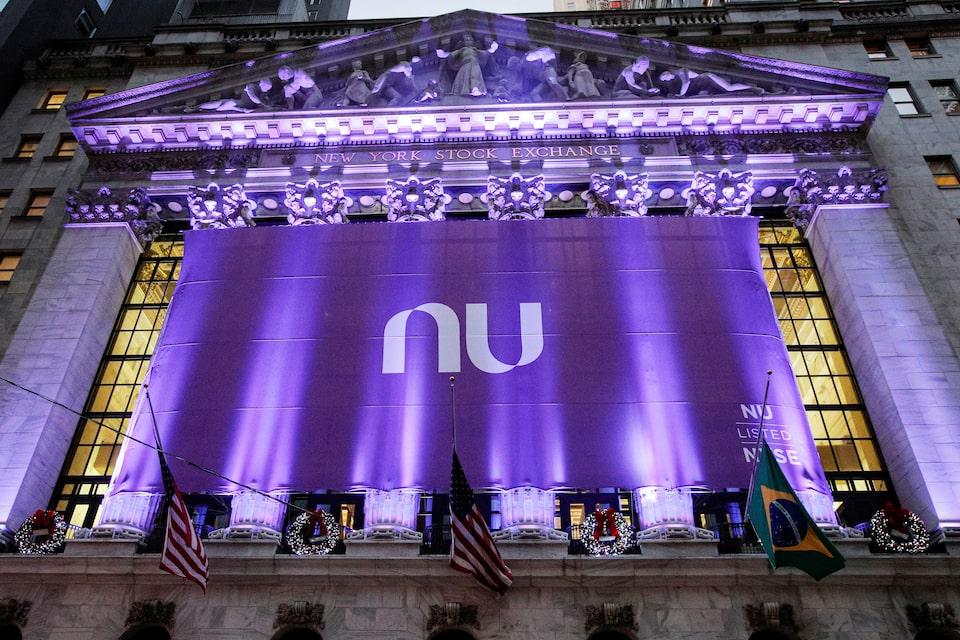
SAO PAULO, Nov 13 (Reuters) - Nu Holdings (NU.N) , opens new tab, the listed entity which runs Brazilian digital lender Nubank, posted on Thursday an increase in its third-quarter net income driven by its Brazilian and Mexican businesses, beating analysts' projections. The company reported a $783 million net income for the July-September period, up 39% year-on-year on a currency-neutral basis and above the $757 million expected by analysts in an LSEG poll. Sign up here. Shares of Nu Holdings rose about 3% in post-market trading right after the results. Chief Financial Officer Guilherme Lago told Reuters the profit increase was mainly supported by the continuous scale gain in Nubank's main market Brazil, while the company grew its credit portfolio in Mexico and cut what it pays for deposits in the country. "The combination of these two things, the operating leverage in Brazil, and the asset liability management in Mexico, led to a large boost to Nubank's consolidated results," Lago said. The firm's annualized return on equity (ROE), a gauge of profitability, stood at a record 31%, up from 30% in the same quarter last year. Nubank revenues rose 39% to $4.2 billion, above market estimates of $3.8 billion, with net interest income rising 32% year-over-year. On the other hand, the closely watched net interest margin contracted about one percentage point to 17.3%. Jefferies' analysts said Nubank posted a solid beat with no red flags in credit quality and with "management reiterating that delinquencies remain in line with expectations." The 15-to-90-day delinquency rate in Brazil came in at 4.2%, a 0.2 percentage point fall both yearly and quarterly. The over-90-day delinquency rate in the country stood at 6.8%, a decline from the 7.2% a year earlier but up from the 6.6% in the second quarter, a result the CFO attributed to seasonal effects. Nubank reached 127 million clients across its operations in Brazil, Mexico and Colombia and in September announced plans to enter the United States. It posted a credit portfolio of $30.4 billion, up 42% year-on-year. https://www.reuters.com/business/finance/digital-lender-nubank-posts-q3-income-beat-record-profitability-2025-11-13/
2025-11-13 22:09
ORLANDO, Florida, Nov 13 (Reuters) - Wall Street tumbled and Treasury yields rose on Thursday as expectations of a Federal Reserve interest rate cut next month faded rapidly, while the dollar also fell in a bleak session for U.S. asset prices. More on that below. In my column today I look at the emerging parallels between the U.S. and Japan, and how both countries are deploying a rather unorthodox policy tool in the broader fight to mitigate sticky inflation - fiscal stimulus. Sign up here. If you have more time to read, here are a few articles I recommend to help you make sense of what happened in markets today. Today's Key Market Moves Today's Talking Points * December Fed cut now only 50-50 A Fed rate cut in December, which was a 90% certainty only a couple of weeks ago according to rates futures markets, is now a coin flip. The rapid shift in market expectations is such that the next fully priced rate cut isn't until March. Very broadly speaking, a split appears to be forming between Fed governors and regional bank presidents: governors, nominated by the president, are leaning dovish; regional bank presidents, less so. Since 1990, the most dissents at a Fed policy meeting has been four. Fed Chair Jerome Powell will earn his leadership spurs next month. * Short goodbye from the Big Short Michael Burry, the 'Big Short' investor who made his fame and fortune betting against the U.S. housing market in the mid-2000s, is closing his hedge fund. On Wednesday, he posted on X that he has bet $9.2 million shorting Palantir stock, although it's unclear if that position is still open. There's an interesting debate around long-term 'shorts.' Market dynamics, structure, and liquidity are very different from 20 years ago. The 'buy the dip' mentality, built on an expected Fed backstop, is such that investors need bags of nerves, patience and deep pockets like never before. * The limits of long bond demand Appetite for U.S. Treasuries this year has been remarkably strong. Just look at where yields are today compared with where they were on January 1 - even the yield on the much-maligned 30-year bond is lower year-to-date. But auctions of 10- and 30-year debt this week have been met with pretty weak demand. Perhaps yields have fallen too far, and investors are now requiring more compensation for holding longer-dated debt given how sticky inflation is looking. US, Japan share unorthodox anti-inflation tool – fiscal stimulus The United States and Japan are both employing a novel inflation-fighting tool: fiscal stimulus. U.S. President Donald Trump and Japan's Prime Minister Sanae Takaichi are looking to placate angry electorates squeezed by cost-of-living issues. But offering lavish fiscal giveaways to cool inflation is a bit like trying to bring a raging fire under control by dousing it with gasoline. Earlier this month, Trump's Republican Party suffered key gubernatorial and mayoral election defeats, where concerns about the high cost of living played a major role. The White House appears to have heard the electorate loud and clear. The president now seems set on sending a $2,000 check to most U.S. households, a 'tariff dividend' funded via money raised by the cranked-up duties on U.S. imports. "It's in discussion," Treasury Secretary Scott Bessent said on Wednesday. But wait, weren't the hundreds of billions of dollars of tariff revenues meant to help cut the budget deficit? Evidently, that's no longer the priority, something that became clear earlier this year when Trump pushed through his 'One Big Beautiful Bill Act'. The package is jammed full of tax cuts that are expected to add $2.4 trillion to the federal budget deficit over the next decade, according to the non-partisan Congressional Budget Office. The Trump administration's key priority is clearly growth, meaning it will run the economy hot, even if the price for that is above-target inflation. While White House officials have never said this publicly, they appear to accept that having inflation closer to 3% than the Fed's 2% target may be worth it to prop up nominal growth. FISCAL HOUSE DISORDER It looks like Japan's new prime minister is taking a similar approach. Rising living costs in Japan were a key factor behind the ruling Liberal Democratic Party's historic election defeat in the summer that led to Takaichi's surprise sweep to power last month. But instead of seeking to tighten policy to stamp out inflation, Takaichi, like Trump, is advocating loosening the fiscal taps. Her newly formed government is preparing an economic stimulus package that will likely exceed last year's $92 billion package. One of its three main aims is to mitigate the impact of rising prices. She is also filling key government economic panels with advocates of expansionary fiscal policy, and this week indicated that she is willing to water down long-term commitments to getting the country's fiscal house in order. Meanwhile, both Takaichi and Trump have made it clear to their respective central banks that they would like to keep monetary policy on the stimulative side too – something many rate-setters might disagree with. In other words, both leaders appear to be intent on countering the effects of inflation with actions that could very well make inflation worse. INFLATION DOOM LOOP Of course, fiscal stimulus can be a powerful and useful tool, especially when directed towards lower-income consumers who will almost always spend the cash they get. Both the 2007-09 Global Financial Crisis and the pandemic in 2020 showed that fiscal largesse is essential during times of crisis when the economy is in a liquidity trap, demand has collapsed, and deflation is the dragon to be slain. But neither the U.S. nor Japan is facing anything approaching economic catastrophe. At an aggregate level, growth in both countries is on the soft side but steady, unemployment is historically low, and inflation is a full percentage point or more above target. It is also unclear how much this fiscal splurge will boost growth. There is no universally agreed measure of the 'fiscal multiplier', how much economic growth is increased by additional government spending or tax cuts. But economists do agree that it is higher in recessions than in expansions, when debt-to-GDP ratios are on the small side, and when monetary policy is less "activist," as a San Francisco Fed paper from 2020 put it. In short, this describes an environment completely different from the ones present in both countries today. Populist fiscal splurges may be politically appealing to Washington and Tokyo right now, but in the context of bringing down inflation it is an unorthodox approach that could make that struggle harder. What could move markets tomorrow? Want to receive Trading Day in your inbox every weekday morning? Sign up for my newsletter here. Opinions expressed are those of the author. They do not reflect the views of Reuters News, which, under the Trust Principles , opens new tab, is committed to integrity, independence, and freedom from bias. https://www.reuters.com/world/china/global-markets-trading-day-graphic-2025-11-13/

2025-11-13 21:54
BOGOTA, Nov 13 (Reuters) - Colombia's state oil producer Ecopetrol on Thursday (ECO.CN) , opens new tab reported a 30% drop in net profit in the third quarter from a year earlier, citing weaker sales volumes and lower crude prices. Net profit landed at 2.56 trillion pesos ($689 million) from 3.65 trillion pesos in the year-ago period, while total sales also fell around 14% to 29.84 trillion pesos. Sign up here. Production slipped 0.4% to 751,500 barrels of oil equivalent per day compared with the same period in 2024. Ecopetrol said it completed its plan to drill 10 exploratory wells in the first nine months of the year. "Ten exploratory wells have been drilled: Eight wells were drilled by Ecopetrol and its subsidiary Hocol in conjunction with its partners, and two were drilled on a risk-only basis by our partners," the company said in a statement. "The results achieved during this period place us in a strong position to meet our operational and financial goals set for 2025," CEO Ricardo Roa added. ($1= 3,719.71 Colombian pesos) https://www.reuters.com/business/energy/colombias-ecopetrol-posts-q3-profit-drop-30-2025-11-13/

2025-11-13 21:26
BERLIN, Nov 13 (Reuters) - Siemens Energy (ENR1n.DE) , opens new tab said on Thursday that it would pay its first dividend in four years and also raised its mid-term outlook following strong demand for gas turbines, services and power transmission technology. "This success was hard-earned and didn't come by chance," CEO Christian Bruch said, in a reference to years of restructuring and cost cuts in the wake of a major quality crisis at the group's wind turbine division. Sign up here. Siemens Energy recommended a dividend of 0.70 euros ($0.82) per share for the fiscal year that ended in September, the highest payout since the company was spun off from former parent Siemens AG (SIEGn.DE) , opens new tab in 2020. As a result of a more optimistic view of the global power equipment market, Siemens Energy now expects sales to grow by at least 10% a year in the 2025 to 2028 period, while the profit margin before special items will rise to 14% to 16% in 2028. The group, which makes everything from gas and wind turbines to electrolysers and power transmission equipment, had previously expected average annual sales growth in the high single-digit percentage range until 2028, with a margin of 10%-12% that year. ($1 = 0.8575 euros) https://www.reuters.com/sustainability/climate-energy/siemens-energy-pay-dividend-2025-raises-mid-term-outlook-2025-11-13/


