2025-11-12 10:41
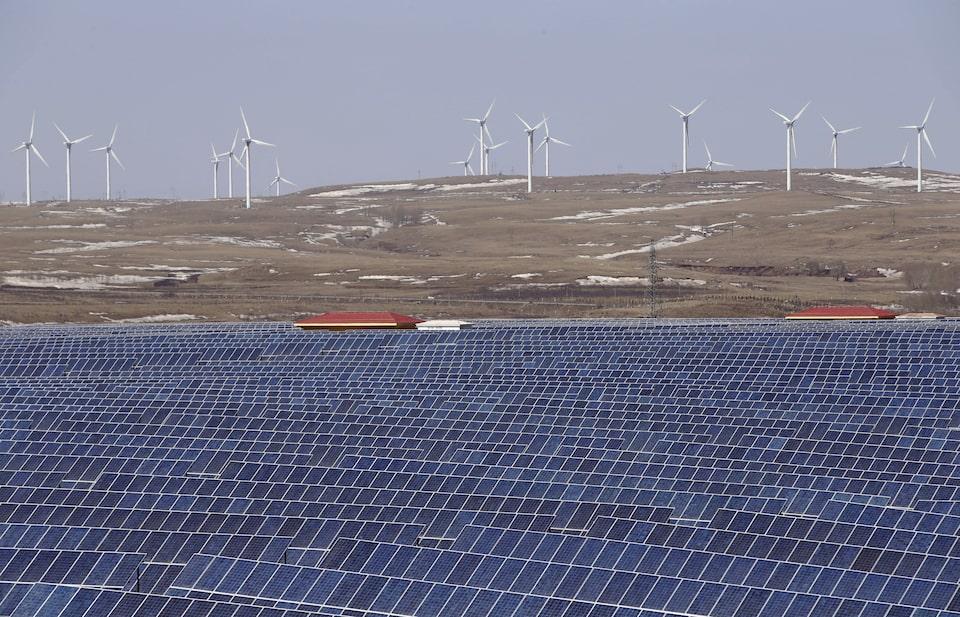
BEIJING, Nov 12 (Reuters) - China's energy administration said on Wednesday that it will push renewable energy use beyond the power sector over the next five years, aiming to better absorb the country's booming wind and solar output. Provinces and power producers should help local governments to build up their industrial bases for green hydrogen, green ammonia, green methanol, and sustainable aviation fuel during the next five-year plan from 2026-2030, the National Energy Administration (NEA) said in its opinion document on integrating new energy. Sign up here. Green hydrogen uses renewable electricity to power a chemical reaction that splits water into hydrogen and oxygen molecules. It can serve as a low-carbon fuel for heavy industry and transport, power industrial processes or vehicles, and as a feedstock for ammonia and methanol, which are used in fertilisers, shipping and elsewhere. The department encouraged coastal areas to explore using offshore wind to produce hydrogen, a still nascent production method. The document also called for using renewables to power heating, particularly in industrial parks. Energy planners see low-carbon industrial parks as a key to decarbonisation goals because industry consumes some 60% of the country's electricity, according to the International Energy Agency. Finding new outlets for renewable power is becoming more urgent as China's fleet, the world's largest, sometimes generates more electricity than the grid can accept, a mismatch known as curtailment. That is expected to be a focus for energy regulators during the next five-year plan. Energy consultancy Wood Mackenzie forecast recently that solar curtailment rates would average more than 5% in 21 Chinese provinces over the next 10 years. That would be up from just 10 provinces experiencing that level of curtailment during January to August this year, according to official data, though still within China's national-level limit of 10%. https://www.reuters.com/sustainability/boards-policy-regulation/china-planning-renewable-energy-expansion-beyond-power-sector-2025-11-12/
2025-11-12 08:00
Nov 12 (Reuters) - Oil major TotalEnergies (TTEF.PA) , opens new tab has agreed a 15-year power purchase deal to supply Alphabet's Google (GOOGL.O) , opens new tab with 1.5 terawatt hours of renewable electricity from its Montpelier solar farm in Ohio, the French company said on Wednesday. The solar facility, which is nearing completion, is connected to the PJM grid, the largest in the United States, and will help power Google’s data centre operations in the state, it said. Sign up here. "This agreement illustrates TotalEnergies’s ability to meet the growing energy demands of major tech companies by leveraging its integrated portfolio of renewable and flexible assets," said Stéphane Michel, President of Gas, Renewables and Power at TotalEnergies. The company's growing investment in electricity is helping the company secure a steadier revenue stream and avoid the boom-and-bust cycles typical of oil and gas, CEO Patrick Pouyanne said earlier this month at the ADIPEC conference in Abu Dhabi. The Paris-listed firm is deploying a 10 gigawatt portfolio in the United States, with onshore solar, wind and battery storage projects. https://www.reuters.com/sustainability/climate-energy/totalenergies-agrees-renewable-power-deal-with-google-ohio-data-centres-2025-11-12/

2025-11-12 07:48
Little room for U.S. soybeans in China after record LatAm buys China to struggle to buy 12 mln tons trumpeted by White House Soybean stocks at China's ports at record 10 mln metric tons SINGAPORE/BEIJING, Nov 12 (Reuters) - China is grappling with a glut of soybeans after months of record imports, curbing prospects for U.S. exports despite a recent trade truce that Washington said includes a pledge by Beijing to resume heavy purchases. Traders and analysts warn that vast stockpiles at ports and in state reserves, coupled with weak crush margins, limit Beijing's appetite for further purchases. Sign up here. "State firms may be waiting for margins to recover before making large-scale purchases," said Johnny Xiang, founder of Beijing-based AgRadar Consulting. "Even with tariff waivers, margins remain negative and Brazilian beans are still cheaper." After President Donald Trump met Chinese leader Xi Jinping last month officials in Washington said China had agreed to buy 12 million tons of U.S. soybeans by year-end and 25 million tons in each of the next three years. China has not publicly committed to making purchases, although it suspended retaliatory tariffs on U.S. imports, while state buyer COFCO has booked only a few cargoes for December and January shipment, traders and analysts say. SURGING STOCKPILES, SHRINKING MARGINS Chinese buyers sharply boosted soybean purchases from South America earlier this year, while shunning those from the United States, fearing a shortfall if the trade war with Washington dragged on, leading to oversupply. Soybean stocks at Chinese ports reached a record 10.3 million tons on Nov.7, up 3.6 million tons on the year, while processors, known as crushers, held 7.5 million tons, the most since 2017, data from Sublime China Information showed. Physical prices for soymeal, used to fatten animals in the world's biggest pig producer, have dropped more than 20% from an April peak in key coastal regions, to hover around 3,000 yuan ($421) a ton, Mysteel data showed. Such areas are the northern region of Tianjin, the eastern provinces of Shandong and Jiangsu and southern Guangdong. Chinese crushers have faced losses since mid-year, with a negative margin this week of about 190 yuan a ton in the processing hub of Rizhao , and traders expect margins to stay negative until at least March. "There is not much room for China to increase soybean imports," said a trader at an international house that runs oilseed processing units. "Soybean stocks are huge and demand for the feed sector is very slow." LITTLE SIGN OF BIG BUYS Market expectations for state grain importers COFCO and Sinograin to quickly resume significant purchases as a goodwill gesture after the trade talks have yet to materialise. It is still possible that state firms could make large purchases despite market conditions. "The administration expects our trading partners to adhere to their deal commitments," a U.S. official told Reuters. "The president reserves the right to adjust tariff rates, export controls, and other concessions to hold our trading partners accountable to their deal commitments." China's commerce ministry did not immediately respond to a request for comment. China's grain and oilseed stocks are a state secret, but at least two traders estimated soybean inventories held by state companies at about 40 million to 45 million tons. That would be double China's U.S. imports last year and sufficient for five months of typical early-year demand. Private importers have continued to book Brazilian cargoes for December shipment. Brazilian soybeans for January shipment were quoted at around $480 a ton, including cost and freight to China, compared with $540 to $550 a ton for U.S. cargoes. Chinese importers have booked about 2 million tons of soybeans for December shipment, covering more than 40% of the month's projected demand, while January bookings remain slow, traders said. "There's very little indication that state buyers are engaged in a program to purchase 12 million metric tons ahead of the end of this year, let alone 25 million tons more for calendar year 2026," Arlan Suderman, chief commodities economist at StoneX, wrote in a note on Tuesday. ($1=7.1230 Chinese yuan renminbi) https://www.reuters.com/world/china/chinas-soybean-glut-could-defeat-us-export-hopes-after-trade-thaw-2025-11-12/

2025-11-12 07:46
BEIJING, Nov 12 (Reuters) - AI data centre-fuelled power demand growth in the U.S. is likely to drive a "boom cycle" for energy storage in the next five years as more storage is needed to smooth out fluctuations from wind and solar generation, according to UBS Securities. Global energy storage demand could increase 40% globally year-on-year in 2026, Hong Kong-based UBS Securities analyst Yan Yishu told a media briefing on Wednesday. Sign up here. "The demand for AI data centres in the U.S. is very robust, but electricity is the biggest bottleneck." Renewables are the only power-generating segment expected to grow significantly in the next five years in the U.S., and because they produce power intermittently, the grid needs more batteries to store that power. The U.S. market is key for Chinese energy storage manufacturers, which have a 20% market share in the U.S., because it is one of the highest-margin markets. However, emerging markets in the Middle East, Latin America, Africa, and Southeast Asia could see the fastest growth rates of 30% to 50% or more, Yan said in the briefing. The biggest risk for Chinese exports to the U.S. is the foreign entity of concern requirements in President Trump's One Big Beautiful Bill, which place restrictions on participation in the U.S. energy sector by Chinese-owned or controlled companies, Yan said. In China, a push to implement market-based pricing for renewables will give a further boost to energy storage projects, which profit by charging up when prices are low and selling power when prices are high. A peak-valley electricity price difference of 0.4 yuan ($0.06) per kilowatt-hour is enough to put independent storage projects, or those that are not combined with a renewable power plant, in the money, Yan said. UBS anticipates Chinese provinces are likely to introduce so-called capacity payments, which compensate battery owners to be available when needed, to further incentivise energy storage. ($1 = 7.1230 Chinese yuan renminbi) https://www.reuters.com/sustainability/climate-energy/data-centres-drive-energy-storage-boom-cycle-next-five-years-ubs-says-2025-11-12/
2025-11-12 07:11
LONDON, Nov 12 (Reuters) - Momentum has been the stock market story of 2025, as trades that have worked just keep on working. It would be brave to bet against momentum at this point, but there might be ways to ride the wave while avoiding a wipeout. Momentum has outperformed as a strategy for much of the past 50 years. But this year it has been especially hot, whether it’s the seemingly unstoppable rise of anything related to artificial intelligence or even the spike in the price of gold, long considered a safe haven. Sign up here. Flows into many momentum-based exchange-traded products have hit all-time highs. For example, a BlackRock AI-themed active ETF raised $7 billion in its first year, and global gold ETPs (exchange-traded products) recorded their largest monthly inflows ever in September. On the flip side, quality-related exchange-traded products have seen outflows, and defensive areas of the market, such as consumer staples, have hit multi-decade lows versus broader markets. What’s driving this? Firstly, and at the risk of stating the obvious, the themes behind these trades are powerful. AI will almost certainly change the world, and big tech companies are set to spend nearly half a trillion dollars this year on their AI capabilities. That’s understandably boosting chip providers like Nvidia, which recently saw its market cap eclipse $5 trillion. Gold is also supported by potent trends. The poor state of many government balance sheets calls into question the perceived safety of government bonds and raises fears of lingering inflation. STRUCTURAL CHANGES Yet there are also structural changes to the market contributing here. One is the rise of retail investors. Retail investors account for about 20% of global equity market participation, up from around 15% in 2019 and 10% in 2010, according to SIFMA data. , opens new tab Greater retail participation is typically associated with more sentiment-driven markets. Another change is the rise of exchange-traded funds. There are now more ETFs than stocks listed in the United States, with 469 new ETFs coming to market in the first half of this year alone. As money pours into ETFs that track major indices or dominant themes, the biggest stocks just keep getting bigger. And many ETFs explicitly attempt to capture the momentum in stock markets by giving investors exposure to a basket of the winners. Given these thematic and structural forces, it’s hard to bet against momentum. But if history is any guide, there should be a reversal at some point. And that reversal might be sharp. For one, retail investors can be “flighty.” They typically hold stocks for only a few months on average versus a few years for institutional investors, according to data from CIBC. , opens new tab And in the event of a correction, ETFs that track momentum would have to rapidly rotate out of the current momentum “winners”. FOCUS ON QUALITY This leaves investors in a challenging position. The higher equities and other momentum darlings rise, the more investors will want to shelter their portfolios from a swift market change. Yet investors will also likely want to participate in the upside for as long as the momentum continues – because it could continue for a while. There is no strategy that can guarantee success here, but a focus on fundamentals is likely to help. Global “quality” companies – those that score well on measures such as profitability and earnings stability – have been on a losing streak versus the MSCI World Index since the start of 2024. That’s especially true in Europe, where valuations of quality companies are currently below the 40-year average, based on LSEG data. This could be an opportunity for skilled stock-pickers to scoop up strong companies at reasonable prices. While some quality companies are in industries that benefit from the AI theme, many can also be found in sectors with less direct AI exposure, including financials, healthcare and consumer discretionary. In the U.S., the earnings gap between the “Magnificent 7” – Amazon, Apple, Alphabet, Meta, Microsoft, Nvidia and Tesla – and the rest of the S&P 500 index is forecast to narrow to just three percentage points next year, based on consensus estimates. And there are already signs in Europe that the region’s large, quality companies, including some in the luxury space, are making a comeback after reporting promising third-quarter earnings numbers. GOLD HAVEN What about the gold boom? Where’s the haven if the price of the ultimate hedge comes down? Perhaps surprisingly, gold mining companies, despite rallying over 100% this year, actually still look cheap relative to their historical averages given their rapid rise in earnings. And mining companies are priced for a much lower gold price than we have today, as there is a large discount between consensus price estimates and both the spot price and futures curve. If gold prices remain elevated, the miners stand to generate enormous amounts of cash. If prices fall further from record highs, the miners may see their share price dip – as we’ve seen recently – but we expect their earnings to remain robust. MOMENTUM CRASH Ultimately, momentum could crash, rather than stall, due to some unforeseen event that upends financial markets, especially if that “something” results in global interest rates moving higher again. In that case, there may be few places for equity investors to hide, at least in the short term. But even in this scenario, a focus on fundamentals is likely to cushion the fall. (The opinions expressed here are those of the author, Helen Jewell, International CIO, Fundamental Equities, at BlackRock. This column is for educational purposes only and should not be construed as investment advice.) Enjoying this column? Check out Reuters Open Interest (ROI), , opens new tab your essential new source for global financial commentary. ROI delivers thought-provoking, data-driven analysis of everything from swap rates to soybeans. Markets are moving faster than ever. ROI , opens new tab can help you keep up. Follow ROI on LinkedIn , opens new tab and X. , opens new tab https://www.reuters.com/markets/europe/how-ride-stocks-momentum-wave-while-avoiding-wipe-out-2025-11-12/
2025-11-12 07:02
Gold prices stabilizing before further gains, analyst says US House due to vote on Wednesday on government shutdown JP Morgan sees gold breaching $5,000/oz by 4Q 2026 Nov 12 (Reuters) - Gold prices were steady on Wednesday as investors awaited a U.S. House of Representatives vote on a deal to reopen the federal government, which could pave the way for clarity on economic data and the potential path for Federal Reserve rate cuts. Spot gold was steady at $4,125.22 per ounce, as of 1158 GMT. U.S. gold futures for December delivery rose 0.4% to $4,130.90 per ounce. Sign up here. "Everyone is awaiting more clarity on the government shutdown and when the data is coming out of the U.S. again," said UBS analyst Giovanni Staunovo. "It's probably some stability before prices keep going up... we are still in an uptrend when it comes to the gold prices. Nothing from the structural side has completely changed," Staunovo added. Gold prices have surged more than 57% year-to-date, reaching a record high of $4,381.21 on October 20, driven by geopolitical tensions, economic concerns, easing Fed monetary policy, de-dollarization, and strong gold-backed ETF inflows. The U.S. Senate approved a deal on Monday to restore federal funding after a record-breaking government shutdown. House lawmakers returned to Washington on Tuesday to vote on the measure that could formally resolve the standoff. Economic data remains a focus, with payroll processor ADP reporting on Tuesday that U.S. companies were cutting more than 11,000 jobs per week through late October. Meanwhile, market expectations for monetary policy have shifted, with CME Group's FedWatch tool showing a 67% probability of a 25-basis-point rate cut at the Fed's next meeting on December 10, up from 62% a day earlier. "Gold's prices have broken above $4,050 resistance level after a consolidation. This confirms a continuation of the prevailing bullish momentum. Yet, the next resistance zone is $4,160-$4,170/oz, breach of this range will push prices towards the record high of $4,380/oz," ANZ said in a note. JP Morgan, in a note on Wednesday, said it expects central banks and consumers to emerge as reliable buyers during price dips and forecast gold prices to exceed $5,000 by the fourth quarter of 2026. Elsewhere, spot silver gained 0.6% to $51.51 per ounce, platinum fell 0.5% to $1,579.85 and palladium lost 1.5% to $1,422.25. https://www.reuters.com/world/india/gold-extends-rise-softer-dollar-fed-rate-cut-hopes-2025-11-12/