2025-10-06 10:17
What matters in U.S. and global markets today By Mike Dolan , opens new tab, Editor-At-Large, Finance and Markets Sign up here. As U.S. markets mull the lengthening government shutdown, the week started with political drama in Japan and France - with the yen and euro falling sharply against the dollar and both gold and the euro/yen exchange rate vaulting to all-time highs. Sanae Takaichi's shock weekend win to lead Japan's ruling Liberal Democratic Party and become Japan's next Prime Minister sent the dollar surging above 150 yen and the Nikkei soaring almost 5% to new records above 48,000. With Takaichi opposed to Bank of Japan tightening and a supporter of further fiscal stimulus, her win has sent long-shaky 30-year Japanese government bond yields to new record highs and sent Japan's yield curve to its highest in a month as October BoJ rate hike bets evaporated. Just as markets were digesting the news from Tokyo, Prime Minister Sebastien Lecornu and his government resigned hours after Lecornu announced a cabinet line-up, making it the shortest-lived in modern French history and knocking stocks and the euro lower. With French politics back in limbo and possibly facing yet another election, the CAC40 French stock index fell more than 1.5% and euro zone stocks dropped too, with the euro falling back below $1.17 and 30-year French bond yields popping higher. The upshot for U.S. markets that are warily watching the length of the government shutdown stateside and the looming earnings season there is that stock futures and the dollar are higher ahead of Monday's bell and long-term Treasury borrowing rates are rising again. Irking the bond markets on another bad day for debt market around the world was a rise in oil prices after the OPEC+ output rise at the weekend fell short of many expectations. In today's column, I discuss Germany's looming fiscal "sugar rush". Today's Market Minute * Japan's ruling party picked hardline conservative Sanae Takaichi as its head on Saturday, putting her on course to become Japan's first female prime minister in a move set to jolt investors and neighbours. * The U.S. administration will start mass layoffs of federal workers if President Donald Trump decides negotiations with congressional Democrats to end a partial government shutdown are "absolutely going nowhere," a senior White House official said on Sunday. * Trump said on Sunday that talks with Hamas to end Israel's war in Gaza and release hostages held by the Palestinian militant group were advancing rapidly. * OPEC+'s continued oil output increases are eroding the group's spare production capacity, a vital cushion that has helped to mitigate volatility in recent years. Energy traders may therefore face rockier days ahead, writes ROI energy columnist Ron Bousso. * The tin market is once again bubbling on supply chain trouble, this time in Indonesia, where the government has launched a sweeping clamp-down on illegal mining. Read the latest from ROI metals columnist Andy Home. Chart of the day Sanae Takaichi's surprise weekend win to lead Japan's ruling LDP and become the next prime minister sank the yen, sent long-term Japanese borrowing rates soaring and lit a fire under Tokyo equities. Takaichi is opposed to further Bank of Japan interest rate rises and, as an ally of former PM Shinzo Abe, is keen on stimulating the economy further. Today's events to watch * New York Fed's September global supply chain index (1000) * US corporate earnings: Constellation Brands * European Central Bank President Christine Lagarde and Bank of Spain Governor Jose Luis Escriva speak; Bank of England Governor Andrew Bailey speaks Want to receive the Morning Bid in your inbox every weekday morning? Sign up for the newsletter here. You can find ROI on the Reuters website , opens new tab, and you can follow us on LinkedIn , opens new tab and X. , opens new tab Opinions expressed are those of the author. They do not reflect the views of Reuters News, which, under the Trust Principles , opens new tab, is committed to integrity, independence, and freedom from bias. https://www.reuters.com/business/finance/global-markets-view-usa-2025-10-06/
2025-10-06 10:12
Defense sector stocks outperform Toronto index, Bombardier shares double Carney commits to 2% GDP military spending target this fiscal year, five years early Fast-track approval for projects to diversify economy, reduce US reliance Materials sector seen as main beneficiary of increased defense spending TORONTO, Oct 6 (Reuters) - Canadian defense, construction and metal mining shares stand to benefit as Ottawa commits to increased military spending and the speeding up of major infrastructure projects that could boost the economy, investors say. Shares of some of the companies in these sectors have already outperformed the broader Toronto stock index so far this year, including aerospace and defense company Bombardier Inc (BBDb.TO) , opens new tab, which has more than doubled. Sign up here. Canadian Prime Minister Mark Carney has vowed to boost funding for the armed forces and hit NATO's initial military spending target of 2% of gross domestic product this fiscal year, five years earlier than promised. On Thursday he launched a new Defence Investment Agency aimed at speeding up Canada's notoriously slow defense procurement, and tapped Doug Guzman, an executive from Canada's largest bank the Royal Bank of Canada, to run it. "It seems like Canada is going to be fully on board with that NATO spend and that's going to be good for a lot of these companies that are related to that spending," said Greg Taylor, chief investment officer at PenderFund Capital Management Ltd. Carney has also identified a number of projects for fast-track approval, including those that would increase natural gas production and expand both metal mines and a major container port, as part of a campaign to diversify the economy and reduce reliance on the United States. Canada now spends about 1.4% of GDP on defense. It will boost pay for service members and buy new submarines, aircraft, ships, armored vehicles and artillery, as well as new radar, drones and sensors, Carney has said. It will also introduce a new policy to ensure the federal government buys from Canadian suppliers. "In light of this elbows-up stance that our country and many others seem to be taking these days, to the extent possible we'll be trying to keep some of those dollars at home," said Brian Madden, chief investment officer at First Avenue Investment Counsel Inc, referring to a hockey term for self-protection. First Avenue owns shares in Bombardier. Kraken Robotics Inc (PNG.V) , opens new tab, which produces subsea sensors, batteries and robotic systems, is another company that could benefit from stepped-up defense spending, Madden said. Canada has further agreed to NATO's new defense investment pledge of 5% of GDP by 2035, which includes 3.5% of GDP for core military capabilities and 1.5% for defense and security-related infrastructure. "The materials sector, we see as the main beneficiary here," said Victor Kuntzevitsky, a portfolio manager at Stonehaven, Wellington-Altus Private Counsel. "As you read through what the Canadian commitment is to NATO, a large percentage of it is the mining area, specifically metals that are required for the military and industrial complex. So anything that can help with permitting, allowing the material companies more easily and quickly and cheaply get those metals out of the ground, will help." A more streamlined assessment of nation-building projects would boost prospects for construction and engineering firms such as AtkinsRealis Group Inc (ATRL.TO) , opens new tab, WSP Global Inc (WSP.TO) , opens new tab and Stantec Inc (STN.TO) , opens new tab, while heavy machinery company Toromont Industries Ltd (TIH.TO) , opens new tab and uranium producer Cameco Corp (CCO.TO) , opens new tab could also benefit, investors say. The building of a small modular nuclear reactor in Ontario is one of the projects under consideration for fast-track approval. The projects are long-term in nature, which has some investors taking a wait-and-see approach, and government policy is not the only factor driving these stocks. Still, it could raise their upside. "We are seeing tangible optimism around the Canadian government policy which is aimed at encouraging economic growth," Kuntzevitsky said. "You're really seeing that the Canadian government is recognizing the significance of being able to export our vast commodities to global markets." https://www.reuters.com/business/canadian-investors-bet-defense-construction-stocks-carney-targets-nation-2025-10-06/
2025-10-06 10:09
PM Lecornu resigns French risk premium spikes to January high French banking shares, bonds under pressure Credit default swaps jump LONDON, Oct 6 (Reuters) - French stocks and the euro fell while France's borrowing costs jumped on Monday, as the government collapsed within hours of being appointed, fuelling uncertainty over the euro zone's second-largest economy. Prime Minister Sebastien Lecornu unexpectedly handed in his resignation to President Emmanuel Macron hours after announcing his cabinet line-up - making it the shortest-lived government in modern French history. Sign up here. Paris' $3 trillion CAC 40 index (.FCHI) , opens new tab dropped more than 1.3%, making it the worst-performing index in Europe. ONLY HOURS INTO THE JOB Shares in major lenders tumbled, leaving BNP Paribas (BNPP.PA) , opens new tab, Societe Generale (SOGN.PA) , opens new tab and Credit Agricole (CAGR.PA) , opens new tab down between 3% and 4%. The euro , which has weathered much of France's political turmoil in the last year, slid 0.2% on the day to $1.172. "There seems to be no willingness in parliament for a budget to be passed, so I think yields higher, pressure on euro-dollar in the near term," said Danske Bank analyst Kirstine Kundby-Nielsen. French mid-cap stocks were hit hard (.CACMD) , opens new tab, tumbling 2.6% and set for their largest one-day drop since April, while other European markets did not go unscathed either. The broader STOXX 600 (.STOXX) , opens new tab dipped 0.3%, Germany's DAX (.GDAXI) , opens new tab was a touch weaker. France has the largest budget deficit in the euro zone, which is almost double the European Union's preferred limit of 3%. Its problems take the shine off this year's European stocks rally, which has been driven by increased spending on security and infrastructure from the likes of Germany. France's long-term finances were already vulnerable, and politics has become increasingly unstable since Macron's re-election in 2022, given the lack of any party, or grouping holding a parliamentary majority. Successive prime ministers - France has now had three in under a year - have tried and failed to push through unpopular budgets and on Monday, Lecornu's cost him his job. "Lecornu’s resignation confirms that French bonds remain uninvestable. As long as there’s no majority in parliament, no one will be able to tackle France’s debt and fiscal problems," Mathieu Savary, BCA Research chief strategist of developed markets ex-U.S., said. "The problem is that dealing with this issue will most likely demand a full-blown crisis in the (bond) market to discipline French politicians," he said. BORROWING COSTS SOAR French bond prices dropped, pushing yields on benchmark 10-year debt up as much as 9 basis points to nearly 3.6%, before retreating to 3.563%. That left the premium investors demand to hold French debt, rather than triple-A rated German paper , at 85 bps, near its highest since January. This spread hit a 2012 high of 90 bps last November. Investors are worried about France's creditworthiness, compounded by a ratings downgrade last month. On Monday, credit default swaps - a derivative that reflects the cost of insuring against a sovereign default - rose to 41 bps, the most since April, up from 38 bps on Friday. "The bigger question is how does this all resolve itself?" said Pepperstone senior research strategist Michael Brown. "Because there doesn’t seem to be an obvious solution or obvious silver bullet that we can look to, to resolve it overnight." https://www.reuters.com/business/finance/french-markets-euro-battered-government-collapses-2025-10-06/
2025-10-06 10:09
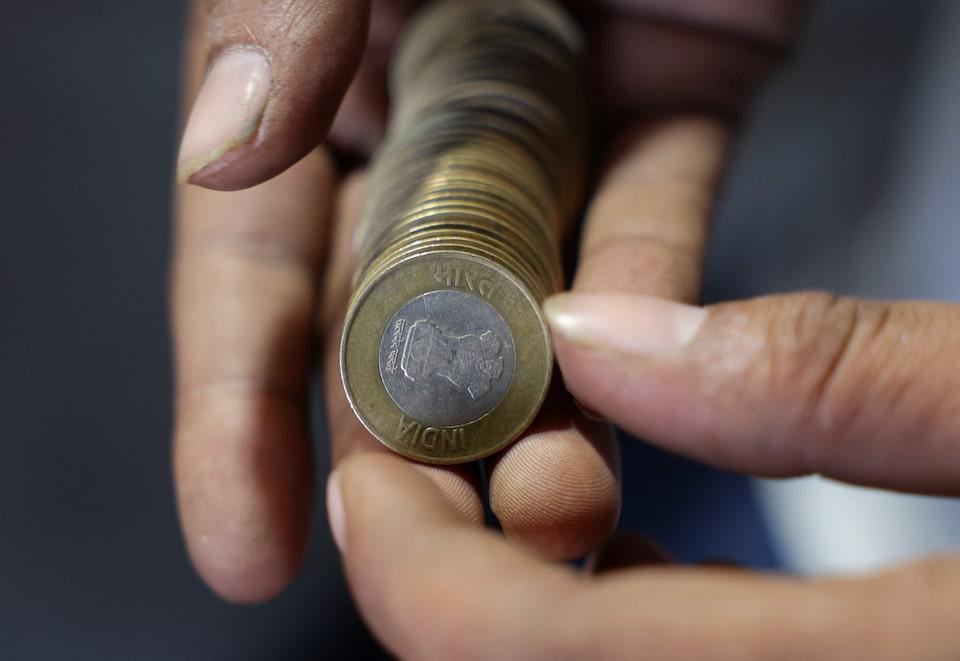
MUMBAI, October 6 (Reuters) - The Indian rupee held in a tight band on Monday, staying just above its record low as likely intervention by the Reserve Bank of India helped stave off pressure stemming from local importers' steady dollar demand. The rupee closed at 88.78 against the U.S. dollar, nearly flat on the day and in touching distance of its record low of 88.80 hit last week. Sign up here. Several traders said that state-run banks were spotted offering dollars through much of the session, most likely on behalf of the RBI. The RBI "has been present near these levels and seems to be protecting it firmly for now," a trader at a private bank said. "If 88.80 breaks, 89 becomes the next level to watch," he added. Persistent worries over the hit to trade, portfolio and remittance flows from steep U.S. tariffs and tighter immigration policies has kept the rupee bogged down over the last few weeks and driving it down over 3.5% on the year despite broad weakness in the dollar. On the day, India's benchmark equity indexes, the BSE Sensex (.BSESN) , opens new tab and Nifty 50 (.NSEI) , opens new tab were up 0.7% each. Traders expect foreign portfolio inflows spurred by two large initial public offerings could offer the rupee some comfort later in the week. Non-bank lender Tata Capital's $1.75 billion share sale kicked off on Monday while LG Electronics India will open its $1.3 billion IPO on Tuesday. "Interestingly, downside risks to (India's) growth remain, but policy stimulus is nearing its limits. We believe if tariffs endure and growth slows materially in the second half of fiscal 2026, asset prices could correct further, potentially impacting the INR as well," analysts at ANZ said in a note. Meanwhile, a drop in the Japanese yen and the euro helped boost the dollar on Monday as political risks across continents came into focus for investors with the new election of a new leader in Japan and the resignation of France's Prime Minister. https://www.reuters.com/world/india/rupee-boxed-by-persistent-importer-hedging-central-bank-intervention-2025-10-06/
2025-10-06 09:43
LONDON, Oct 6 (Reuters) - A selloff in French markets gathered pace on Monday after French media reports that Prime Minister Sebastien Lecornu has resigned. French stocks fell sharply (.FCHI) , opens new tab, government bond yields were up 8 basis points and the euro was last down 0.65% at $1.1667 . The premium investors demand to hold French government debt, rather than benchmark German bonds, hit its widest since January. Sign up here. COMMENTS: CARLO FRANCHINI, HEAD OF INSTITUTIONAL CLIENTS, BANCA IFIGEST, MILAN: "French banks are getting hammered today and the spread against Bunds is widening sharply. The situation in France is increasingly complicated - politically and economically. I don't think Macron will resign. That would likely make things worse, especially with the populist wave sweeping across Europe and the risk of far-right gains. Volatility is likely to persist, but so far, markets seem to be absorbing the shock. There's no major spillover yet, though French banks are clearly bearing the brunt." PHILIP SHAW, CHIEF ECONOMIST, INVESTEC, LONDON: "French bond spreads have widened out, which is not surprising, but the move looks contained. You could argue Lecornu's task was impossible and the measures he was proposing. "The impasse is likely to going to continue. There is already a certain degree of uncertainty price in. One question is does this mean we are heading to fresh elections but at this point it hard to tell what (French President Emmanuel) Macron will do. "We have been here before, but elections did not solve (it)." CHRIS BEAUCHAMP, CHIEF MARKET ANALYST, IG GROUP, LONDON: "It's just one government after another and we're looking at the run of finance ministers ... this is the major problem for French assets but it has spillover effects for the rest of Europe. "It certainly makes people wary about European assets at this point because of the uncertainty and the spillover effects that go from France just being unable to find its way out of this malaise." STEPHANE EKOLO, GLOBAL EQUITY STRATEGITST, TRADITION, LONDON: "This unprecedented move — the first time under the Fifth Republic that a prime minister has stepped down before addressing Parliament — pushes France into uncharted political territory. Given the impasse, the likelihood of a parliamentary dissolution and snap elections has risen materially. Alongside this political uncertainty/crisis, one can expect an economic one (sentiment is likely to deteriorate) given the uncertainty surrounding the wide budget deficit. "Is France heading toward the appointment of a technical government, the nomination of yet another prime minister, or even a snap election? Alternatively, could the country face a prolonged political vacuum similar to Belgium’s 18-month government hiatus? "What seems clear for now is that France will be unable to present a budget before year-end, underscoring the depth of the current political paralysis. Banks & financials overall are likely in this uncertainty to be under pressure." MICHAEL BROWN, SENIOR RESEARCH STRATEGIST, PEPPERSTONE, LONDON: "The market reaction is exactly as you would expect, the euro is lower, (French) OAT-Bund spread wider, French equities lower -- that’s all very predictable. The bigger concern for the market is really what comes next, because if Macron decides to appoint another prime minister that’s going to be the sixth PM in two years, who will again face the exact same challenging parliamentary arithmetic, the exact same problems when trying to pass the budget, so that feels a little like a non-starter. "The thing that is really playing on market participant’s minds is not really the fact that the PM has quit - which has clearly come as a bit of surprise, though his future was looking ropey this week anyway, I think the bigger question how does this all resolve itself? Because there doesn’t seem to be an obvious solution, or obvious silver bullet that we can look to, to resolve it overnight." LEE HARDMAN, SENIOR CURRENCY ANALYST, MUFG, LONDON: "The fall in the euro shows markets are becoming more uneasy about the political uncertainty in France. The pressure now goes back to President Macron to see how he deals with this deadlock. For the market, the worst case would be if he tries to break that deadlock by calling snap parliamentary elections, that would extend the uncertainty in the near term and likely trigger another leg lower for the euro. The risk of that has increased after Lecornu's resignation." KIRSTINE KUNDBY-NIELSEN, ANALYST, DANSKE BANK, COPENHAGEN: “It’s concerning that the new cabinet only lasted 12 hours. There seems to be no willingness in parliament for a budget to be passed, so I think yields higher, pressure on euro-dollar in the near term. “There doesn’t seem to be a willingness to get lower government deficits and consolidate French public finances and investors want a premium for that.” KIT JUCKES, CHIEF FX STRATEGIST, SOCIETE GENERALE, LONDON: "This is ongoing issue - France - as far as the euro is concerned. France can have some impact on the euro, but the overall impact is much less than it was." https://www.reuters.com/business/view-french-markets-tumble-after-pm-lecornu-resigns-2025-10-06/

2025-10-06 08:39
Lagarde: inflation risk range has narrowed Lane: increasing downside risk may warrant more policy easing Markets see almost no chance of a rate cut this year FRANKFURT, Oct 6 (Reuters) - The European Central Bank may need to reduce borrowing costs slightly if the risk of inflation going too low increases, but interest rates are appropriate now, the ECB's top brass said on Monday. The central bank for the 20 euro zone nations has cut interest rates by 2 full percentage points in the year to June but rates have been on hold ever since as the bank debates whether to go lower or level off at the current 2% since inflation is now at target. Sign up here. "Shifts in the risk distribution will also matter for our rate decisions: an increase in the likelihood or intensity of downside risk factors would strengthen the case that a slightly lower policy rate might better protect the medium-term inflation target," the ECB's chief economist, Philip Lane, said in a speech in Frankfurt. "Alternatively, an increase in the likelihood or intensity of upside risk factors would indicate that maintaining the current policy rate would be appropriate in the near term." However, ECB President Christine Lagarde argued that the risk of undershooting the 2% target was shrinking even though trade tensions with the U.S. keep the outlook uncertain. "As new information has come in, the range of risks on both sides has narrowed," Lagarde told lawmakers in Strasbourg. Financial markets see almost no chance of another rate cut this year and comments from Lagarde and ECB Vice President Luis de Guindos only strengthened those expectations. "We could say that risks for inflation are balanced and that our projections, which showed that the price stability objective can be secured in some way, are being fulfilled to some degree," de Guindos told an event in Madrid. "We consider the current level (of interest rates) to be appropriate based on recent inflation trends." But the jury is still out. Some policymakers fear that the full extent of U.S. tariffs is yet to be felt and a strong euro will hurt exporters while pulling overall inflation below the ECB's 2% target. Lane noted that the stronger euro has a multi-year impact on activity and inflation, and the underlying reasons for the currency movement affect the extent of the price shock. "These effects will be larger than the average if euro appreciation is more due to external factors, such as weakness in main trading partners or portfolio rebalancing due to an increase in the risk premium in overseas financial markets," he said. The euro is up 13% against the dollar since the start of the year as investors have reduced dollar holdings owing to concerns about erratic U.S. economic policy. https://www.reuters.com/business/rising-risk-undershooting-would-support-slight-cut-ecb-rates-lane-says-2025-10-06/