2025-09-23 21:27
Trump cancels meeting with Democrats amid funding dispute House passed stopgap bill, failed in Senate with 53 Republican seats Federal shutdown could affect services, furlough workers Republicans, Democrats posture to pin blame on rivals WASHINGTON, Sept 23 (Reuters) - U.S. President Donald Trump on Tuesday scrapped a meeting with top congressional Democratic leaders to discuss government funding, raising the risk of a partial government shutdown beginning next week. Democrats and the Republican president postured to try to pin blame on each other for a potential shutdown, which would interfere with a range of federal services and likely furlough hundreds of thousands of federal workers. Sign up here. "I have decided that no meeting with their congressional leaders could possibly be productive," Trump wrote in a post on his Truth Social media site. Senate Democratic Leader Chuck Schumer and House of Representatives Democratic Leader Hakeem Jeffries earlier on Tuesday said Trump had agreed to meet this week at the White House, before government funding expires on September 30. Lawmakers are at odds over so-called discretionary funding, which accounts for about one-quarter of the roughly $7 trillion federal budget. "Democrats are ready to work to avoid a shutdown," Schumer said in a statement responding to Trump's message. "Trump and Republicans are holding America hostage." At issue is how to win enough votes in the deeply divided Congress to pass a stopgap funding bill to keep the government operating into the new fiscal year starting October 1. Schumer said it is also urgent for Congress to extend an enhanced tax credit for federally backed health insurance premiums, which is due to expire on December 31. Healthcare policy nonprofit KFF estimates out-of-pocket premium payments rising over 75% for the Affordable Care Act plan year beginning on October 1. "It's the difference between a family trying to make the mortgage payment and having healthcare," Schumer told reporters at a press conference in New York's Brooklyn borough. Republican leaders say they have not slammed the door on extending the tax credit, but have argued that a stopgap funding bill was not the place to accomplish that. The Republican-led House passed a bill last week to extend government funding through November 21, but it failed in the Senate where Republicans hold 53 of the 100 seats. Republican House Speaker Mike Johnson has said he does not intend to call House members back to Washington before October 1 - by which point the government will have shut down absent Senate action. Johnson says his chamber completed its work when it passed its stopgap funding bill on Friday, a move that also presents the Senate - where bills require bipartisan support to pass - no chance to modify the House bill. Jeffries told House Democrats to return to Washington from a week-long break on Monday. UNUSUAL POSITION FOR DEMOCRATS In a long posting on Truth Social, Trump attacked Democrats, but said he would meet with the parties' Leaders "if they get serious about the future of our Nation." Without specifically laying out his conditions, Trump said, "All Congressional Democrats want to do is enact Radical Left Policies that nobody voted for — High Taxes, Open Borders, No Consequences for Violent Criminals, Men in Women’s Sports, Taxpayer funded 'TRANSGENDER' surgery, and much more." Democrats have largely embraced efforts to secure the U.S. border with Mexico, but have criticized Trump's unilateral tactics of targeting immigrants for deportation without due process. They also have criticized Trump's use of some states' National Guard troops in Democratic-controlled cities, ostensibly to reduce crime rates. Voting against bills to keep the government operating puts Democrats in an unusual position, as Schumer over the years has chastised Republicans for voting against the sort of funding extensions known as continuing resolutions that the House passed last week. The federal government has partially shut down 14 times since 1981, but it is unclear what operations would continue and what would close on October 1 if government funding runs out since the Office of Management and Budget has not made public agencies' contingency plans. Mandatory spending, such as on the Social Security and Medicare benefits would continue, as would interest payments on the federal government's $37.5 trillion in debt. https://www.reuters.com/world/us/trump-scraps-meeting-with-democrats-funding-us-shutdown-looms-2025-09-23/
2025-09-23 21:12
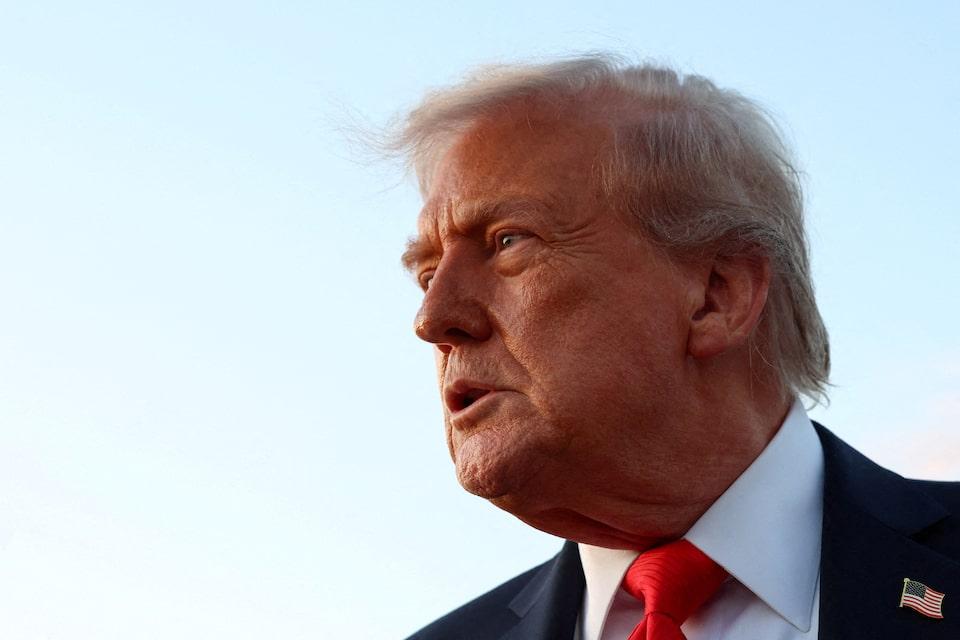
Macklem sees US dollar's safe haven status under threat Fed's Powell praised for handling political pressure Canada urged to adapt to changing U.S. trade dynamics OTTAWA, Sept 23 (Reuters) - Bank of Canada Governor Tiff Macklem on Tuesday expressed concern about President Donald Trump's attempts to pressure the U.S. Federal Reserve, saying his actions had started to hit financial markets. In his first observations on Trump's efforts to influence Fed decision making, Macklem said the impact could be seen on the U.S. dollar. Sign up here. In the last few months, Trump has cranked up his demands for a rate cut, tried to remove one of the Fed's governors and repeatedly insisted that Chair Jerome Powell resign at a time when the U.S. president's trade actions have disrupted the global trade order. "Why I'm talking about it is that it's starting to have consequences in financial markets," Macklem said when asked by reporters about the timing of his comments. "I do think you are starting to see some impacts, and in that sense, it's time to talk about it." Earlier in the day, Macklem told the Saskatoon Chamber of Commerce that Trump's attempts to influence the Federal Reserve were raising questions about the continued independence of U.S. monetary policy. He also noted how the U.S. dollar was suffering due to Trump's actions and accompanying global uncertainty. "The question now is whether U.S. dominance in global financial flows will ebb as the United States pulls back from trade and runs large fiscal deficits. The recent performance of the U.S. dollar may be telling us something," Macklem said. The greenback, he noted, was losing its appeal, falling almost 10% since Trump unleashed a barrage of tariffs globally in April. This, Macklem said, had called the dollar's safe-haven role into question. "For now, the greenback remains dominant, and — without a clear alternative — I suspect it will remain the global reserve currency for the foreseeable future. But for many, its value as a hedge in times of stress has been dented," he said. He later commended Fed Chair Jerome Powell for "doing a very good job under very trying circumstances," but stressed the need for the Fed to remain free of political pressure. "Central banks that have operational independence for monetary policy do a better job at delivering price stability for their citizens," he said. CANADA RAMIFICATIONS Macklem said the shifting trade equation with the U.S. had immense ramifications for Canada. "We can't afford to wait this out," he said, adding that Canadian businesses as well as political and economic leaders would need to chart a new course. "We should have been making these changes 15 years ago. But the next best time is now," he said. Canada has long suffered from anemic productivity, which economists and businesses say is helping fuel inflation. Canada's economy will work less efficiently, costs will go up and incomes will shrink due to increased trade friction with the U.S., he said, but noted monetary policy would not be able to soften these impacts. "Monetary policy cannot undo the efficiency costs of U.S. tariffs... nor can counter-cyclical fiscal stimulus," he said. https://www.reuters.com/world/americas/bank-canada-head-expresses-concern-about-trumps-fed-actions-2025-09-23/

2025-09-23 21:07
ORLANDO, Florida, Sept 23 (Reuters) - U.S. stocks slid on Tuesday in a wave of profit-taking from the previous day's highs, as investors digested cautious remarks from Federal Reserve Chair Jerome Powell , opens new tab and data that showed U.S. business activity slowing for a second straight month. In my column today I look at who is paying the record tariffs swelling U.S. Treasury coffers. So far, U.S. companies have taken the pain, but that burden is expected to shift to consumers. Will they be willing - or able - to "eat the tariffs"? Sign up here. If you have more time to read, here are a few articles I recommend to help you make sense of what happened in markets today. Today's Key Market Moves Today's Talking Points: * U.S. government shutdown It's that time of year again, when budget gridlock in Washington threatens to trigger a U.S. government shutdown and, in the worst case scenario for markets, some form of technical default. We are eight days away from what would be the 15th partial shutdown since 1981. Uncertainty and volatility could ripple through markets until agreement on government funding is reached, which history shows is often at the 11th hour. Investors won't be getting complacent though, and on Tuesday President Donald Trump raised the stakes, scrapping a meeting with Democratic leaders. Eight days and counting. * (Dis)United Nations? The United Nations 80th General Assembly roared into life on Tuesday, with Trump center stage. In a 56-minute combative speech, Trump rejected the idea of a Palestinian state, urged Europe to pressure Russia to force an end to the war in Ukraine, and told leaders of nations he deems soft on immigration: "Your countries are going to hell." Meanwhile, in a nod to U.S. foreign policy, Brazil's President Luiz Inacio Lula da Silva said recent "unilateral attacks" against Brazil's institutions and economy were unacceptable. Despite that, Trump said he will meet Lula next week , opens new tab, adding that they had "excellent chemistry" during a brief encounter at the U.N. * Golden years Gold rose as much as 1% on Tuesday, hitting a new peak and bringing $4,000/oz closer into view. It is up a whopping 45% this year, and recently scaled its previous inflation-adjusted high from 1980 of around $3,500/oz. Inflation worries are a factor, but there must be more to it - if it was just inflation, long-dated yields would be spiking and yield curves would be steepening sharply too. Geopolitical concerns, central bank demand, divestment out of fiat currencies and into hard assets must also be driving this. Do U.S. consumers have the appetite to eat the tariffs? In May, U.S. President Donald Trump lashed out at Walmart, telling the retail giant to "eat the tariffs" instead of raising prices for consumers. Corporate America heard the message. The consensus among economists is that Trump's tariff burden has so far been shouldered by U.S. companies and that consumers have got off relatively lightly, although these scales are widely expected to tip the other way in the coming months. How far remains to be seen. But given that consumer spending accounts for around 70% of annual U.S. economic activity, changes to the final price of imports could be a vital part in determining how growth and inflation rates pan out. The dust is settling on a pretty chaotic six months since Trump's April 2 "Liberation Day" tariff announcement, even though the final duties on goods from China and India, and key imports such as chips and semiconductors, have yet to be agreed. But the parameters are emerging. The average effective tariff rate will probably be somewhere between 15% and 20%, up significantly from 2.5% in December and the highest since the 1930s. The Budget Lab at Yale's latest estimate is 17.4%. Up to now, the effective rate has been closer to 10% to 12%, most of which has been swallowed by U.S. firms, who have been reluctant to pass the higher costs to customers. Distortions around the front-loading of imports, and chaos around tariff rates and implementation were so high it made sense to sit tight. CONSUMER SQUEEZE COMING Tariffs vary hugely from sector to sector, and industry to industry. Michael Pearce, deputy chief U.S. economist at Oxford Economics, notes that consumers are bearing almost all the tariffs burden in sports and furniture goods, while domestic and foreign firms are doing the heavy lifting in autos and clothing. But on aggregate, consumers have yet to really feel the squeeze. BNP Paribas economists calculate that U.S. firms have shouldered 64% of tariff pain so far, foreign exporters just under 20%, and U.S. consumers only 17%. Their economic models suggest that will flip dramatically in the coming months to 63% for the U.S. consumer and just 1% for U.S. firms, while a recent Atlanta Fed blog , opens new tab concluded that, on average, U.S. firms reckon they could pass through more than half of a 10% cost increase without damaging demand. Will the consumer pay up? Economic growth in the first half of the year was around half of what it was last year, job growth is evaporating, and the Fed has started cutting interest rates again. Companies will be wary of passing on hefty price hikes to their customers, especially with inflation still uncomfortably sticky. And there's also this to consider, although few will admit it - many companies won't pass on significant price hikes for fear of antagonizing the Trump administration. "The burden of tariffs on the economy is creeping up. And the biggest impact (on consumers) is still to come," says Michael Pearce, deputy chief U.S. economist at Oxford Economics. "But in the near term, the risk is that less than two thirds gets passed onto the consumer." GOVERNMENT REVENUE FROM TARIFFS Trump administration officials, especially those at the Treasury, may not mind much who ultimately pays - federal government revenues from tariffs are soaring. The Budget Lab at Yale estimates put revenue raised from new tariffs year-to-date through August at $88 billion, with around $23 billion of that in August alone. Torsten Slok, chief economist at Apollo, calculates that the government is currently collecting around $350 billion in tariffs at an annualized rate, equivalent to 18% of annual household income tax payments. Looking out over the next decade, tariffs are projected to bring in a net $2 trillion to government coffers, according to the Budget Lab at Yale, and cut the deficit by around $2.6 trillion, according to Oxford Economics. America's wider fiscal outlook is not great, meaning the longer this revenue stream keeps running, the less inclined future lawmakers will be to turn it off at source. That's a few years out. More immediately, we may be about to find out if consumers are willing to do what businesses have done for the most part up to now and "eat the tariffs". What could move markets tomorrow? Want to receive Trading Day in your inbox every weekday morning? Sign up for my newsletter here. Opinions expressed are those of the author. They do not reflect the views of Reuters News, which, under the Trust Principles , opens new tab, is committed to integrity, independence, and freedom from bias. https://www.reuters.com/business/global-markets-trading-day-graphic-2025-09-23/

2025-09-23 21:06
TSX ends down 0.5% at 29,815.63 Posts intraday record high above 30,000 Technology falls 2.9% with Shopify down 4.5% Industrials end 1.5% lower Sept 23 (Reuters) - Canada's main stock index pulled back on Tuesday from a record intraday high, ultimately ending lower as industrial and technology shares lost ground. The S&P/TSX composite index (.GSPTSE) , opens new tab ended down 143.35 points, or 0.5%, at 29,815.63. During the session the index traded above the 30,000 threshold for the first time after posting a record closing high on Monday. It has advanced 20.6% since the start of the year. Sign up here. "In spite of our difficult trading arrangement with the United States, the whole world needs what we have and that's energy, copper, gold and who doesn't want to buy an oligopoly of bank stocks," said Matt Skipp, President of SW8 Asset Management. Five banks dominate the domestic lending market. Financials account for roughly one-third of the TSX's market capitalization, while resource shares make up an additional 32%. Bank of Canada Governor Tiff Macklem said the new global uncertainty, triggered in part by U.S. tariffs, underscored the need for Canada to boost productivity and find new foreign markets. Last week, the central bank eased interest rates for the first time since March to support the economy, lowering its benchmark rate by 25 basis points to 2.50%. Wall Street also ended lower on Tuesday. The Toronto market's industrials sector (.GSPTTIN) , opens new tab fell 1.5% and technology (.SPTTTK) , opens new tab lost 2.9%. Shares of e-commerce company Shopify Inc (SHOP.TO) , opens new tab were down 4.5%. Energy (.SPTTEN) , opens new tab was a bright spot, rising 1.1%. The price of oil settled 1.8% higher at $63.41 a barrel after a deal to resume exports from Iraq's Kurdistan stalled. https://www.reuters.com/markets/europe/tsx-futures-tick-up-gold-hits-fresh-record-high-2025-09-23/

2025-09-23 21:02
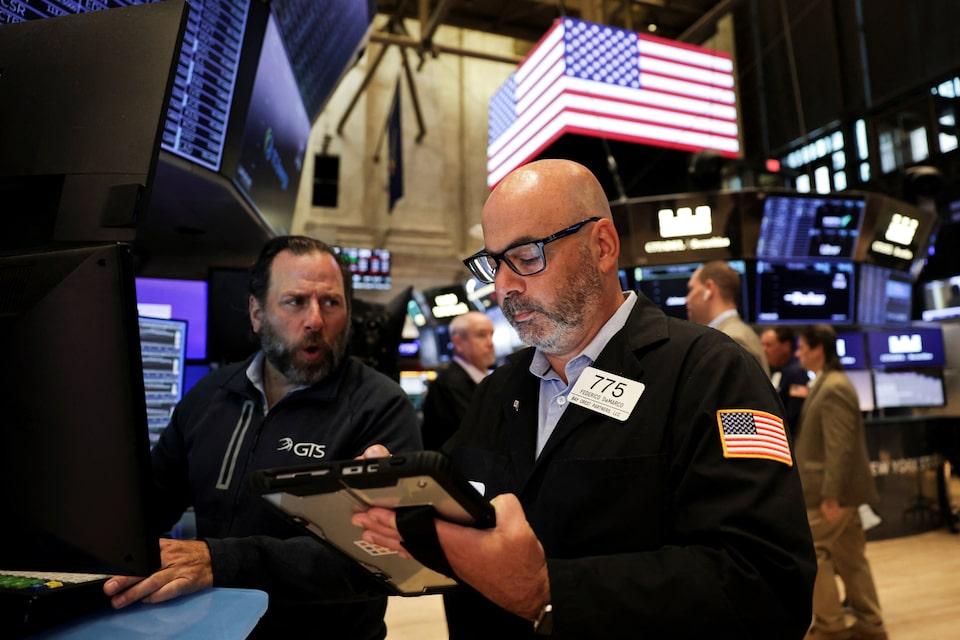
Boeing rises on Uzbekistan deal, potential China order Powell strikes middle path on inflation, jobs Indexes: Dow down 0.2%, S&P 500 down 0.6%, Nasdaq down 0.9% NEW YORK Sept 23 (Reuters) - U.S. stocks finished lower on Tuesday, breaking a three-session string of record closing highs, as Federal Reserve Chair Jerome Powell said the U.S. central bank needs to balance inflation concerns with a weakening job market in its coming interest rate decisions. The Nasdaq led declines, with shares of Nvidia (NVDA.O) , opens new tab falling 2.8% after rising in the previous session, when the chipmaker said it plans to invest up to $100 billion in OpenAI. Sign up here. Amazon.com (AMZN.O) , opens new tab, Microsoft (MSFT.O) , opens new tab and Apple (AAPL.O) , opens new tab also were lower. In comments Tuesday, Powell offered little hint of when he thinks the Fed might next cut interest rates. The Fed last week cut rates for the first time this year and indicated further cuts may be coming. "The big event of the day was Powell's speech. He was somewhat on the dovish side, but also he showed cautiousness, and that indicates that while he left the door open for another rate cut, there was really no hint of when and how much the next rate cut could be," said Peter Cardillo, chief market economist at Spartan Capital Securities in New York. "The market began to sell off on that," he said, adding: "It was also ripe for some sort of a pullback." Powell also said equity prices are fairly highly valued. The three major U.S. indexes registered record closing highs for the previous three sessions. The Dow Jones Industrial Average (.DJI) , opens new tab fell 88.76 points, or 0.19%, to 46,292.78, the S&P 500 (.SPX) , opens new tab lost 36.83 points, or 0.55%, to 6,656.92 and the Nasdaq Composite (.IXIC) , opens new tab lost 215.50 points, or 0.95%, to 22,573.47. Powell's colleagues earlier gave comments on both sides of the policy argument. Fed Vice Chair for Supervision Michelle Bowman said the Fed could downplay concerns about persistent inflation and needed to make a commitment to cut rates in support of the job market. Helping to limit declines on the Dow, Boeing shares rose 2% after it secured an order from Uzbekistan Airways worth over $8 billion. After the closing bell, shares of Micron Technology (MU.O) , opens new tab were up 0.7% as the company reported results and gave an upbeat forecast. The stock ended the regular session up 1.1%. Declining issues outnumbered advancers by a 1.12-to-1 ratio on the NYSE. There were 561 new highs and 86 new lows on the NYSE. On the Nasdaq, 1,786 stocks rose and 2,871 fell as declining issues outnumbered advancers by a 1.61-to-1 ratio. Volume on U.S. exchanges was 18.89 billion shares, compared with the 17.66 billion average for the full session over the last 20 trading days. https://www.reuters.com/business/wall-street-futures-hold-steady-after-tech-fueled-rally-powell-focus-2025-09-23/
2025-09-23 20:46
This is a breaking news story. Full coverage will be available soon. Us judge inclined to receive additional briefings about recommended bid for citgo parent through oct 15, final oral arguments set for oct 20-21, court filing Sign up here. https://www.reuters.com/world/us/us-judge-inclined-receive-additional-briefings-about-recommended-bid-citgo-2025-09-23/