2025-09-23 20:24
Exelon aims to own regulated power supplies in Mid-Atlantic amid rising bills CEO Butler advocates for legislative changes to allow regulated power generation Independent power companies oppose regulated generation NEW YORK, Sept 23 (Reuters) - Major U.S. electric utility Exelon (EXC.O) , opens new tab plans to step up its push to own power plants in its Mid-Atlantic service area next year, where electricity bills are spiking in the face of rising demand and new supplies are slow to be added, CEO Calvin Butler told Reuters this week. Exelon's effort comes as PJM Interconnection, the country's largest grid providing electricity to over 65 million people in the Midwest to the Mid-Atlantic, faces supply shortfalls amid surging demand from data centers and the electrification of industries like transportation. Sign up here. Chicago-based Exelon said in July that it was considering its options for building and owning regulated power generation, which electric utilities are legally barred from in about half of U.S. states. In those states, regulated utilities generally own power lines, while independent power producers own and operate power plants to diversify market power, which can help prevent anti-competitive behavior. Butler said allowing electric utilities like Exelon to build new regulated power supplies, which is currently barred by state laws in much of PJM's territory, would ease the grid's power crunch and bring down prices. Regulated power generation in the region where Exelon operates would require a series of changes to state law, which Butler said his company is laying the groundwork for by talking to lawmakers and governors ahead of next year's lawmaking meetings. "I believe the 2026 legislative sessions are going to be an opportunity for us," Butler told Reuters at a meeting in New York on Monday. "We're going to be advocating for it." About half of U.S. states are considered deregulated, generally, meaning that electric utilities that own transmission and distribution lines cannot also own regulated power generation. The deregulation effort began in the 1990s in response to rising electricity costs. As power bills rise again, some of the 13 states in PJM, like Maryland and New Jersey, have considered amending their laws to allow regulated power generation. "I'm one of the staunchest supporters for competitive markets when they work, but we are seeing that the competitive marketplace in PJM is not working," Butler said. U.S. power demand is forecast to hit record highs this year and next, according to the U.S. Energy Information Administration. FIGHTING RISING BILLS If allowed by the states, Butler said he would seek to build community solar in low-to-moderate income neighborhoods, which he said would reduce power bills. Some 80% of recent household electricity bill increases are power supply costs, Butler said, as opposed to utility charges. With nearly 11 million customers, Exelon is one of the biggest power utilities in the country and covers some of the most impoverished urban communities, including those in Philadelphia, Baltimore and Atlantic City. Some of those cities have also seen the biggest power bill increases over the summer. Independent power companies have argued against the idea of regulated power generation in deregulated states, saying utilities would pass the cost down to customers and further raise bills. Butler said regulated utilities can often build power supplies with a lower impact on bills. They have lower borrowing costs and cost of capital and a speedier permitting process because utilities like Exelon already own substantial land and easements to develop new power generation, he said. Exelon's overall return on its assets is about 9.5%, or roughly half of what he said independent power producers earn. https://www.reuters.com/sustainability/boards-policy-regulation/exelon-intensify-push-own-mid-atlantic-power-plants-ceo-says-2025-09-23/
2025-09-23 20:08
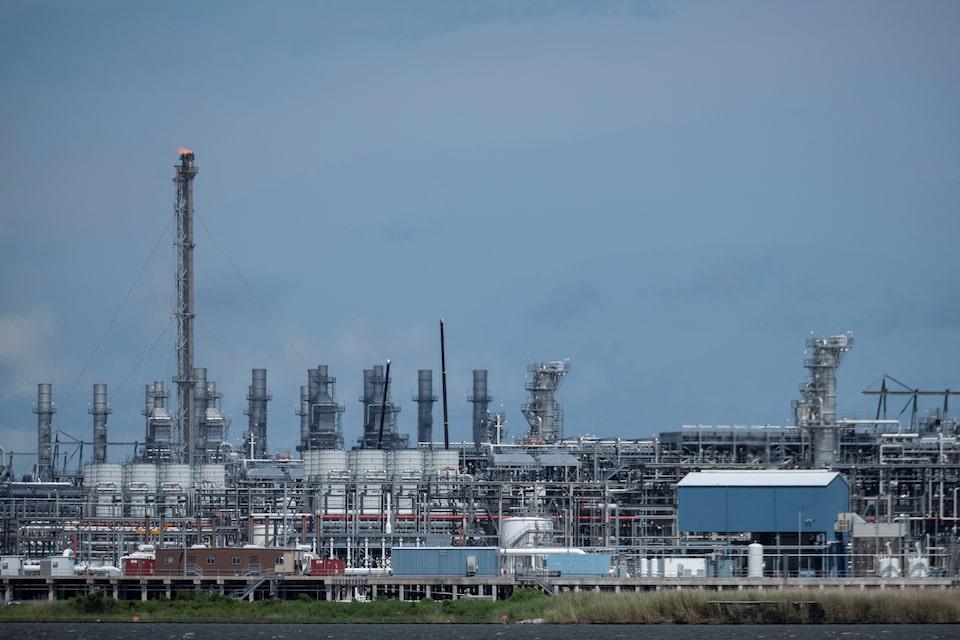
HOUSTON, Sept 23 (Reuters) - Gas flow into the largest U.S. liquefied natural gas (LNG) plant fell nearly 600 million cubic feet on Tuesday from Monday, short of peak demand by 1.4 billion cubic feet (bcf), according to preliminary data from financial firm LSEG. Cheniere Energy's (LNG.N) , opens new tab Sabine Pass plant in Texas, which can pull over 5 bcf a day of natural gas to convert into LNG, was down to 3.8 bcf from 4.4 bcf on Monday, suggesting at least one of its processing plants, which are called trains, could be offline, LSEG data showed. Sign up here. The company did not immediately respond to a request for comment. Cheniere is the largest exporter of the superchilled gas in the U.S. and played a key role in making the country the world's largest LNG exporter. https://www.reuters.com/business/energy/chenieres-biggest-lng-plant-pulling-less-gas-tuesday-lseg-data-shows-2025-09-23/
2025-09-23 18:58
International dollar bonds rise more than 2 cents Stocks tick up after Monday rally Shape and size of US support remains unclear; World Bank to deploy $4 billion NEW YORK/LONDON, Sept 23 (Reuters) - Argentina's international bonds extended gains on Tuesday and the local peso firmed against the dollar after U.S. President Donald Trump spoke in support of his right-wing peer in Argentina, Javier Milei, and his economic program. The World Bank said it aims to deploy up to $4 billion in Argentina in the coming months to support the South American country's reform agenda. Sign up here. Argentine assets rose as Trump said the U.S. will help Milei's economic program to "ensure both countries' success," adding that the South American grains exporter will not need an outright bailout. Milei faces a key midterm election on October 26. The day's market moves lifted bonds up by 2 to 3 cents, data from MarketAxess showed, with the 2046 up 2.8 cents at 59 cents on the dollar. The peso rose 4% to the dollar following a similar gain on Monday. Stocks drifted higher, with the local benchmark (.MERV) , opens new tab up 1% after a Monday gain near 8%, and shares traded in U.S. exchanges (.BKAR) , opens new tab rose 3%. Argentine assets rallied , opens new tabon Monday after U.S. support was initially announced by Treasury Secretary Scott Bessent. Specifics of that support have not been disclosed. "We're still awaiting more details, but the core aim is to stabilize Argentinean assets," said Shamaila Khan, head of fixed income for emerging markets and Asia Pacific at UBS. "The statements from Bessent yesterday were remarkably strong and unprecedented in their support for Argentina," she added. "Regardless of the specific announcements, we anticipate that Argentina will receive the necessary support." WHAT WILL U.S. SUPPORT LOOK LIKE? The country's embattled peso currency strengthened nearly 5% to the dollar, extending Monday's rise in a sharp reversal from last week, when the Argentine central bank burned through more than $1 billion of reserves to defend its currency. Lack of detail on what the Trump administration would provide to Argentina had investors speculating on the shape and size of the support. "For the short term, it's certainly good," said Juan Perez, director of trading at Monex. "But in the long term, we'll see what the commitment actually materializes into." He said Argentina is benefiting from being politically aligned with the Trump administration. "The U.S. administration has made it very clear that when it comes to global trade, any type of commercial relationship is not going to be based solely on numbers or business. It's also going to be somewhat embedded with an agenda or with some sort of political goal behind it." Earlier this year, Argentina renewed a $5 billion swap line with China's central bank, which forms part of an overall $18 billion facility with the PBOC that has helped the South American nation to shore up its reserves, but has also drawn ire from Washington. MILEI'S REFORMS ON TRACK? Financial assets of Argentina, a serial defaulter on its debt, have been on a rollercoaster in recent months and years. Investors have broadly warmed to Argentina since Milei became president in December 2023 and launched an ambitious reform program. However, markets have fallen sharply in recent weeks, with international bonds still down near 10% for the year and the peso coming under pressure after corruption allegations inside Milei's inner circle and a larger-than-expected loss in a local election in Buenos Aires triggered concern over his ability to reshape the economy. https://www.reuters.com/business/finance/argentina-markets-extend-stellar-rebound-ahead-expected-trump-milei-meeting-2025-09-23/

2025-09-23 18:17
By Promit Mukherjee and David Ljunggren OTTAWA, Sept 23 (Reuters) - President Donald Trump's actions are raising questions about the continued independence of U.S. monetary policy and have also dented the safe haven appeal of the U.S. dollar, Bank of Canada Governor Tiff Macklem said on Tuesday. Sign up here. The observations mark the first time Macklem has commented on Trump's attempts to influence the Federal Reserve. In the last few months, Trump has cranked up his demands for a rate cut, tried to remove one of the Fed's governors and repeatedly insisted that chair Jerome Powell resign. "President Trump's attempts to influence the Federal Reserve are raising questions about the continued independence of U.S. monetary policy," Macklem told the Saskatoon Chamber of Commerce in the western province of Saskatchewan. Macklem said the new global uncertainty, triggered in part by tariffs, underscored the need for Canada to boost productivity and find new foreign markets. "The question now is whether U.S. dominance in global financial flows will ebb as the United States pulls back from trade and runs large fiscal deficits. The recent performance of the U.S. dollar may be telling us something," he said. The greenback, he noted, was losing its appeal, falling almost 10% since Trump unleashed a barrage of tariffs globally in April. This, Macklem said, had called the dollar's safe haven role into question. "For now, the greenback remains dominant, and — without a clear alternative — I suspect it will remain the global reserve currency for the foreseeable future. But for many, its value as a hedge in times of stress has been dented," he said. He said the shifting trade equation with the U.S. had immense ramifications for Canada. "We can't afford to wait this out," he said, adding that Canadian businesses as well as political and economic leaders would need to chart a new course. "We should have been making these changes 15 years ago. But the next best time is now," he said. Canada has long suffered from anemic productivity which economists and businesses say is helping fuel inflation. "We need to diversify our trade by growing our internal market and finding new overseas markets. And we need to improve our productivity and make ourselves more attractive to investors," Macklem said. Canada's economy will work less efficiently, costs will go up and incomes will shrink due to increased trade friction with the U.S., he said, but noted monetary policy would not be able to soften these impacts. "Monetary policy cannot undo the efficiency costs of U.S. tariffs ... nor can counter-cyclical fiscal stimulus," he said, adding that only positive structural reform could offset that. ((Reuters Ottawa bureau)) Keywords: CANADA CENBANK/ https://www.reuters.com/world/americas/bank-canada-head-trump-is-raising-questions-about-independence-us-monetary-2025-09-23/

2025-09-23 17:42
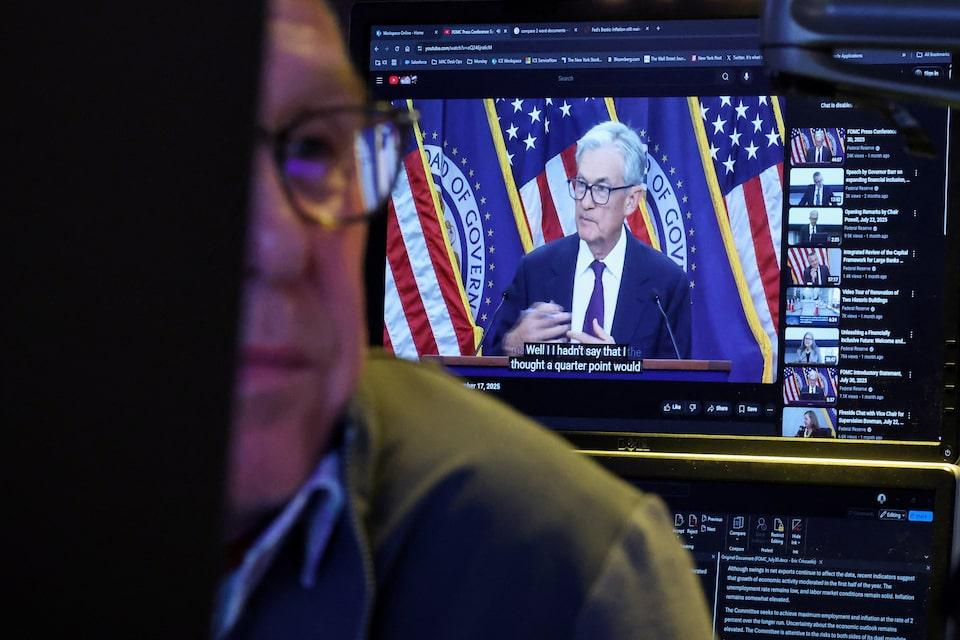
NEW YORK, Sept 23 (Reuters) - U.S. Federal Reserve Chair Jerome Powell said on Tuesday the central bank is in a "challenging situation" with an ongoing risk of faster-than-expected inflation at the same time that weak job growth has raised concern about the health of the labor market. In prepared comments to Rhode Island's Greater Providence Chamber of Commerce, Powell offered little indication of when he thinks the Fed might next cut interest rates, noting that there was danger to both cutting too fast and risking a new surge of inflation, or reducing rates too slowly and possibly causing unemployment to rise unnecessarily. Sign up here. MARKET REACTION STOCKS: The S&P 500 (.SPX) , opens new tab extended declines and was last down 40.71 points, or 0.60%, to 6,653.37. BONDS: Treasury yields moved lower, with the yield on the benchmark U.S. 10-year note off 2.7 basis points to 4.118% and the two-year note yield off 0.9 basis point to 3.592%. FOREX: The dollar index briefly strengthened before reversing and was last down 0.1% to 97.23. COMMENTS: OLIVER PURSCHE, SENIOR VICE PRESIDENT, WEALTHSPIRE ADVISORS, NEW YORK: “I think market participants have priced in 50 basis points worth of cuts (this year). We've gotten 25. And (Powell’s) comments, along with the comments from the other Fed governor yesterday, put doubt into whether or not we're going to see another rate cut this year. “As we've seen for the better part of this year, while there's certainly been resilience in the economy, the data has hardly been even and consistent and is now dipping to more of a slowdown. “The economy is surprisingly resilient and the consumer is surprisingly resilient. However, we know from history that when the job market starts to weaken and we shift from a lack of hiring to layoffs, which is the fear; it hasn't materialized, but that's the concern. Then the consumer tends to also slow down. And heading into the fourth quarter, that's potentially problematic. I think that the market needs to start to consider that as a very real possibility. “And by the way, Powell has flat-out said that. In these prepared remarks he says that inflation risks are real and persistent, and that's what's putting them in such a difficult position.” “The take-away should be that, with this being the third year of double digit returns for the S&P 500, there needs to be another strong catalyst to move stocks materially higher. And right now, it is not clear what that catalyst can be.” ADAM SARHAN, CHIEF EXECUTIVE, 50 PARK INVESTMENTS, NEW YORK: "Powell has made it very clear there's still uncertainty with respect to inflation, and inflation still remains elevated. It's not a deal breaker... but it's not an all-clear, either. So we're in a situation now where we're likely to continue to get small, slow-and-steady modest cuts from the Fed, but anyone who was expecting like a 200-basis-point cut most likely that's not going to happen, until inflation comes down. "It's a muted reaction. He's not telling us anything new. We know inflation is high, and we know with the jobs environment that there's some uncertainty there." EUGENE EPSTEIN, HEAD OF TRADING AND STRUCTURED PRODUCTS, MONEYCORP, NEW JERSEY: “Powell reiterated some of his tone from the Fed decision last week really. His tone now and last week is dovish, I would argue. The question was always would his dovishness meet the expectations of dovishness, meaning how dovish he was going to be. And I would say it didn’t really meet expectations. . . There was a high bar for dovishness that was set, and I don’t think it was met. Regardless, the tone was and is still concern over the job market. That’s why I think you can make the argument that the dollar didn’t retrace substantially.” https://www.reuters.com/business/view-feds-powell-repeats-no-risk-free-path-job-inflation-risks-weighed-2025-09-23/
2025-09-23 17:08
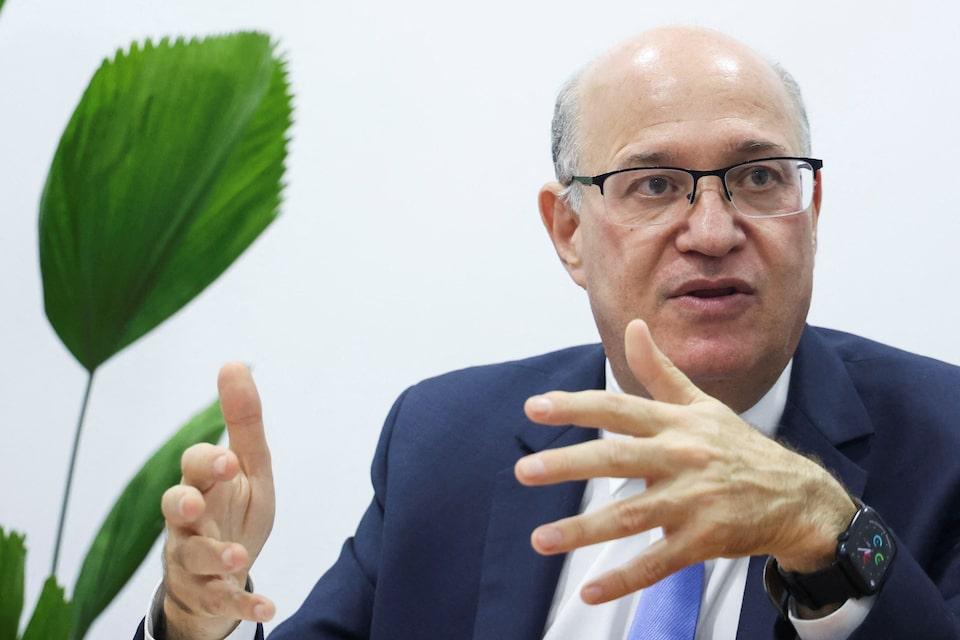
Sept 23 (Reuters) - The Inter-American Development Bank is aiming to attract private capital to Latin America by helping turn a pool of up to $500 billion of regional local loans into investable global assets, the lender said on Tuesday. ReInvest+, a partnership between the IDB Group and Brazil's presidency of the COP30, seeks to convert performing loans already on local bank balance sheets into investment-grade, hard-currency securities by adding political and foreign exchange risk insurance. The move is designed to attract institutional investors who typically shy away from early-stage, unrated, and local-currency projects. Sign up here. “Up until now, we’ve asked investors to change their risk appetite,” IDB President Ilan Goldfajn said. “We’re flipping the script. The projects must go where the money is.” The initiative is part of a broader push to close the $1.3 trillion annual climate financing gap in developing countries outside China. Public funds cover only a fraction of that need, and private flows have lagged due in part to the perceived added risks. A study commissioned by the IDB estimates that the global pool of eligible loans could exceed $3 trillion. The IDB is calling for proposals from commercial and international banks to join the initiative, with submissions due by Oct. 24. Selected partners will be announced at COP30 in Brazil, where they are expected to commit to asset purchases over the next year. There is no preliminary amount goal set. The IDB will act as a trusted intermediary, setting criteria and offering financial technologies to support the transition. https://www.reuters.com/sustainability/climate-energy/idb-group-targets-500-bln-latin-american-loan-pool-global-investment-2025-09-23/