2025-09-23 06:42
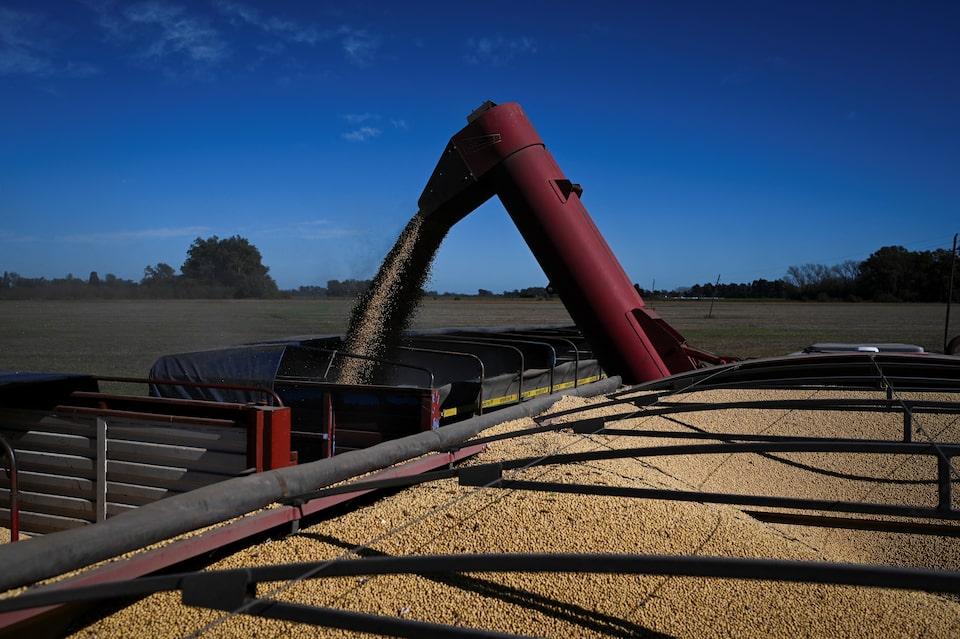
China buys at least 10 Argentine soybean cargoes after tax drop Cargoes for delivery in key period typically dominated by US Move piles pressure on US as China skips new-crop beans SINGAPORE/BEIJING, Sept 23 (Reuters) - Chinese buyers booked at least 10 cargoes of Argentine soybeans after Buenos Aires scrapped grain export taxes, three traders said on Tuesday, dealing another setback to U.S. farmers already shut out of their top market and hit by low prices. Argentina's temporary tax move boosts the competitiveness of its soybeans, prompting traders to secure cargoes for fourth-quarter inventories in China, a period usually dominated by U.S. shipments but now clouded by Washington's trade war with Beijing. Sign up here. The Panamax-sized shipments of 65,000 metric tons each are scheduled for November, with CNF (cost and freight) prices quoted at a premium of $2.15-$2.30 per bushel to the Chicago Board of Trade (CBOT) November soybean contract , two traders with direct knowledge of the matter said. One of the traders said Chinese buyers had booked 15 cargoes. The deals are a fresh blow for U.S. farmers, who are missing out on billions of dollars of soybean sales to China halfway through their prime marketing season as unresolved trade talks freeze exports and rival South American suppliers led by Brazil step in to fill the gap, traders and analysts have said. "Every time China turns to South America instead of the U.S., soybean farmers and our farm families here at home lose out," said Caleb Ragland, a farmer from Magnolia, Kentucky, and president of the American Soybean Association. "Without a trade deal that removes retaliatory tariffs, farmers like me are left watching key opportunities slip away." CHINA AVOIDS US SOY China, the world's biggest buyer of soybeans, has yet to purchase any U.S. soybean cargoes from its autumn harvest, traders have said. "These deals were done last night after Argentina's decision on export tax," said one of the traders, declining to be identified as they were not authorised to speak with media. "It clearly means that China doesn't need U.S. beans." On Friday, Chinese President Xi Jinping and U.S. President Donald Trump held a phone call but neither side reported any update on agriculture, further squeezing Chicago soybean futures already near five-year lows. After Argentina scrapped its export tax, Chicago soybean futures set a six-week low on Tuesday. "China is trying to avoid the U.S. during our export window," said Ted Seifried, chief market strategist for Zaner Ag Hedge in Chicago. "The timing is really perfect for them." Earlier this month, Reuters reported that China had nearly completed soybean purchases for October shipment and booked around 15% of its November needs, all from South America. By that time in previous years, traders said, China would have bought 12-13 million tons from the U.S. for September-November shipment. China has been gobbling up Argentina's raw soy during the trade war, with Argentine exports hitting a six-year high in the 2024/25 season. Local processors, however, are feeling the pinch. "It's clearly a concern," said Gustavo Idigoras, head of Argentina's soybean crushing chamber. "The temporary tax cut encourages China to take Argentina's soy." TEMPORARY TAX BREAK Argentina's government said the temporary grain tax suspension will last through October, or until declared exports reach $7 billion, a move that drove Chinese soymeal futures lower on Tuesday. By 0639 GMT, China's most-active Dalian soymeal futures were down 3.5% and the most-active Dalian soybean oil futures dropped 3.5%. "The decline in prices was mainly due to Argentina's removal of grain export taxes yesterday, which made prices more attractive to Chinese buyers given the favourable crushing margins," said Johnny Xiang, founder of Beijing-based AgRadar Consulting. "But the impact of this news is likely to be short-lived, as the policy will last for just over a month and Argentina's overall supply is limited," he added. Argentina typically imposes a 26% export tax on soybeans. China's soybean imports hit record highs in May, June, July and August, boosting inventories, partly as a hedge by buyers against potential fourth-quarter supply disruptions. "Looking ahead, the key factors to watch are actual Argentine soybean purchases and arrivals, along with the outcome of U.S.-China talks and how they might affect soybean imports in the fourth quarter and early next year," said Wan Chengzhi, an analyst at Capital Jingdu Futures. https://www.reuters.com/world/china/chinese-buyers-book-least-10-argentine-soybean-cargoes-sources-say-2025-09-23/
2025-09-23 06:22
NEW DELHI, Sept 23 (Reuters) - Sri Lanka has no immediate plans to import liquefied natural gas (LNG) from India, as the required infrastructure including storage facilities is yet to be built, the country’s energy minister said on Tuesday. India announced last year it would supply LNG to Sri Lanka’s power plants and work on cross-border energy connectivity, including a petroleum pipeline and power grid link. Sign up here. However, no progress has been made on the supply of LNG. "We have to first build the storage facility. Construction has not commenced yet,” said Sri Lanka's energy minister Kumara Jayakody, speaking to Reuters on the sidelines of Confederation of Indian Industry's energy summit in New Delhi. Sri Lanka is yet to finalise the LNG contract procurement with India, he said. The minister said it would take at least three years to complete construction of the storage infrastructure, and imports would begin only after that. While discussions to build storage had taken place under the previous government, no contracts have been finalised, he added. “We are studying the earlier content, deciding the location, and evaluating the loan and pricing aspects,” Jayakody said. Indian state-run firm Petronet LNG (PLNG.NS) , opens new tab had last year signed a deal to supply LNG to Sri Lankan engineering firm LTL Holdings' power plants in Colombo. The minister said both countries have formed a team and are working on submitting prospective reports about the planned work of developing a cross-border transmission system from southern India to the island's north. https://www.reuters.com/sustainability/climate-energy/sri-lanka-says-no-immediate-lng-imports-india-infrastructure-lags-2025-09-23/

2025-09-23 06:20
ROME, Sept 23 (Reuters) - Italy's government has given a conditional green light to the merger between energy contractor Saipem (SPMI.MI) , opens new tab and its Norwegian rival Subsea7 (SUBC.OL) , opens new tab, financial newspaper MF reported on Tuesday. Rome's approval, given on September 18, is subject to Saipem keeping in Italy all those activities that are considered strategic, giving priority to Italian energy infrastructure and continuing its underwater drone project, the report said. Sign up here. The merger will be voted on by the two companies' shareholder meetings, both on Thursday, the report said. The newspaper added that despite the conditions, which are aimed at protecting the national interest, the government sees the merger as "crucial for Saipem". The Italian government controls 12.8% of Saipem through state lender CDP. State-backed energy group Eni (ENI.MI) , opens new tab holds a further 21.2%. The combined group, to be renamed Saipem7, will have an order backlog of 43 billion euros ($50.62 billion), revenue of about 21 billion euros and core earnings of more than 2 billion euros, the companies said in a statement in July. The deal is expected to be completed in the second half of 2026, the companies said. Saipem, Subsea7 and the Italian government were not immediately available for comment. https://www.reuters.com/business/energy/italy-gives-conditional-green-light-saipems-merger-with-norways-subsea7-paper-2025-09-23/

2025-09-23 06:18
Fed Chair Jerome Powell to speak at 1635 GMT Miran says Fed endangering its job goal with restrictive rates Spot gold hits record high of $3,759.02/oz Sept 23 (Reuters) - Gold prices steadied on Tuesday after reaching a record high, underpinned by expectations of more U.S. rate cuts and a weaker dollar, as investors awaited Federal Reserve Chair Jerome Powell's speech for further policy cues. Spot gold was up 0.2% at $3,753.25 per ounce, as of 0604 GMT, after hitting a record high of $3,759.02 earlier in the session. Sign up here. U.S. gold futures for December delivery rose 0.3% to $3,787.40. The U.S. dollar index (.DXY) , opens new tab extended its losses from the previous session, making greenback-priced gold cheaper for overseas buyers. "I think it's predominantly a factor of monetary policy expectations, potentially lower interest rates, and upside risks to inflation," said Capital.com analyst Kyle Rodda. "The short-term trend is still bullish intact, but on an intraday basis, we do expect a short-term pullback more due to technical factors," OANDA senior market analyst Kelvin Wong said. Investors are closely awaiting Powell's speech, due at 1635 GMT, for signals on the U.S. central bank's policy. The U.S. Personal Consumption Expenditures index, Fed's preferred inflation gauge, is due on Friday. New Federal Reserve Governor Stephen Miran said on Monday that the Fed is misreading how tight it has set monetary policy and will put the job market at risk without aggressive rate cuts, a view countered in remarks by three of his colleagues who feel the central bank needs to remain cautious about inflation. According to the CME FedWatch tool, investors see a 90% probability of a 25-basis-point rate cut in October and a 75% chance of another one in December. "We see slowing economic growth, higher inflation, the shifting geopolitical landscape and a weaker USD keeping gold's investment demand strong," ANZ said in a note. Spot silver fell 0.6% to $43.82 per ounce, hovering near a 14-year high. Platinum was down 0.3% at $1,412.64 and palladium inched higher 0.3% to $1,182.24. "Sustained tightness in the spot market and continued supply dislocation is expected to keep (silver) prices volatile," ANZ added. https://www.reuters.com/world/india/gold-hits-record-high-traders-bet-us-rate-cuts-eye-powells-signal-2025-09-23/

2025-09-23 06:08
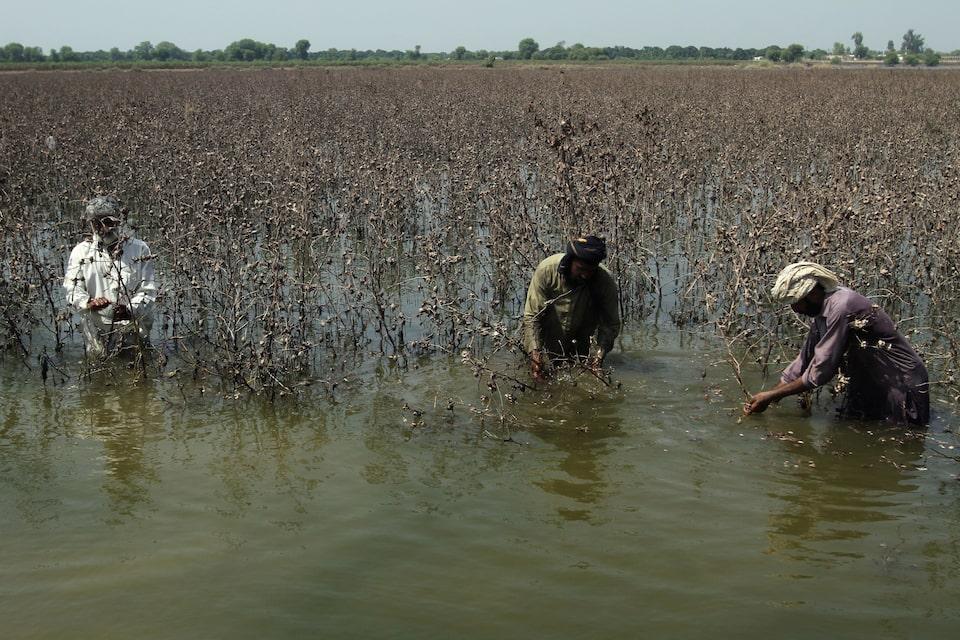
Pakistan growth target hit as floods swamp farms, cities Crop Monitor maps 220,000 hectares of rice fields flooded Report flags risks to wheat sowing despite strong 2024 reserves Cotton shortfall may ripple through textile sector IMF to review FY26 budget agility after floods KARACHI/ ISLAMABAD, Sept 23 (Reuters) - Massive floods in Pakistan have struck both the rural heartland and industrial centres for the first time in decades, causing billions of dollars in damage while straining food supplies, exports and a fragile economic recovery. The government had been optimistic about 2026, pencilling in 4.2% growth on the back of a rebound in farming and manufacturing after the economy was stabilised under a $7 billion International Monetary Fund bailout. Sign up here. Instead, record monsoon rains since late June, amplified by dam releases from India, have submerged large swathes of Punjab and Sindh, the two most populous and economically vital provinces. While waters have yet to recede in many districts, officials and analysts warn the hit could be deeper than in 2022, when a third of the country lay under water, due to dual shocks to agriculture and manufacturing. Out on the plains, satellite images have traced the scale. A report from agricultural monitoring initiative GEOGLAM estimates at least 220,000 hectares of rice fields flooded between August 1 and September 16. In Punjab, Pakistan's rice, cotton and maize engine, 1.8 million acres of farmland have been inundated, according to the provincial disaster management agency. "About 50% of rice, and 60% of cotton and maize crops have been damaged," said Khalid Bath, chairman of the Pakistan Farmers Association. He said losses could exceed 2.5 million acres, worth up to one trillion rupees ($3.53 billion). "This is unlike anything we have seen in recent decades," said Iqrar Ahmad Khan, former vice chancellor of the University of Agriculture Faisalabad. He estimates at least a tenth of the country's crops are destroyed, with vegetable losses topping 90% in some districts. The timing is perilous: Pakistan is about to sow wheat, the crop that provides nearly half of the country's caloric intake. National reserves remain comfortable after a strong 2024 harvest, according to Crop Monitor, but the sowing window is at risk in fields still slick with silt and mud. "Food insecurity is coming, not just higher prices," Khan warned. UNDERPLAYING RISKS Planning Minister Ahsan Iqbal acknowledged the floods would "set back" GDP growth and said a clearer damage tally would be ready in about two weeks. Pakistan's central bank said the deluge would cause a "temporary yet significant supply shock," and it put growth near the lower end of its 3.25–4.25% range. It argued the shock would be less severe than the $30 billion disaster in 2022, with stronger forex reserves and lower interest rates offering some resilience. But prices for wheat, sugar, onions and tomatoes have jumped, pushing a sensitive price index to a 26‑month high. IMF resident representative Mahir Binici said an upcoming review of the Extended Fund Facility this week will assess whether the 2026 fiscal year budget and emergency provisions can meet the nation's needs. Iqbal called on the fund to "help us mitigate the damages". Some economists say policymakers are underplaying the risks. "The floods will increase the current account deficit by $7 billion. They are worse than the previous floods," former finance minister Hafeez Pasha said. COUNTING LOSSES In industrial cities such as Sialkot - a hub for the textiles, sporting goods and surgical equipment that underpin Pakistan's exports - several workshops were marooned. The hit to agriculture is also a blow for manufacturers. Industrialists say cotton shortfalls will ripple into the textile sector, the country's top foreign exchange earner, while rice exporters warn Pakistan risks losing competitiveness to India as prices rise. "We had 400 acres of cotton, but only 90 are left," farmer Rab Nawaz said, near the historic city of Multan. At least 1,006 people have been killed since June 26, the National Disaster Management Authority said, while over 2.5 million people have been evacuated in Punjab and Sindh. In provincial capital Lahore, homes and small businesses were gutted. Mohammad Arif, a 50‑year‑old rickshaw driver and father of five, said he moved his vehicle to higher ground as his home was inundated. "We have been on the roads for three days," he said. https://www.reuters.com/sustainability/climate-energy/pakistan-floods-batter-fields-factories-fiscal-plans-2025-09-23/
2025-09-23 05:44
Sept 23 (Reuters) - A sixth tanker carrying liquefied natural gas from Russia's sanctioned Arctic LNG 2 project discharged at China's Beihai terminal on Tuesday, according to Kpler's ship‑tracking data and LSEG. The Arctic Mulan offloaded more than 75,000 cubic meters of LNG at the southern Guangxi port, according to data compiled by LSEG, marking its second delivery to China since August 28. Sign up here. The tanker had previously loaded at Kamchatka in the Russian Far East, which has exclusively handled cargoes from Novatek's (NVTK.MM) , opens new tab Arctic LNG 2 project. Another vessel, the Arctic Vostok, also loaded at Kamchatka, was seen passing southeast of China's Hainan Island on Tuesday, according to LSEG and Kpler, although tracking data does not confirm docking at Beihai. The tanker is owned by Lule One Services Inc and managed by Ocean Speedstar Solutions, both registered in India, according to sanctions data provider OpenSanctions. Reuters could not immediately get in touch with the shipowners or the companies managing these vessels. Kpler's data showed that the vessel was in the Gulf of Tonkin on September 16, where the Beihai terminal is located. However, neither provider shows the vessel having docked at Beihai. Two more sanctioned tankers are currently underway. The La Perouse, carrying 150,000 cubic meters of LNG from Gydan in northern Siberia, has passed Cape Town en route to the Indian Ocean. Meanwhile, the Arctic Metagaz, loaded with more than 133,000 cubic meters from Murmansk, is passing Japan and continuing south, according to Kpler's data, with no confirmed destination. The Arctic LNG 2, 60% owned by Russia's Novatek, was set to become one of the country's largest LNG plants, with a target annual output of 19.8 million metric tons, but Western sanctions have cast uncertainty over its future. https://www.reuters.com/business/energy/china-receives-sixth-cargo-sanctioned-russian-lng-project-2025-09-23/