2025-09-10 18:33
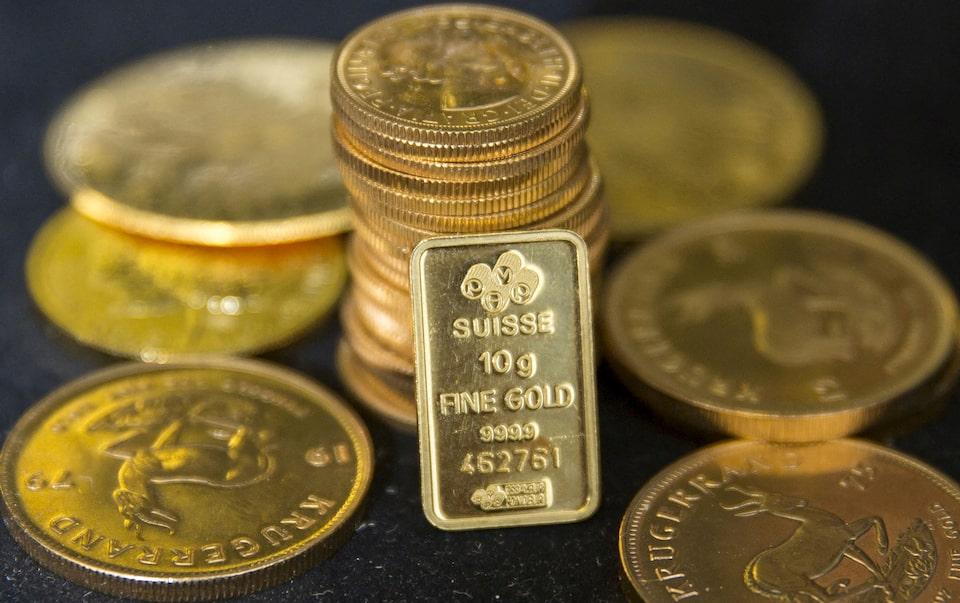
US producer prices slip in August Gold hit record high of $3,673.95/oz on Tuesday US CPI data due at 8:30 ET on Thursday Sept 10 (Reuters) - Gold hovered near all-time highs on Wednesday, supported by expectations that the Federal Reserve will resume rate cuts at next week's meeting, following softer-than-expected U.S. inflation data. Spot gold was up 0.6% at $3,647.94 per ounce, as of 2:18 p.m. EDT (1817 GMT), after hitting a record high of $3,673.95 on Tuesday. Sign up here. U.S. gold futures for December delivery settled flat at $3,682. U.S. producer prices unexpectedly fell in August, pulled down by a decline in the costs of services, Labor Department data showed. "Any further weakness in U.S. data should continue to support gold in the view that more than two rate cuts could be on the way before the year is out," said Fawad Razaqzada, market analyst at City Index and FOREX.com. Gold, traditionally seen as a hedge against political and economic uncertainty and inflation, also tends to do well in low-interest rate environments. It has risen more than 39% this year. Markets are pricing in a 90% probability of a quarter-point cut at the Fed's September 16-17 meeting, with slim odds on a larger cut, CME's FedWatch tool , opens new tab showed. Market confidence in easing was reinforced after last week's soft nonfarm payrolls report, which pointed to cooling labor market conditions. The Labor Department also revised down job growth estimates through March, suggesting job growth was already slowing before U.S. President Donald Trump's aggressive tariffs on imports. Meanwhile, a federal judge on Tuesday temporarily blocked Trump's attempt to remove Federal Reserve Governor Lisa Cook, an early setback for the White House in a legal fight that threatens the central bank's independence. Attention now turns to Thursday's consumer price index reading, seen as pivotal in shaping the Fed's policy stance. "The $3,750 mark is emerging as the next significant resistance, and a consolidation above it could see the precious metal approach $3,900 by year-end," Ricardo Evangelista, senior analyst at ActivTrades said. Elsewhere, spot silver added 0.8% to $41.21 per ounce. Platinum gained 1.7% to $1,391.80 and palladium rose nearly 3% to $1,180.81. https://www.reuters.com/world/india/gold-near-record-highs-softer-inflation-data-fuels-fed-cut-bets-2025-09-10/

2025-09-10 18:32
ATHENS, Sept 10 (Reuters) - U.S. oil major Chevron (CVX.N) , opens new tab has submitted a bid to explore for natural gas in four blocks offshore Greece in a consortium with Greece's Helleniq Energy (HEPr.AT) , opens new tab, Greece's Energy Minister Stavros Papastavrou said on Wednesday. The country launched the tender this year after Chevron and oil refiner Helleniq Energy expressed interest in four deep-sea blocks off the Peloponnese peninsula and the island of Crete. Sign up here. The deadline for bids was at 1700 (1400 GMT) on Wednesday. A Chevron spokesperson confirmed the bid for the four blocks. "Chevron has a large and important position in the Eastern Mediterranean, a region which is very much a part of our future and a priority for us." Greece, which produces very small volumes of oil, has ramped up renewables output in recent years but still relies heavily on gas for power generation. The country aims to tap domestic resources as part of a European Union push to shift away from Russian energy after Moscow invaded Ukraine. Major gas finds off Egypt, which lies south of Crete, have sparked hopes that Greek waters could also contain significant gas reserves. The area off Crete borders two licensed blocks where an ExxonMobil-led consortium has been seismic data before taking any final decision on test drilling. (This story has been corrected to say 'Helleniq Energy,' not 'Hellenic Energy,' in paragraphs 1 and 2) https://www.reuters.com/business/energy/chevron-bids-tender-gas-exploration-offshore-greece-2025-09-10/
2025-09-10 18:24
U.S. to sell $22 billion in 30-year bonds on Thursday Lack of appetite globally for long end of curve August auction saw weak demand NEW YORK, Sept 10 (Reuters) - Investors are cautiously approaching the U.S. Treasury's sale of $22 billion in 30-year bonds on Thursday after an underwhelming auction last month that had some of the weakest demand metrics of 2025, though some believe it could be different this time. The auction size is $3 billion smaller than that in August and could be easier to absorb, which could be an advantage, analysts said. Sign up here. However, the 30-year bond sale comes amid global disdain for the long end of the yield curve as worries about fiscal deficits, an age-old issue, continue to grip sovereign debt markets. The U.S. Treasury market - widely regarded as the cornerstone of the global financial system - has come under pressure amid mounting concerns over the high national debt, the inflationary impact of tariffs and growing unease about the Federal Reserve's independence. "The long end remains a singled-out segment, particularly the 30-year, where any problem that arises, investors' knee-jerk reaction has been to sell it," said Guneet Dhingra, head of U.S. rates strategy at BNP Paribas, in New York. "That dynamic, plus the fact that global long-end bond markets from Japan to the UK are flashing amber or red, is going to keep the long end of the U.S. curve under pressure." In last month's auction, the bid-to-cover ratio, a measure of investor demand, was 2.27, the lowest level since November 2023. End-user demand, which combines both indirect and direct bids, slumped to 82.5%, the worst since August 2024. Direct bidders in Treasury auctions are firms, such as pension funds and hedge funds, who submit bids for their own investment accounts directly to the U.S. Treasury. Indirect bidders, on the other hand, are investors who submit competitive bids through an intermediary, such as a primary dealer or a financial institution. These bidders also include foreign investors. That said, August is typically "seasonally negative" for 30-year supply, said Vail Hartman, U.S. rates strategist at BMO Capital. Since 2009, he noted that just one 30-year bond auction in August managed to go smoothly and that was in 2014. Overall, long-dated U.S. government debt continued to face headwinds, with the five-year/30-year yield curve steepening to 126 basis points last Friday — its widest level in more than four years . The move signaled persistent selling pressure on 30-year bonds, driving yields higher as investors reassessed the outlook for long-term rates. The curve has flattened a little bit this week as investors reduced their steepening positions ahead of Thursday's 30-year auction. "We'll be curious to see the reception to longer-dated supply at a moment when duration has proved to be a continuous underperformer on the curve," wrote BMO in a research note. DIFFERENT THIS TIME? But perhaps it could be different this time around, analysts said, especially as the Fed has shifted to a more dovish tone since the central bank gathering in Jackson Hole, Wyoming, on August 22. "With two very weak U.S. jobs reports, the market is much more confident about the slower growth sentiment," said Will Compernolle, macro strategist at FHN Financial in Chicago. "So the rally (in Treasuries) that we've seen in the 30-year since last Wednesday is on much firmer ground." The 30-year yield has declined by 28 basis points since last Wednesday, when it briefly topped 5% for the first time since mid July, and was last little changed at 4.719% / The selloff that lifted the long-bond yield to 5% immediately drew buyers. The long bond sale could also see support following a stellar $58 billion U.S. three-year note auction on Tuesday and another solid sale of $39 billion in benchmark 10-year notes on Wednesday. The well-subscribed three-year note sale offset the disappointing results from August. It had good support from indirect bids which took 74.2% of supply, up from 54.0% in the previous auction. For the 10-year note auction, the bid-to-cover of 2.65 was strong, higher than the 2.35 last month and the 2.61 in July. Indirect bidders were awarded a huge 83.1% of supply, well above the prior 64.2% and the second largest on record. https://www.reuters.com/business/investors-wary-treasurys-30-year-bond-auction-after-recent-disappointments-2025-09-10/
2025-09-10 18:10
Sept 10 (Reuters) - The White House update to its tariff schedule is a "welcome development" after challenges caused by a recent U.S. Customs ruling on gold bars, the London Bullion Market Association said on Wednesday. The executive order, issued on September 5 by President Donald Trump, updates the tariff schedule for certain goods, including key gold products. The White House referred to them as reciprocal tariffs. Sign up here. Under the update, gold bars imported from "aligned partner" countries under certain codes of the Harmonized Tariff Schedule of the United States - including 7108.11.00, 7108.12.50, 7108.13.10, 7108.13.55, 7108.13.70, and 7108.20.00 - will face a 0% tariff on entries made after September 8, 2025. The LBMA said the move was a "significant and positive step for the industry" following uncertainty caused by a recent U.S. Customs and Border Protection ruling. Earlier in August, the CBP website suggested that widely traded gold bullion bars could be subject to country-specific tariffs, prompting some traders to pause shipments to the U.S. while awaiting clarification. But days later, on August 11, President Trump sought to calm the market, posting on his social media account that "Gold will not be Tariffed!", though he offered no further details. "LBMA will continue to monitor developments and provide further updates as needed," the association said, noting ongoing discussions with members, market infrastructure providers and authorities in the U.S., Europe and the UK on tariffs for silver. In addition to the U.S. tariff update, the LBMA has clarified the classification of kilobars under the UK's REACH chemical regulation. According to the LBMA, the UK Health and Safety Executive indicated that kilobars imported as investment products could be classified as "articles," exempting them from registration. However, kilobars supplied for manufacturing purposes, such as jewellery making, may still be considered chemical substances, LBMA added. https://www.reuters.com/business/white-house-tariff-update-gold-bars-welcome-development-lbma-says-2025-09-10/
2025-09-10 17:11
Producer Price Index falls 0.1% in August Goods prices edge up 0.1%; cost of services eases 0.2% Producer prices increase 2.6% on year-over-year basis WASHINGTON, Sept 10 (Reuters) - U.S. producer prices unexpectedly fell in August amid a compression in trade services margins and mild increase in the cost of goods, suggesting that domestic firms were probably absorbing some of the tariffs on imports. The lack of strong producer price pressures, despite import duties, could also be signaling softening domestic demand against the backdrop of a struggling labor market. The Federal Reserve is expected to cut interest rates at its policy meeting next Wednesday, with a quarter-percentage-point reduction fully priced in, after it paused its easing cycle in January because of uncertainty over the impact of President Donald Trump's sweeping import tariffs. Sign up here. "Inflation barely has a heartbeat at the producer level which shows the tariff effect is not boosting across-the-board price pressures yet," said Christopher Rupkey, chief economist at FWDBONDS. "As time goes on, one has to wonder if there are slow-growth reasons and weak economic demand that is keeping inflation in check. There is almost nothing to stop an interest rate cut from coming now." RETAILERS MAY BE EATING TARIFF COSTS The Producer Price Index for final demand dipped 0.1% last month after a downwardly revised 0.7% jump in July, the Labor Department's Bureau of Labor Statistics said on Wednesday. Economists polled by Reuters had forecast the PPI would advance 0.3% after a previously reported 0.9% surge in July. A 0.2% drop in services prices accounted for the fall in the PPI. That decrease followed a 0.7% rebound in July. Services last month were held down by a 1.7% decline in margins for trade services, reflecting a 3.9% decrease in margins for machinery and vehicle wholesaling. "It does look like retailers have been eating tariff costs in recent months," said Stephen Stanley, chief economist at Santander U.S. Capital Markets. "This is quite consistent with the commentary from second-quarter earnings reports and other anecdotal evidence. Firms have consistently said that they have held the line as long as they could, but that they would need to begin selectively hiking prices going forward." The cost of services less trade, transportation and warehousing, however, increased 0.3% while prices for transportation and warehousing services shot up 0.9%. Portfolio management fees increased 2.0%. Airline fares rose 1.0% while the cost of hotel and motel rooms increased 0.9%. Prices for dental services accelerated 0.6%. Goods prices edged up 0.1% after increasing 0.6% in the prior month. Food prices gained 0.1%, with declines in the costs of eggs and fresh fruits partially offsetting more expensive beef and coffee because of tariffs. Wholesale beef prices surged 6.0% and were up 21.1% from a year ago. Coffee vaulted 6.9% and increased 33.3% on a year-over-year basis. Energy prices fell 0.4%. Excluding the volatile food and energy components, producer goods prices rose 0.3%, indicating some pass-through from tariffs. The so-called core goods prices gained 0.4% in July. In the 12 months through August, the PPI increased 2.6% after climbing 3.1% in July. FED EXPECTED TO CUT INTEREST RATES Trump seized on the tame producer inflation to demand a big rate cut from Fed Chair Jerome Powell, whom he derisively calls "Too Late." "Just out: No Inflation!!! 'Too Late' must lower the RATE, BIG, right now," Trump wrote on his Truth Social media platform. Stocks on Wall Street were mostly trading up, with the S&P 500 (.SPX) , opens new tab and Nasdaq Composite (.IXI) , opens new tab indexes hitting intraday record highs. The dollar slipped against a basket of currencies. U.S. Treasury yields fell. Economists, however, cautioned against complacency on inflation, arguing that the PPI readings were too volatile. "More than anything, they likely reflect ongoing adjustments in business strategies to deal with the tariffs," said Oren Klachkin, financial market economist at Nationwide. "Going forward, tariff impacts will be somewhat easier to see in the second half (of the year) now that businesses have drawn down their inventories and certain tariff reprieves have ended." The impact of tariffs may be reflected in the consumer price data due to be released on Thursday. A Reuters survey of economists forecast the Consumer Price Index increased 0.3% last month after climbing 0.2% in July. Consumer prices are expected to have advanced 2.9% on a year-over-year basis in August after rising 2.7% in July. Core CPI inflation is predicted to have increased 0.3% for a second straight month. That reading would keep the annual increase in core CPI inflation at 3.1%. Firmer consumer inflation would add to labor market weakness in fueling concerns that the economy was in danger of stagflation. The government estimated on Tuesday that the economy likely created 911,000 fewer jobs in the 12 months through March than previously estimated. That data followed the release last Friday of the monthly employment report, which showed job growth almost stalled in August and the economy shed jobs in June for the first time in four and a half years. "The Fed is almost certain to cut rates in light of worsening labor market conditions, but slow growth and higher prices continue to punish American families," said Elizabeth Pancotti, managing director of policy and advocacy at Groundwork Collaborative. https://www.reuters.com/business/cooler-us-producer-inflation-hints-softening-demand-2025-09-10/

2025-09-10 16:34
Barclays raises 2025 S&P 500 target to 6,450, Deutsche Bank to 7,000 Upgrades driven by earnings strength and AI optimism Barclays turns positive on U.S. tech; Deutsche Bank sees high valuations Sept 10 (Reuters) - Barclays and Deutsche Bank raised their year-end targets for the S&P 500 on Wednesday, citing stronger corporate earnings, resilient U.S. economic growth and optimism around artificial intelligence. Deutsche Bank increased its target to 7,000 from 6,550, while Barclays raised its forecast to 6,450 from 6,050. Sign up here. The index touched a record high of 6,555.97 earlier on Wednesday and has risen 11.2% so far this year. Barclays and Deutsche Bank join a spate of banks that recently upgraded their view on the U.S. stock market despite lingering concerns about President Donald Trump's tariffs on the economy and corporate earnings. "We expect equity valuations to remain elevated by historical standards, driven by higher payout ratios, perceptions of higher trend earnings growth...and earnings resilience with fewer significant drawdowns," says Binky Chadha, analyst at Deutsche Bank. The S&P 500 has rallied more than 30% from its April lows, buoyed by resilient earnings and investor enthusiasm around the AI boom. "Corporate earnings are solid and global GDP growth is stabilizing, but US labor market risks are worsening," say Barclays strategists, whose target suggests the S&P could end the year just below current levels. Data on Friday showed U.S. job growth weakened sharply in August and the unemployment rate rose to a near four-year high of 4.3%. Signs of a cooling labor market and tame inflation have increased expectations of U.S. Federal Reserve rate cuts this year and next, further supporting equities. Barclays expects three rate cuts before year-end, which it says will help offset labor market weakness. In addition, it lifted its 2026 target for the S&P 500 to 7,000 from 6,700. Investors will be closely watching the Fed's policy meeting next week for clues on the rate cut path and broader market direction. https://www.reuters.com/business/barclays-deutsche-bank-raise-sp-500-forecasts-bull-run-continues-2025-09-10/