2025-09-09 05:48
MEXICO CITY, Sept 8 (Reuters) - Mexico expects its budget deficit to fall slightly in 2026 to 4.10%, as GDP growth is seen ticking up, the finance ministry said on Monday in the government's budget proposal. The government has been under pressure to narrow the deficit, which it now expects will close 2025 at 4.32%, while maintaining a pledge to boost social programs and shore up the finances of highly indebted state oil firm Pemex. Sign up here. The government also forecast Latin America's second-largest economy to expand between 1.8% and 2.8% - an increase of 1.3 percentage points on both ends of the range. That is rosier than both the IMF's growth forecast, which sees a 1.4% expansion in 2026, and the Bank of Mexico's most recent forecast of 1.1% growth. The ministry also put its inflation forecast for end-2026 at 3.0%, meeting the target set by the Bank of Mexico, which sees inflation converging to target in the third quarter next year. Pemex is slated to receive some 263.5 billion Mexican pesos ($14.14 billion) from the government in 2026 to help the firm meet its debt and loan payments, according to the document. After President Claudia Sheinbaum said last week that her government was considering imposing tariffs on countries such as China that have no trade agreement with Mexico, the budget proposal said the country's 'General Import Tax' would be reviewed for 2026 to encourage national development, without giving any detail. The draft budget also announced new "healthy taxes" to serve as disincentives for unhealthy products, which would boost taxes on products like soft drinks, video games, and nicotine pouches. The budget proposal will now be debated by lawmakers in Congress, where Sheinbaum's party and its allies hold strong majorities in both chambers. ($1 = 18.6348 Mexican pesos) https://www.reuters.com/world/americas/mexico-sees-budget-deficit-lower-2026-growth-ticks-up-2025-09-09/

2025-09-09 05:34
Investors await preliminary U.S. jobs data revisions Traders increase bets on jumbo 50-bp Fed rate cut Bank Indonesia said to have intervened to stabilise market SINGAPORE, Sept 9 (Reuters) - The dollar sank to an almost seven-week low on Tuesday as investors braced for U.S. data revisions that could show the jobs market in worse shape than initially thought, shoring up the case for even deeper Federal Reserve interest rate cuts. The dollar index fell to lows of 97.323 in Asia trade, representing the weakest level for the greenback since July 24, ahead of the release of preliminary benchmark revisions , opens new tab for jobs data covering the period from April 2024 to March 2025. Sign up here. Economists anticipate a downward revision of as much as 800,000 jobs, which could signal that the Fed is behind the curve in efforts to achieve maximum employment. "The employment numbers are getting worse and worse at a heavy rate," said Alex Hill, managing director at Electus Financial in Auckland. "That's translating into a weaker U.S. dollar slowly, but we expect that to accelerate." Advisors to the Trump administration are preparing a report laying out the alleged shortcomings of the Bureau of Labor Statistics, which they may publish in coming weeks, The Wall Street Journal , opens new tab reported on Tuesday, citing unnamed sources. Last month U.S. President Donald Trump fired BLS Commissioner Erika McEntarfer, accusing her, without evidence, of faking the employment data. U.S. bond investors say they are seeing cracks emerging in the outlook, warning the market is underpricing long-term fiscal risks and the danger posed by White House pressure on the central bank to cut interest rates. Traders' expectations of more aggressive Fed easing are gradually increasing. Pricing of Fed funds futures on Tuesday implied an 11.6% probability of a jumbo 50 basis point rate cut at the Fed's September meeting, compared with an 11% chance on Monday, according to the CME Group's FedWatch tool, with a cut of at least 25 basis points viewed as a certainty. Gold set a new record high, up as much as 0.5% to $3,656.92. The euro appreciated 0.1% in Asia hours, trading to as much as $1.1778 , the strongest level since July 24. Its appreciation was restrained as France's parliament brought down the government on Monday over plans to tame ballooning national debt, deepening a political crisis that is weakening the euro zone's second-largest economy. The European Central Bank is widely expected to hold rates at its policy meeting on Thursday. Analysts from ING said they expected limited spillover to European financial markets, as "the hurdle for pricing in more European Central Bank easing is high." The yen strengthened against the dollar, reversing weakness from Monday after Prime Minister Shigeru Ishiba resigned. The currency was 0.3% stronger at 147.125 yen and speculation turned to who could succeed him. "There may be growing expectations that macroeconomic policy could tilt toward easing among foreign investors in particular," analysts from Morgan Stanley MUFG Securities wrote in a research note. "Regardless of the political situation, if weak U.S. economic data—including employment data—continue, the bar for the BOJ to raise rates will likely become higher." The Indonesian rupiah weakened 0.8% after the government replaced its finance minister on Monday. Bank Indonesia , opens new tab was seen buying longer-dated government bonds on Tuesday in an attempt to stabilise the market, according to two traders. The Australian dollar fetched $0.6606 , up 0.2% in early trade, while the kiwi traded 0.2% higher at $0.5949 . The offshore yuan traded 0.1% stronger at 7.1193 yuan per dollar , while sterling traded at $1.3576 , up 0.2% so far on the day. https://www.reuters.com/world/middle-east/dollar-hits-7-week-low-jobs-gloom-heightens-fed-cut-chances-2025-09-09/

2025-09-09 05:24
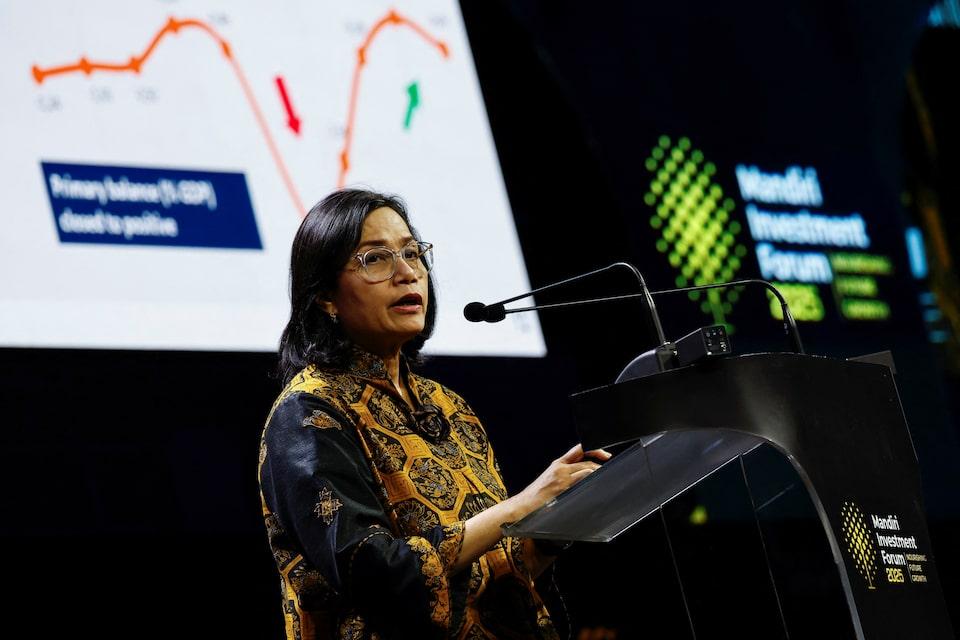
Investors worry fiscal discipline could erode Rupiah sinks over 1%, prompting central bank intervention Indo stocks drop 1.6% led by banking stocks Spotlight will be on new finance minister's policies SINGAPORE, Sept 9 (Reuters) - The abrupt removal of Indonesia's influential finance minister Sri Mulyani Indrawati has stunned markets, as investors fear the hard-fought fiscal credibility could be eroded by the populist and costly spending plans under President Prabowo Subianto. The news of the finance minister's removal sent the rupiah tumbling over 1% on Tuesday, prompting Bank Indonesia to intervene in a bid to stabilize the currency. The rupiah was last 0.9% weaker at 16,440 per U.S. dollar. Jakarta stocks (.JKSE) , opens new tab also sank 1%, with banking stocks the biggest drag. Sign up here. Indonesia's central bank was also active in the bond market, buying longer-dated government bonds in an attempt to stabilise the market, two traders told Reuters. Global investors have viewed Sri Mulyani, one of Indonesia's longest-serving finance ministers in three different stints, as crucial to their bets in Southeast Asia's biggest economy and her previous departures sent markets tumbling. "Mulyani was the safeguard of prudent fiscal policy," said Hasnain Malik, EM equity and geopolitics strategist at Tellimer. "Her departure will stir up fears of widening deficits under an unconstrained and, after the protests, under-pressure Prabowo." The move to replace Sri Mulyani with Purbaya Yudhi Sadewa, an economist who has promised accelerated growth, comes at a delicate time for Indonesia as it grapples with widespread protests and unrest that have raged for two weeks. Calls for a fairer taxation system have erupted as Prabowo faces the biggest challenge of his presidency so far while his flagship free meals programme that seeks to provide meals to over 80 million Indonesians has struggled in its first year. "IDR may have to bear the brunt ... until greater confidence about what the cabinet reshuffle entails for any prospective shifts in budgetary outlays and funding sources," said Aninda Mitra, head of Asia macro strategy at BNY Investment Institute. "Market participants will want certainty about policy settings and a steady hand at the fiscal till." NEW FINANCE MINISTER'S CHALLENGES Sri Mulyani has won plaudits for reforming the taxation system and is widely considered the lynchpin behind improving Indonesia's fiscal performance in the past decade and winning investor approval. That fiscal prudence though has been at odds with Prabowo's spending plans and the challenge now lies with the new finance minister to find room in the budget to accommodate the president's wishes and tackle growing economic worries. "To afford the lunch program, she (Mulyani) had to make the difficult decision of cutting expenditure very aggressively to maintain fiscal sustainability," said Trinh Nguyen, senior economist for emerging Asia at Natixis. Purbaya told reporters the president's target of 8% economic growth was "not impossible" and that he would find ways to quickly boost the economy and push for more involvement of both the private sector and the government. "The issue is how is the new FM going to afford the 1.5% of GDP lunch program and raise spending for sectors such as defence without punching a larger hole in the deficit," Nguyen said. "For investors, that will be a key concern. Beyond the rupiah market, investors were also keeping tabs on Indonesia's international bonds which fell on Monday. The focus is on whether Sri Mulyani's departure could force an exodus of global investors, although their exposure has drastically reduced in the past decade. Foreigners hold less than 14% of outstanding Indonesian government securities, down from around a quarter back in December 2020, with the high-yielding bond market notoriously volatile during Indonesia's previous episodes of skyrocketing inflation. With foreign exchange reserves at $150.7 billion at the end of August, down from the $152 billion a month earlier, suggesting ample firepower for the central bank to defend the currency in the near term. "Bank Indonesia will continue to be present in the market to maintain exchange rate stability and sufficient liquidity of the rupiah," said Erwin Gunawan Hutapea, the central bank's head of monetary management. https://www.reuters.com/world/asia-pacific/indonesian-finance-ministers-removal-unnerves-investors-rupiah-sinks-2025-09-09/
2025-09-09 05:12
SINGAPORE, Sept 9 (Reuters) - The use of alternative fuels in shipping will accelerate after 2030 as tighter emissions standards come into effect, in contrast to the stop-start transition for now, shipping executives told the APPEC conference in Singapore on Tuesday. The take-off in this decade is expected to be gradual as shipping companies grapple with factors such as trade volatility and geopolitical uncertainty, but gains are expected in the following 10 years. Sign up here. "Between 2030 and 2040, I think this is where we're going to see the real kind of volume shift to low carbon fuels," said Emma Mazhari, CEO at Maersk Oil Trading (MAERSKb.CO) , opens new tab. Regulations including the European emissions trading scheme and maritime fuel standards are driving the shift, Mazhari said. "We can already see now when we bunker in Europe, there is increased supply of low carbon fuel ... so there's definitely a lot of change coming," she said. Because of the expected shift, Maersk is no longer investing in single-fuel ships. "If we invest in new assets now, they have to be dual-fuel, so that we have the optionality also to make sure that we can recoup the investments on a long-term scale," Mazhari said. Takeshi Hashimoto, CEO of Japan's second-largest shipping company Mitsui O.S.K. Lines (MOL) (9104.T) , opens new tab told the conference that over the next five to 10 years, shipping companies will focus first on reducing emissions through "proven products" like LNG and methanol. MOL is also aggressively exploring the use of wind power to assist ship propulsion systems, he said. Hashimoto added that shipping decarbonisation has been going through a "stop and go" currently, though the development of low-carbon marine fuels like green ammonia, green methanol and biomethane will be an imperative for the industry over the longer term. The shipping industry has been exploring lower-carbon alternative fuels to reduce its reliance on oil as it tries to meet carbon emission reduction targets set out by the U.N.'s International Maritime Organization. An executive from Tata NYK Shipping said regardless of geopolitical volatility, decarbonisation needs to be a priority. "Decarbonisation as a necessity and a strategy for shipowners will be there despite whatever we are hearing from the White House," said Amitabh Panda, managing director at Tata NYK Shipping, a joint venture between India's Tata Steel (TISC.NS) , opens new tab and Japan's NYK Line (9101.T) , opens new tab. But he acknowledged that the shifting geopolitical landscape complicates corporate decision making. "We are not very sure when and how much to invest, so the capital allocation becomes an issue." https://www.reuters.com/sustainability/climate-energy/alternative-marine-fuels-uptake-will-speed-up-after-2030-shipping-executives-say-2025-09-09/

2025-09-09 04:46
SINGAPORE, Sept 9 (Reuters) - Japan's second-largest shipping company Mitsui O.S.K. Lines (9104.T) , opens new tab wants to tie up with Indian companies to build tankers in India, aiding the South Asian nation's effort to boost local manufacturing, its chief executive, Takeshi Hashimoto said. New Delhi is modernising its maritime laws to allow foreign participation in the sector, including ship-building, ports and shipyards, to reduce freight outgoings to foreign firms by at least a third by 2047. Sign up here. "The Indian government has a strong preference to see the new vessels constructed in India. If possible, we want to be involved in the project," Hashimoto told reporters at the APPEC conference in Singapore on Tuesday. India's shipping fleet has not kept pace with its surge in trade, including the import of energy and the export of refined oil products. "We definitely need to work with the local partners and together with strong cooperation with Indian shipyards," Hashimoto said. India will set up a 250 billion rupees ($2.84 billion) maritime development fund for the long-term financing of the country's shipbuilding and repair industry, the government said in its budget in February. Shipbuilding is among the industries the government is looking to promote in a multibillion-dollar effort to turn India into a world-class manufacturing nation. ($1 = 87.9800 Indian rupees) https://www.reuters.com/world/india/japans-mitsui-osk-eyes-shipbuilding-partnerships-india-2025-09-09/

2025-09-09 04:33
A look at the day ahead in European and global markets from Rae Wee The political noise just keeps coming. Sign up here. Over the span of a few days, British Deputy Prime Minister Angela Rayner and Japanese Prime Minister Shigeru Ishiba have resigned, French lawmakers voted to oust Prime Minister Francois Bayrou, Argentine President Javier Milei's party suffered a heavy defeat and Indonesia abruptly replaced its long-standing finance minister. Investors in Europe will now look out for whom President Emmanuel Macron appoints as France's fifth prime minister in less than two years. Macron has so far resisted the idea of calling a snap election and appears set on proposing a new prime minister, possibly turning to the centre-left. There are no rules governing whom Macron must choose, or how quickly, but his office said he would appoint one in the next few days. The euro has thus far held steady, while French bond futures barely budged in Asia. Clearly, political volatility sometimes has next to no impact on markets. Sometimes, though, it's huge. Over in Indonesia, the rupiah slid more than 1% and the yield on the 10-year government bond jumped on Tuesday after the shock removal of influential finance minister Sri Mulyani Indrawati, as investors fear hard-fought fiscal credibility could be eroded by populist spending plans under President Prabowo Subianto. The Argentine peso lost as much as 5.6% to the dollar on Monday following Milei's election drubbing. But in the broader market, investor sentiment remained buoyant on the prospect of an interest rate cut by the U.S. Federal Reserve next week. With markets already pricing in a 25 basis-point cut, the question now is whether the Fed could deliver an outsized 50 bp move. Clues may lie in the U.S. Labor Department's preliminary revision estimate to employment for the year through March later on Tuesday, ahead of readings on consumer and producer price inflation later this week. A downside surprise in any of those figures could see traders price in a greater chance of a 50 bp cut, which currently stands at just above 11%, the CME FedWatch tool showed. Key developments that could influence markets on Tuesday: https://www.reuters.com/world/china/global-markets-view-europe-2025-09-09/