2025-12-04 03:01
MUMBAI, Dec 4 (Reuters) - The Indian rupee is expected to extend its slide on Thursday after breaching the 90-per-dollar mark, a move that traders say has firmed a weak bias and is likely to draw in speculative bets. The 1-month non-deliverable forward indicated the rupee will open in the 90.25-90.35 range versus the U.S. dollar, having settled at 90.19 on Wednesday. Sign up here. Bankers said the fall past the psychologically important 90 handle has further cemented the rupee's bearish bias, a shift that will nudge importers to step up hedging and prompt exporters to hold back in anticipation of better levels. Moreover, with no immediate positive catalysts on the horizon and the central bank signalling a preference for measured rather than heavy-handed intervention in recent days, bankers said speculative accounts will become more confident in wagering against the rupee. Madan Sabnavis, chief economist at Bank of Baroda, noted that a India-U.S. trade deal "is still not on the table", which is a sore point for the rupee. "Hence the importers are rushing in while exporters are holding back," he noted, adding that the RBI "appears to be apparently silent on intervention". "Any mark breached by the rupee which prevails for 2-3 days, becomes the new benchmark", he said. This in a way reinforces expectations of traders that the 90 level may now be sticky. The rupee's slide comes despite a broadly steady dollar index, underscoring that the weakness is being driven by flows. India's widening trade deficit, alongside weak capital flows, has skewed the underlying demand-supply balance for the dollar. This combination, bankers say, has brought the market to a point where routine corporate buying is enough to pile pressure on the rupee if the central bank is not there to absorb the flow. KEY INDICATORS: ** One-month non-deliverable rupee forward at 90.50-90.56; onshore one-month forward premium at 18.5 paise ** Dollar index at 98.96 ** Brent crude futures up 0.4% at $62.9 per barrel ** Ten-year U.S. note yield at 4.08% ** As per NSDL data, foreign investors sold a net $448.7 million worth of Indian shares on December 2 ** NSDL data shows foreign investors bought a net $2.1 million worth of Indian bonds on December 2 https://www.reuters.com/world/india/rupee-likely-extend-slide-90-breach-cements-weak-bias-invites-speculative-bets-2025-12-04/

2025-12-04 02:14
BENGALURU, Dec 4 (Reuters) - The Indian rupee will regain some lost ground against the U.S. dollar over the next three months, according to a Reuters poll of FX strategists, but a reversal in the currency's fortunes hinges upon India and the U.S. agreeing to a trade deal. U.S. President Donald Trump's punitive 50% tariff on Indian goods has soured sentiment among foreign investors, who have sold around $17 billion of Indian equities so far this year, pushing the rupee to record-low levels. Sign up here. Despite the Reserve Bank of India selling dollars in recent weeks and the economy growing at a robust 8.2% in the July-September quarter, the rupee hit a new low of 90.29 per dollar on Wednesday. The currency is down nearly 5% for the year against the greenback. Between foreign investors' reluctance to enter Indian equity markets without a U.S.-India trade deal and the RBI's tight leash on the rupee, the currency is expected to move in a narrow range in the near term. The partially convertible rupee was forecast to rise nearly 1.1% from current levels to 88.91 per dollar by end-February 2026, and then be marginally stronger at 88.83 by end-May, according to the median view of 37 forex analysts polled between December 1-3. "I was expecting some kind of India-U.S. trade deal to happen by November, and that hasn't happened. But still, the base case is that it should happen before the financial year-end, so that itself will boost the sentiment for the rupee," said A. Prasanna, head of fixed income research at ICICI Securities Primary Dealership. "The equity flows have been quite erratic, and FDI flows on a net basis have been weak. We don't see anything that tells us that the capital flows can improve on a sustainable basis...But we don't expect this kind of outright depreciation or one-sided pressure on the currency to continue." The currency was expected to gain nearly 0.3% to trade around 89.65 against the dollar in the coming 12 months, the poll also showed. (Other stories from the December foreign exchange poll) https://www.reuters.com/world/india/indian-rupee-rise-record-lows-us-trade-deal-key-recovery-2025-12-04/

2025-12-04 00:16
LONDON, Dec 4 (Reuters) - Great British Energy, a state-owned energy company, unveiled a five-year strategic plan on Thursday aimed at accelerating the country’s transition to renewable power to help meet its climate targets. Britain is seeking to largely decarbonise its power sector by 2030, a goal that it says will help drive down energy costs and that will also require a huge increase in renewable capacity. Sign up here. GBE was launched last year to invest in and co-develop clean power projects. The government has pledged a total of 8.3 billion pounds ($11.04 billion) over the current Parliament. Under the strategic plan, GBE said it would deliver some 15 gigawatts of clean energy generation and storage capacity by 2030, enough to power around 10 million homes, by using its own investments and partnerships to help mobilise 15 billion pounds of private finance. The company will focus on three priority areas: local community energy, onshore energy development, and offshore wind expansion, and will operate as both developer and equity investor, with returns from the publicly owned assets reinvested into new capacity. “GBE will build a portfolio which is generating income by 2030 and be on a pathway to company-wide profitability,” the strategic plan said. The initiative is expected to directly support over 10,000 jobs, including in regions that are historically reliant on oil and gas, while backing more than 1,000 local community energy projects, GBE said. ($1 = 0.7519 pounds) https://www.reuters.com/sustainability/climate-energy/britains-great-british-energy-unveils-plan-boost-renewable-power-by-2030-2025-12-04/

2025-12-03 23:53
Dec 4 (Reuters) - Australian telecom company Optus has fully restored its National Broadband Network (nbn) services in Brisbane and other affected areas of Queensland following a recent outage, according to an update on its website on Thursday. Optus, owned by Singapore Telecommunications (SingTel) (STEL.SI) , opens new tab, did not immediately respond to a Reuters' request for comment, while SingTel is also yet to respond. Sign up here. The outage on Wednesday left almost 100,000 Optus customers across Brisbane and southeast Queensland unable to dial "000", Australia's emergency number, after an nbn disruption, according to media reports , opens new tab. The outage also prevented some landline users from reaching emergency services, the reports added. Media outlets also reported that a spokesperson of the company told Brisbane radio the disruption had been caused by a network server failure. https://www.reuters.com/business/media-telecom/optus-restores-nbn-services-across-brisbane-parts-queensland-website-shows-2025-12-03/

2025-12-03 23:33
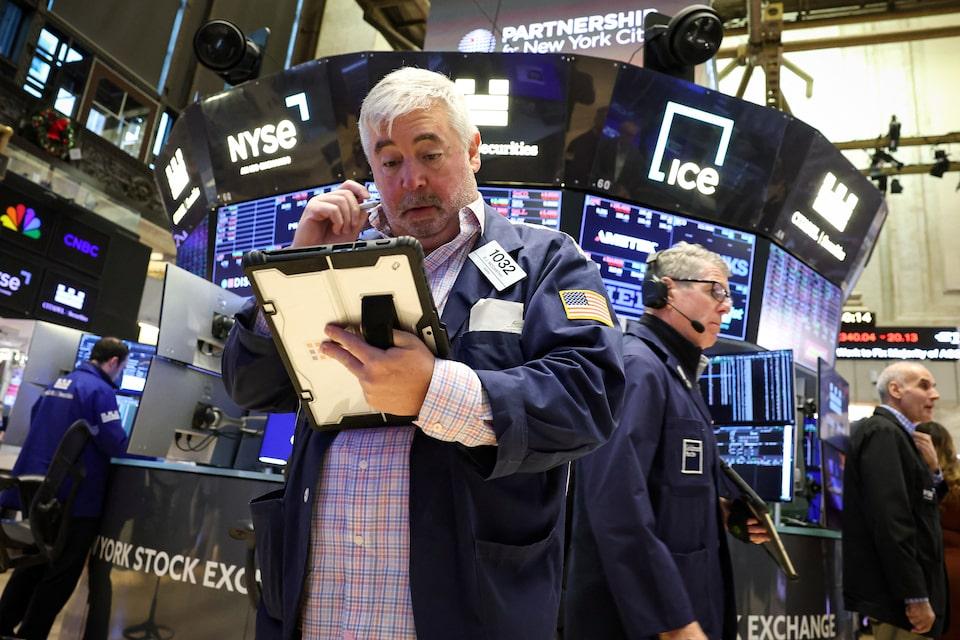
Investors assess ADP employment and ISM services reports Microsoft pares declines after disputing report about AI sales quotas Small caps outperform Indexes up: Dow 0.86%, S&P 0.30%, Nasdaq 0.17% NEW YORK, Dec 3 (Reuters) - U.S. stocks advanced to close higher on Wednesday, as a flurry of economic data kept expectations elevated for an interest rate cut by the Federal Reserve next week, while a fall in Microsoft's shares curbed the advance. The record-long 43-day U.S. government shutdown kept investors in the dark about official data and hampered the ability to gauge the Fed's likely path on interest rates. But the backlog is now being cleared along with data from non-governmental sources. Sign up here. The Institute for Supply Management said U.S. services activity was little changed in November at 52.6 versus 52.4 in October while the prices paid component dipped but remained elevated. The reading comes ahead of the delayed personal consumption expenditures report, the Fed's preferred inflation gauge, on Friday. Separately, the ADP National Employment Report showed U.S. private payrolls unexpectedly declined in November. With official employment reports for October and November due only after the central bank's policy announcement, market participants have placed more weight than usual on private-sector data. "For market participants, at least, the Federal Reserve will have ammo to lay off the hawkish tone that we saw a couple of weeks ago and perhaps lean more dovish into what looks to be disappointing and weakening labor data as we get this kind of real-time restart of the data cadence that we're used to," said Keith Buchanan, senior portfolio manager at Globalt Investments in Atlanta. "That's something that the markets are obviously receiving really well today, and we'll see as the onslaught of data continues if it will continue with this tone, and the markets will continue to receive it in the same way." The Dow Jones Industrial Average (.DJI) , opens new tab rose 408.44 points, or 0.86%, to 47,882.90, the S&P 500 (.SPX) , opens new tab gained 20.35 points, or 0.30%, to 6,849.72 and the Nasdaq Composite (.IXIC) , opens new tab gained 40.42 points, or 0.17%, to 23,454.09. Microsoft (MSFT.O) , opens new tab fell as much as 3% after a report said the tech giant has cut AI software sales quotas after many sales staff missed their targets in the fiscal year that ended in June. But shares bounced off session lows to decline by as little as 1.2% after CNBC said Microsoft denied the report, which helped pull the S&P 500 and Nasdaq into positive territory. Microsoft closed down 2.5%. The tech sector (.SPLRCT) , opens new tab finished 0.4% lower, one of two S&P 500 sectors in the red. Energy (.SPNY) , opens new tab, up 1.8%, was the best performing sector, lifted in part by a rise in oil prices. Traders' expectations for a 25-basis-point cut at next week's Fed meeting inched up to 89% after the data, up from around 87% earlier in the day, according to CME's FedWatch Tool , opens new tab. Investors weighed a report that President Donald Trump's administration has abruptly canceled interviews with finalists for the Fed chair role. This fueled expectations that Kevin Hassett - seen as likely to favor aggressive interest rate cuts - will replace Jerome Powell next May. Rate cut expectations have also lifted small caps recently, with the Russell 2000 index (.RUT) , opens new tab gaining nearly 2% on the session, following last week's 5.5% surge - its strongest weekly performance in more than a year. "We expect small caps to outperform in 2026, with earnings to drive returns," said Jill Carey Hall, equity and quant strategist at BofA Securities, adding that Fed rate cuts and a strong capex cycle would be strong drivers. Marvell Technology (MRVL.O) , opens new tab jumped 7.9% after the chipmaker said it will buy semiconductor startup Celestial AI in a deal worth $3.25 billion. Microchip Technology (MCHP.O) , opens new tab rallied 12.2% after the chipmaker raised its expectations for third-quarter results. American Eagle Outfitters (AEO.N) , opens new tab surged 15.1% after raising its annual comparable sales forecast, betting on strong demand during the holiday season. Advancing issues outnumbered decliners by a 2.88-to-1 ratio on the NYSE and by a 2.73-to-1 ratio on the Nasdaq. The S&P 500 posted 27 new 52-week highs and two new lows while the Nasdaq Composite recorded 108 new highs and 96 new lows. Volume on U.S. exchanges was 15.44 billion shares, compared with the 18.19 billion average for the full session over the last 20 trading days. https://www.reuters.com/business/retail-consumer/wall-st-futures-edge-higher-rate-cut-hopes-data-focus-2025-12-03/
2025-12-03 22:03
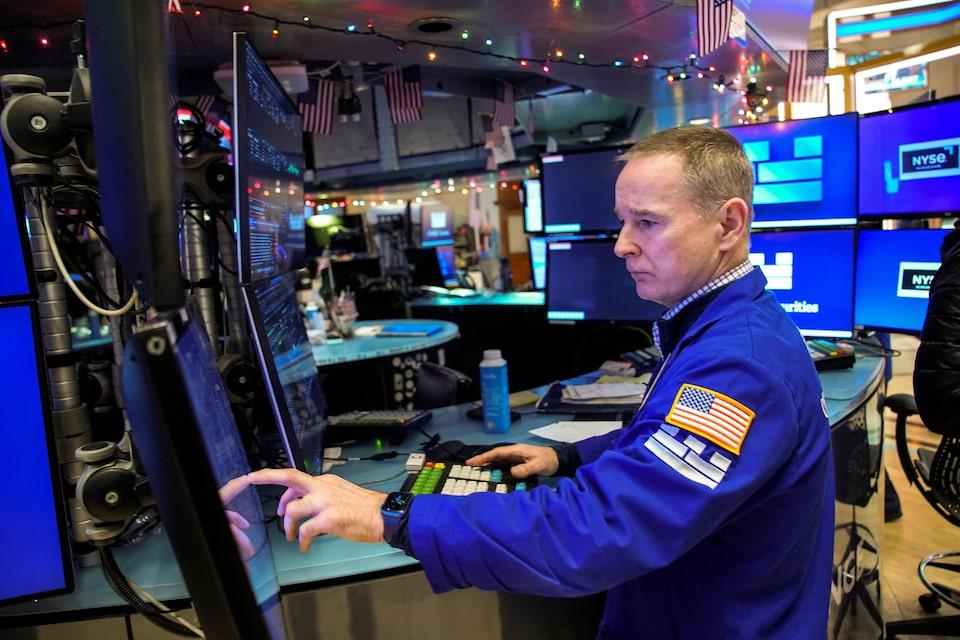
ORLANDO, Florida, Dec 3 (Reuters) - Stocks rose while U.S. bond yields and the dollar fell on Wednesday, after surprisingly weak private sector jobs data increased the likelihood that the Federal Reserve will lower interest rates again next week. More on that below. In my column today, I look at China's seemingly incongruous twin strategy of allowing its currency to strengthen and boosting exports. There are good reasons to believe it will work. Sign up here. If you have more time to read, here are a few articles I recommend to help you make sense of what happened in markets today. Today's Key Market Moves Today's Talking Points * Bill yields tumble If ultra short-dated U.S. T-Bill yields are the best proxy for near-term Fed rate expectations, the signals being sent out now could not be clearer. The one-month bill yield on Wednesday slumped nearly 8 basis points below 3.77%. Remarkably, it has fallen nearly 25 basis points since Friday, meaning bills traders have effectively moved to fully price in a quarter-point rate cut from the Fed next week in the last four days. * When low hiring drifts to firing Expectations for a Fed rate cut next week have been strengthening for days, but Wednesday's ADP jobs data looks to have sealed the deal. The 32,000 fall in private sector jobs in October was a surprise - economists had expected a slight rise - marking the worst month since early 2023. Many economists and investors have long looked down on the ADP report, saying it bears little correlation to the broader official non-farm payrolls data. But post-government shutdown, perhaps ADP will be scrutinized more closely - and if low hiring morphs into outright firing, Houston, we have a problem. * Small cap resilience After rallying 5.5% last week - its best week in over a year - the Russell 2000 strongly outperformed again on Wednesday, surging nearly 2%, more than six times the benchmark S&P 500's 0.3% rise. This may seem a little surprising, given that the bulk of surprise ADP 32,000 job losses were reported by small businesses. With AI bubble fears refusing to die down, the rotation into small caps that has played out in recent months may have further to run. Rising yuan won't slow China's export boom China's desire to keep its export growth engine roaring seems at odds with the steady appreciation of its currency. But these trends can continue to co-exist, highlighting the tenuous relationship between a country's exchange rate and trade flows. The People's Bank of China has steered the yuan 3% higher since April to 7.07 per dollar, its strongest point in over a year. The currency is expected to stay on that path, with many analysts predicting the dollar will break below 7.00 yuan next year, perhaps to 6.60 yuan. That would imply a further 7% appreciation to levels last seen in 2022. Yet one clear takeaway from the Communist Party leadership's October planning meeting, or plenum, was Beijing's reluctance to wean itself off its export-oriented growth model. On the one hand, that makes sense given China's domestic economy is still struggling with a burst property bubble, deflation and weak demand. Exports have contributed more than half of headline real GDP growth over the last two years, according to Goldman Sachs. But shouldn't a strengthening currency make China's goods more expensive, and therefore uncompetitive, on the global market? In theory, yes. But in practice, the robust yuan certainly doesn't appear to be stemming the flow of China's export volumes. Brad Setser, senior fellow at the Council on Foreign Relations and a long-standing China watcher, notes that China's export volumes have risen a cumulative 40% since the end of 2019, while imports have increased just 1%. ECONOMIES OF SCALE The fact is, China's goods are still relatively cheap. Indeed, on a real effective exchange rate (REER) basis - which adjusts for inflation differences between countries - the yuan is roughly at its weakest level in 15 years, down almost 20% since early 2022 and nearly 50% since 2012. A housing crash, economic slump, capital flight and unfavorable interest rate differentials have accelerated the currency's slide in recent years, and most analysts agree it is substantially undervalued. What's more, China can absorb a modest exchange rate appreciation because of its presence, expertise and dominance across global supply chains in a range of industries such as electric vehicles, solar panels and batteries. China is no longer the world's cheap consumer goods factory, instead operating at the higher end of the economic, technological and strategic value chains. "China's sheer scale is very daunting," says Marc Chandler, managing director at Bannockburn Capital Markets and another veteran China watcher. Given the size of China's footprint in many advanced sectors, how sensitive are its exports to fluctuations in its currency? Not very, it turns out. Consider German automaker Volkswagen, which has invested billions in its plant in the Chinese city of Hefei. The company said last month that a new EV model in China can cost up to 50% less than elsewhere. It will take more than another 5-10% rise in the yuan's value to really dent that level of competitiveness. WEAK FX, TRADE LINKS Of course, the exchange rate is not the sole or even most important input influencing a country's trade balance. Domestic demand, global growth, changes in commodity prices, and trade policy all play a role. And now, tariffs and other trade measures must be added to that mix. Take Switzerland. The Swiss franc is currently near its strongest level in 15 years on a 'REER' basis. Yet Switzerland continues to post a substantial trade surplus, which has exceeded 10% of GDP in each of the last three calendar years. On the flip side is Japan. The yen has been on the slide for years, and is currently hovering around its weakest levels ever in 'REER' terms, yet the country has posted a trade surplus every year for the past five years. It looks like Beijing will continue its strategy of managed currency appreciation which, on the margins at least, should help cool simmering trade tensions with Washington and deflect criticism from competitor nations in Asia that China is muscling into its markets. Though, ultimately, "muscling in" is exactly what China wants to do - and a firmer yuan shouldn't stand in its way. What could move markets tomorrow? Want to receive Trading Day in your inbox every weekday morning? Sign up for my newsletter here. Opinions expressed are those of the author. They do not reflect the views of Reuters News, which, under the Trust Principles , opens new tab, is committed to integrity, independence, and freedom from bias. https://www.reuters.com/world/china/global-markets-trading-day-graphic-2025-12-03/