2025-09-03 10:00
Doubts over tariff legality spark risk-off move across markets Yields surge on fiscal worries, concerns over Fed independence Stocks wobble on Treasury yield surge, gold rises NEW YORK, Sept 2 (Reuters) - Investors are bracing for more volatility after Wall Street’s summer lull gave way when markets reopened from the Labor Day unofficial end-of-summer holiday on Tuesday. With September historically the worst month for the U.S. stock market, fears over Federal Reserve independence and President Donald Trump's tariff uncertainty were at the fore, converging to jolt stocks and bonds. Sign up here. Market participants have long fretted over frothy valuations in stocks and corporate bonds, even as signs of a slowing economy piled up this summer. At the same time, an escalating spat between Trump and the Federal Reserve raised concerns that political strong-arming of the U.S. central bank could rattle the U.S. Treasury market, even as markets had appeared to take that in stride in recent weeks. On Tuesday, those simmering anxieties boiled over, reignited by fresh doubts about the legality of Trump's tariffs that emerged over the holiday weekend. That pushed stocks and bonds down, with many in the market anticipating more turbulence ahead of a pivotal jobs report on Friday. "We have some uncertainty around these tariffs, and that's the trigger right now I think for the risk-off sentiment," said Seth Hickle, portfolio manager at Mindset Wealth Management. "The concern is that the bond vigilantes will awaken and cause some chaos in the bond market, given the fact that we may have to send some of this tariff money back overseas," he said, referring to bond investors who punish bad policy by selling government debt. The CBOE Market Volatility index (.VIX) , opens new tab touched its highest mark in over four weeks, while the S&P 500 (.SPX) , opens new tab stock index dropped 0.7% on Tuesday. Long-dated Treasury yields spiked amid a global bond selloff. Benchmark 10-year Treasury yields, which rise when bond prices drop, surged by nearly five basis points to 4.269%, while 30-year yields surged to their highest since mid-July. Rising yields can hurt stocks as bond returns become more attractive. Investors often look at 10-year yields of about 4.5% as a level at which demand for stocks wobbles. They also tend to support the dollar , which staged a rebound from recent weakness on Tuesday. Mark Luschini, chief investment strategist at Janney Montgomery Scott, said the surge in 30-year Treasury yields to nearly 5% was "helping to put some pressure on the tape." The court ruling against Trump's tariffs "has obviously put a little consternation in terms of what it means for the collection of tariff revenues here in the U.S. and help toward paring back our budget deficit," Luschini said. SEPTEMBER CHILLS Seasonal weakness may stem in part from investors returning from summer holidays cleaning up portfolios while also making tax and other adjustments ahead of the end of the year. Over the past 35 years, September has ranked as the worst-performing month of the year for the S&P 500, with an average decline of 0.8% during that period, according to the Stock Trader's Almanac. The index has fallen in 18 of those 35 Septembers, the only month to have been down more times than up in that period, according to the Almanac. Christian Hoffmann, head of fixed income and portfolio manager at Thornburg Investment Management, said a risk-off move was largely expected this month, with heavy debt issuance in credit markets on Tuesday exacerbating the selloff in government debt as investors reallocated funds to corporate debt. "Our bias has been to be lightening up on risk through the summer as valuations ground tighter," he said. Corporate bond spreads -- the premium over U.S. Treasury yields that highly rated companies must pay to borrow -- hit their tightest-ever at 75 basis points last month, according to the ICE BofA Corporate Index. "Given the lack of volatility that we've been seeing and where spread levels were, it seemed like the more likely case was to have some more volatility," Hoffmann said. Friday's August jobs data will be crucial for investors to assess how aggressively the Fed will cut rates in the coming months, although continued inflation pressures could limit its ability to come to Wall Street's rescue. Investors also will be watching this week's confirmation hearing for Stephen Miran, a close Trump ally and his pick for a temporary Fed post, replacing Adriana Kugler who resigned on August 1. His appointment comes as Trump escalates attacks on the Fed, including relentless criticism of Chair Jerome Powell for not lowering interest rates, and a push to remove Governor Lisa Cook. "The market sees the possibility of a less independent central bank and there's going to be implications because of that," said Josh Chastant, portfolio manager for public markets at GuideStone Funds. Investors also look for alternative assets that can help protect portfolios in volatile markets. Gold bullion rose to a record high near $3,540 an ounce on Tuesday. “This year, gold and bitcoin are both up, not one or the other,” said Aakash Doshi, head of gold strategy at State Street Investment Management. The two assets – one historically viewed as a hedge, the other as a high-volatility strategy - converge when it comes to the U.S. dollar, he noted. “Both offer an alternative to fiat currencies and de-dollarization.” https://www.reuters.com/business/investors-edge-september-reset-exposes-simmering-us-market-risks-2025-09-02/
2025-09-03 07:58
BERLIN, Sept 3 (Reuters) - Deutsche ReGas on Wednesday said it had signed long-term agreements with German chemical producer BASF (BASFn.DE) , opens new tab and Norway's energy major Equinor (EQNR.OL) , opens new tab for liquefied natural gas regasification capacity at its terminal in Mukran on the Baltic Sea. "We are proud to support the energy security of one of the leading chemical companies and to work with the leading supplier of natural gas for Germany and Europe," Deutsche ReGas CEO Ingo Wagner said in a statement. Sign up here. Terms of the agreements were not disclosed. An Equinor spokesperson confirmed that the company has booked capacity at the Mukran terminal, for shipments from its Hammerfest LNG plant in northern Norway and volumes sourced from third parties. https://www.reuters.com/business/energy/deutsche-regas-secures-lng-regasification-deals-with-basf-equinor-2025-09-03/
2025-09-03 07:45
Sept 3 (Reuters) - Germany's chemical industry association on Wednesday said its capacity utilization hit its lowest level in more than 30 years in the second quarter as sales and prices declined on uncertainties around U.S. tariffs. In the April-June period, Germany's chemical industry was running at only 72% of its full production capacity, the lowest level since 1991, and well below the level required to break even, VCI said. Sign up here. The VCI association said pull-forward effects in business with the United States waned throughout the April-June period, as exports had been brought forward in anticipation of tariffs on goods from Europe. European chemical manufacturers are grappling with renewed challenges as U.S. tariffs disrupt global trade, leading customers to postpone purchases and weakening demand in a sector still recovering from the 2022 energy crisis. Overall production in Germany's chemicals sector including pharmaceuticals fell 3.8% quarter-on-quarter, contrasting with the January-March quarterly increase of 6.7%. "Weak demand, declining sales, and production far below pre-crisis levels - this is the current reality in our industry and also in large parts of German industry," VCI managing director Wolfgang Grosse Entrup said in a statement. The sector, the third-largest industry in Europe's economic powerhouse Germany, can be seen as a bellwether for the broader economy as it produces materials used in sectors ranging from automotive and construction to agriculture and textiles. Pharmaceutical output fell by 5.6% compared with the previous quarter. On an annual comparison, overall quarterly production was down 3.1%, or 5.1% when pharmaceuticals were excluded, and revenue fell by 2.7% compared with the same period last year. The industry maintained its 2025 guidance for production volumes including pharmaceuticals to fall by 2% and industrial sales by 1%. https://www.reuters.com/sustainability/boards-policy-regulation/german-chemical-sector-running-lowest-capacity-more-than-30-years-vci-says-2025-09-03/

2025-09-03 07:45
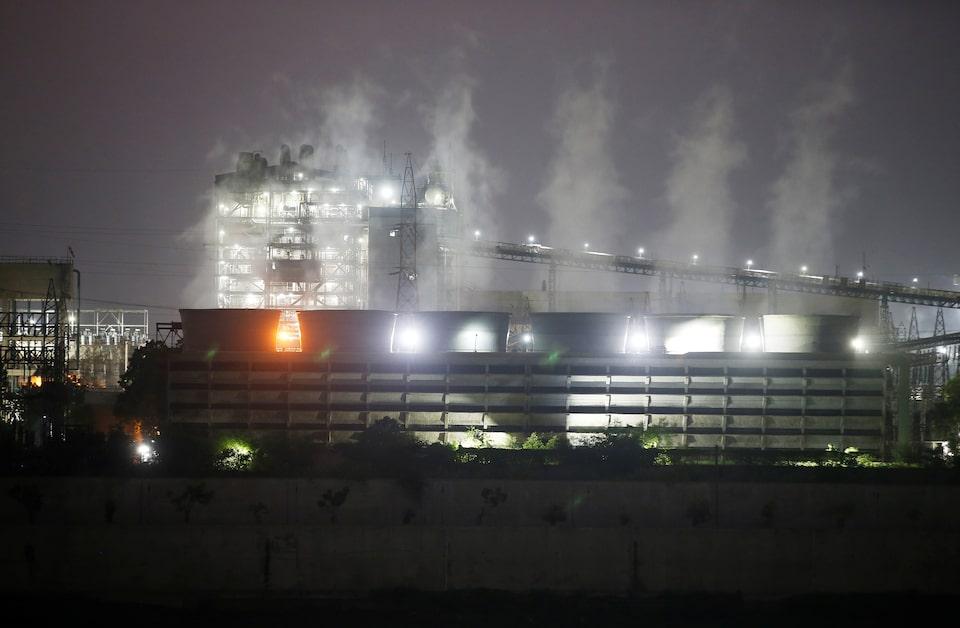
NEW DELHI, Sept 3 (Reuters) - India will test the installation of battery storage systems at some coal power plants, as the country grapples with integrating massive solar capacity while maintaining reliable electricity supply, an advisor to the country's power ministry said. The concept addresses a critical challenge facing India's power grid, where thermal plants must ramp down during peak solar hours but maintain capacity for evening demand when solar generation drops. Sign up here. The Central Electricity Authority (CEA) has been working on guidelines for coal-based power plants and technical minimum load requirements as the country rapidly expands renewable energy capacity. India is aiming to expand its non-fossil fuel capacity to 500 GW by 2030, but coal remains central to its energy security. The government plans to increase coal-based capacity by 97 GW by 2035, taking the total to around 307 GW to ensure round-the-clock power. "At times there are only two choices. Either you shut down the coal plant (during excess solar generation) or lose the thermal capacity in the evening, which we don't want," CEA chairman Ghanshyam Prasad told Reuters on the sidelines of PowerGen India 2025 event in New Delhi. "We are just trying this as an experiment," he said, adding that the country's top coal power generator NTPC (NTPC.NS) , opens new tab had been tasked with testing this at some plants and given funding support. The batteries would allow the coal plants to capture excess energy and dispatch it to the grid at a later point when needed, allowing the plants to operate at a stable rate, saving costs and extending their lives, CEA's Prasad said. Recently, NTPC floated a tender for setting up of 1.7 GW of battery storage across 11 coal plants. https://www.reuters.com/sustainability/boards-policy-regulation/india-test-battery-storage-coal-plants-balance-grid-solar-power-surges-2025-09-03/
2025-09-03 07:12
MOSCOW, Sept 3 (Reuters) - Russia will help China overtake the United States as the world's biggest producer of nuclear power, the chief of Russia's Rosatom state nuclear corporation said in comments broadcast on state TV on Wednesday after talks in Beijing. The United States operates the world's largest network of nuclear reactors, with nearly 97 gigawatts (GW) of installed capacity. Sign up here. China is racing to build dozens of reactors though and had 53.2 GW of operating nuclear power reactor capacity as of April 2024, according to the U.S. Energy Information Administration. "China has ambitious plans for the development of atomic energy. The task has been set to catch up and surpass the United States in installed capacity, which means reaching a capacity of more than 100 gigawatts," Alexei Likhachev, the Rosatom chief, told Russian state television. Asked by state television if Russia would help China in that target, Likhachev said: "Of course. We will help. We are already helping." Russia has already helped build four nuclear reactors in China and is building four more and China needs a large amount of uranium and nuclear fuel for its ambitious plans, Likhachev said. As a result China will need to develop a new generation of closed nuclear fuel cycle reactors based on Russian technology, he said. https://www.reuters.com/business/energy/russia-says-it-will-help-china-overtake-united-states-nuclear-power-2025-09-03/

2025-09-03 07:00
Sept 3 (Reuters) - Shell (SHEL.L) , opens new tab will not resume construction of a biofuels facility at its Shell Energy and Chemicals Park in Rotterdam after an in-depth evaluation found it would not be competitive, the company said on Wednesday. The project's construction was paused in July 2024 due to weak market conditions. Shell in September 2021 had approved the development of the plant to produce 820,000 metric tons per year and had planned to bring it online in 2025. Sign up here. "As we evaluated market dynamics and the cost of completion, it became clear that the project would be insufficiently competitive to meet our customers' need for affordable, low carbon products," said Machteld de Haan, Shell's Downstream, Renewables and Energy Solutions President. "This was a difficult decision, but the right one, as we prioritise our capital towards those projects that deliver both the needs of our customers and value for our shareholders," Haan said. Along with other major oil companies, Shell has been shifting away from renewable projects and back to its traditional expertise of fossil fuel production. https://www.reuters.com/sustainability/climate-energy/shell-scraps-plans-biofuels-facility-rotterdam-2025-09-03/