2025-09-01 12:37
Nayara relied solely on Russian crude in August, data shows Most recent deliveries from Saudi Arabia, Iraq recorded in July Nayara's refinery operating at 70-80% capacity post-sanctions NEW DELHI, Sept 1 (Reuters) - Saudi Aramco and Iraq's state oil company SOMO have stopped selling crude oil to India's Nayara Energy in the aftermath of sanctions imposed in July by the European Union on the Russian-backed refiner, three sources familiar with the matter said. The halting of supply from the two Gulf exporters means Nayara, majority-owned by Russian entities including oil major Rosneft (ROSN.MM) , opens new tab, relied entirely on Russia for its crude oil imports in August, according to sources and LSEG shipping data. Sign up here. Nayara typically receives around 2 million barrels of Iraqi crude and 1 million barrels of Saudi crude each month, but did not receive shipments from either of the two suppliers during August, shipping data from Kpler and LSEG showed. SOMO and Nayara did not respond to requests for comment. Saudi Aramco declined to comment. Two of the sources said that the sanctions had created payment problems for Nayara's purchases from SOMO, without providing further details. The most recent cargo of Basra crude from SOMO was discharged for Nayara by the Kalliopi, a very large crude carrier (VLCC), at Vadinar port on July 29, according to Kpler and LSEG data as well as data obtained from industry sources. The private refiner received 1 million barrels of Arab Light carried by the VLCC Georgios co-loaded with a similar quantity of Basrah heavy on July 18, its last Saudi delivery, according to LSEG data. Nayara is receiving direct supplies from Rosneft, an official from the Russian Embassy in New Delhi said last month. The private company is operating its 400,000 barrel-per-day refinery at Vadinar in western India at about 70-80% capacity due to difficulties in selling its products resulting from the sanctions, sources have said. Nayara Energy, which controls about 8% of India's 5.2 million barrel-per-day refining capacity, has been struggling to transport fuel since the EU sanctions, relying on so-called dark fleet vessels after other shippers backed out, according to shipping reports and LSEG data. The company's CEO resigned in July. Last week, Nayara announced the appointment of a senior executive from Azerbaijan's national oil company SOCAR as its chief executive. https://www.reuters.com/business/energy/saudi-aramco-iraqs-somo-halt-crude-sales-indian-refiner-nayara-sources-say-2025-09-01/
2025-09-01 12:22
Russian drones knock out Ukraine power facilities Zelenskiy vows more strikes deep inside Russia OPEC+ due to meet on September 7 LONDON, Sept 1 (Reuters) - Oil prices rose by more than 1% on Monday on concern over supply disruptions stemming from intensified Russia-Ukraine airstrikes as well as a weaker dollar. Brent crude was up 83 cents, or 1.2%, at $68.31 a barrel by 1215 GMT. U.S. West Texas Intermediate crude also rose 83 cents, or 1.3%, to $64.84. Trading is expected to be muted because of a U.S. public holiday. Sign up here. Brent and WTI crude registered their first monthly declines in four months in August, losing 6% or more on increased supply from the OPEC+ producer group. "Crude fell in August and has started September with no clear direction within established ranges as fears of a fourth-quarter supply glut are offset by geopolitical tensions," said Ole Hansen, head of commodity strategy at Saxo Bank. Investors were focused on Beijing, where Chinese President Xi Jinping, Russian counterpart Vladimir Putin and Indian Prime Minister Narendra Modi are attending a regional summit. Also on the radar was OPEC+ meeting on September 7, Hansen added. Markets remain concerned about Russian oil flows, with weekly shipments from its ports dropping to a four-week low of 2.72 million barrels per day (bpd), according to tanker tracker data cited by ANZ analysts. Ukrainian President Volodymyr Zelenskiy vowed on Sunday to retaliate with more strikes deep inside Russia after Russian drone attacks on power facilities in northern and southern Ukraine. Both countries have intensified airstrikes in recent weeks, targeting energy infrastructure and disrupting Russian oil exports. A Reuters poll on Friday showed that oil prices are unlikely to gain much from current levels this year, as rising output from top producers adds to the risk of a surplus and U.S. tariff threats weigh on demand growth. Coming out of the summer season, oil inventories should rise in the last quarter of 2025 and the first quarter of 2026, HSBC analysts said in a note, with a surplus of 1.6 million barrels per day in the fourth quarter. Elsewhere, the U.S. labour market report this week will give a read on the economy's health and test investor confidence that interest rate cuts are coming soon, a view that has strengthened appetite for riskier assets such as commodities. Ahead of the data, the dollar was close to a five-week low on Monday, making oil less expensive for buyers using other currencies. https://www.reuters.com/business/energy/oil-rises-weaker-dollar-russian-supply-disruptions-2025-09-01/
2025-09-01 12:18
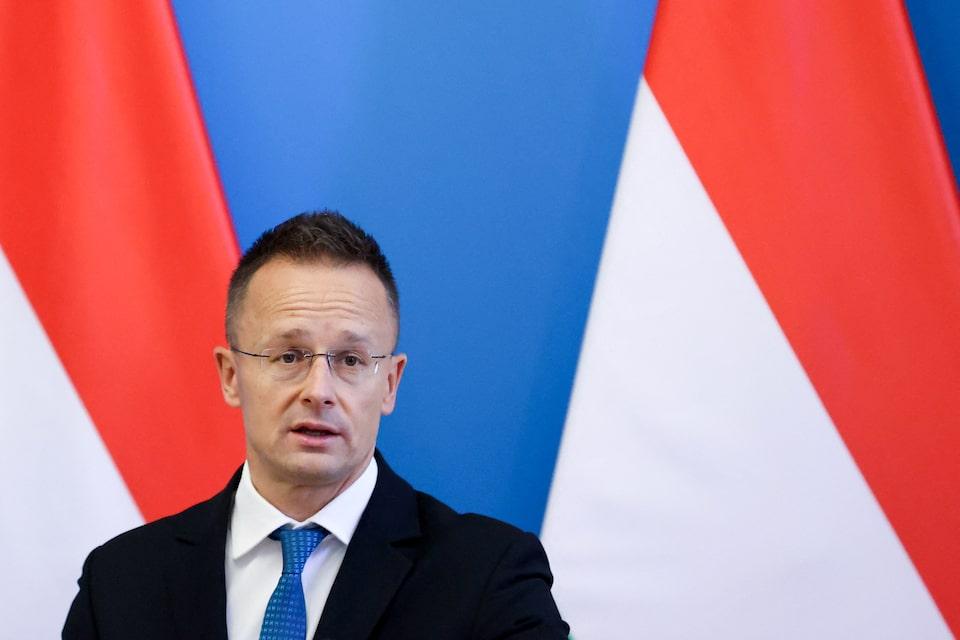
BUDAPEST, Sept 1 (Reuters) - The Hungarian section of a planned oil pipeline from Hungary to Serbia will be completed by the end of 2027, Hungarian foreign minister Peter Szijjarto said on Monday. In a statement released following a meeting with Serbia's energy minister, Szijjarto also said Hungary had imported some 5 billion cubic metres of gas via the Turkstream pipeline through Serbia by the end of August, meaning this year's gas imports via Turkstream could hit a record high. Sign up here. Szijjarto said the construction of the new crude pipeline by Hungarian oil group MOL (MOLB.BU) , opens new tab would be accelerated, enabling Serbia to be supplied with Russian Urals crude oil. "In Hungary, MOL will soon close the first phase of the preparatory work, and permissioning and environmental preparations are underway," he said, adding that the Hungarian section of the pipeline would run for 190 km (118 miles). Russian oil supplies to Hungary and Slovakia were suspended late in August for several days after a Ukrainian strike on a facility in Russia. Russia and Ukraine have stepped up attacks on each other's energy infrastructure, hitting Ukrainian domestic heating supplies, Russia's Druzhba pipeline and other facilities, over the past few weeks as U.S. President Donald Trump has pushed for a deal to end the conflict. The European Union reduced energy supplies from Russia after its invasion of Ukraine in 2022 and is seeking to phase out Russian oil and gas by the end of 2027. But EU members Slovakia and Hungary have maintained relations with Russian President Vladimir Putin and oppose the phase-out. https://www.reuters.com/business/energy/hungarian-section-new-oil-pipeline-serbia-be-finished-by-end-2027-minister-says-2025-09-01/
2025-09-01 11:56
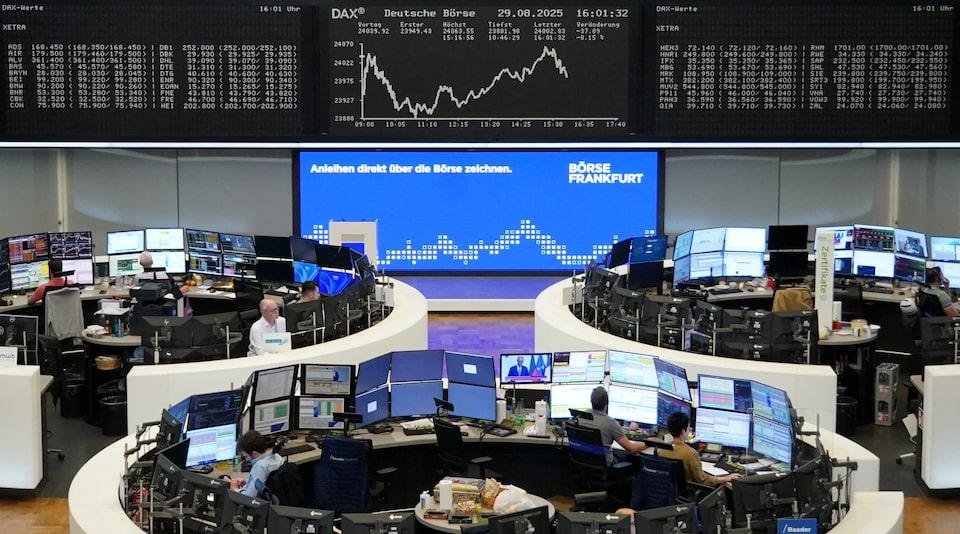
Europe shares tick up, Alibaba surges in Hong Kong Gold rises as dollar slips, oil nudges higher Raft of US data to test market wagers on Fed rate cuts Trump tariff policy in doubt after court ruling Turbulent French politics still in focus LONDON/SYDNEY, Sept 1 (Reuters) - A holiday on Wall Street left shares around the world free to go their own ways on Monday, with Chinese tech names surging and Europe steady, while European long-dated bonds remained under heavy pressure. Europe's broad STOXX 600 was last up 0.1% (.STOXX) , opens new tab as initial positivity on improved manufacturing data petered out. There was more excitement in Asia, where Chinese tech giant Alibaba's Hong Kong shares (9988.HK) , opens new tab rose 18.5% after it said AI drove a surge in revenue to its cloud business. Sign up here. U.S. share futures were up marginally. The U.S. is likely to be the main focus of the rest of the week, with a raft of data there including surveys of manufacturing and services, and labour numbers culminating in the August payrolls report on Friday. Median forecasts are for employment to have climbed by 75,000 jobs, though estimates range widely from zero to a 110,000 gain amid uncertainty caused by July's surprisingly weak report. The jobless rate is seen ticking up to 4.3%. "The jobs market is the number one factor for the Federal Reserve's policy path. There's lots of talk from the Fed and from market commentators that labour markets are cooling, leading to a rate cut in September, but it's not a clear-cut situation," Samy Chaar, chief economist at Lombard Odier, said. "So it's a 'make or break' week." The prospect of lower borrowing costs has kept Wall Street near record highs, and would be timely given September has been the worst performing month of the year for the S&P 500 over the past 35 years. U.S. tariff policy also remained a concern after a Court of Appeals ruled that many of President Donald Trump's sweeping import levies were illegal, but left them in place until mid-October awaiting an appeal to the Supreme Court. The White House has other means to apply sectoral levies, but it puts a question mark over trade agreements already reached or being negotiated. Talks with Japan have hit a stumbling block over rice, while negotiations with South Korea have become bogged down. Investors will also be wary of Trump's attacks on the independence of the Fed, with Fed Governor Lisa Cook set to file fresh arguments against her firing on Tuesday. BOND SELLOFF The other focus for European investors was France, where Prime Minister Francois Bayrou will kick off a series of talks with France's political parties, seeking to stave off the collapse of his government in a confidence vote next week that opposition leaders said is bound to fail. Markets have stabilised after selling off on the announcement of the confidence vote, but further developments could drive renewed focus on France's embattled finances. The gap between French and German 10-year yields widened sharply last week, but was last steadier at 79 basis points . "We see more than even odds that the government fails the no confidence vote. It is likely to lead to a period of political uncertainty and a possibility of early elections. We retain our negative view on France and see France spreads moving towards 90bp level," Mohit Kumar, chief European economist at Jefferies, said. Worries about the fiscal situation in many countries around the world have been sending long-dated bond yields higher. German 30-year yields hit a fresh 14-year high of 3.38% on Monday and benchmark 10-year yields rose 3 bps to 2.76%. With Treasury markets closed for the holiday, the higher European yields drove the euro higher. The euro was last up 0.25% at $1.1711. In commodity markets, gold benefited from the dollar's decline and the outlook for lower rates to rise 2.2% last week. The metal added as much as 1.1% to a four-month top of $3,489.5 an ounce . Oil prices edged up on Monday as worries about rising output and the impact on demand from U.S. tariffs offset supply disruptions stemming from intensified Russia-Ukraine airstrikes and pressure from a weaker dollar. Brent was up 1% at $68.2 a barrel. https://www.reuters.com/world/china/global-markets-wrapup-6-2025-09-01/
2025-09-01 11:54
RIO DE JANEIRO, Sept 1 (Reuters) - Brazilian state-run oil company Petrobras (PETR3.SA) , opens new tab will lower the average price of jet fuel sold to distributors by 3.7%, or 0.13 real ($0.0240) per liter, starting September 1, the company said on Monday. Petrobras makes monthly alterations to its jet fuel prices based on factors including oil prices and currency exchange rates. Sign up here. ($1 = 5.4212 reais) https://www.reuters.com/business/energy/brazils-petrobras-lowers-jet-fuel-prices-by-37-2025-09-01/
2025-09-01 11:25
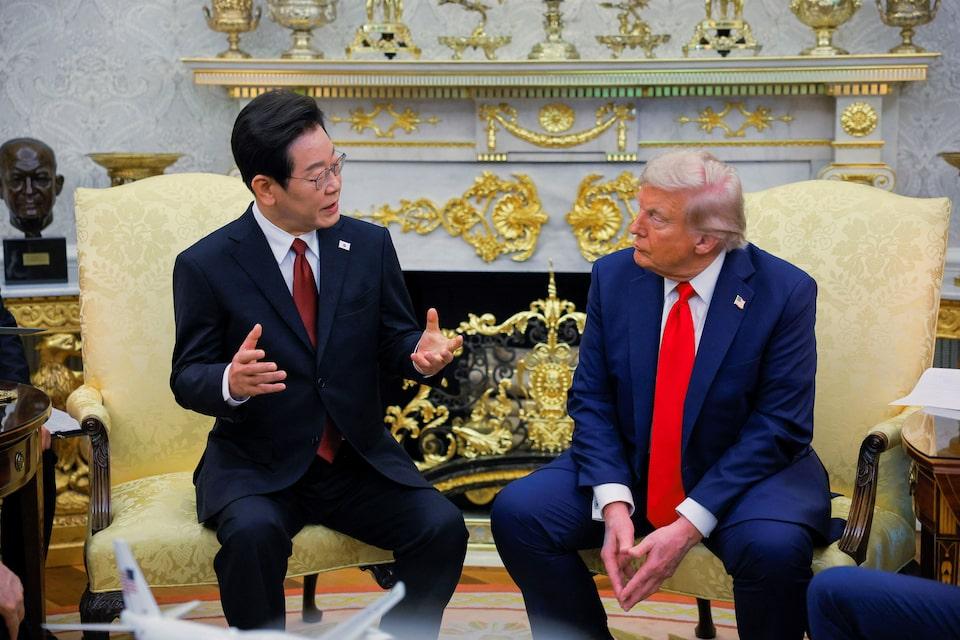
Negotiations slowed despite handshake agreement and summit Tariff and defence issues remain unresolved, impacting progress $350 billion investment fund and agriculture market disagreements persist SEOUL, Aug 29 (Reuters) - Negotiations ranging from tariffs to defence between South Korea and the United States were bogged down, overshadowing a handshake agreement and a promising presidential summit, officials in Seoul said. South Korean President Lee Jae Myung met U.S. President Donald Trump for the first time on Monday, and emerged declaring success after displaying personal chemistry and avoiding any public split between the two long-time allies. Sign up here. Behind the scenes, however, the two sides were unable to agree on a joint statement or even a fact sheet, and a month after announcing a deal on tariffs, the agreement still has not been finalised on paper. Lee's national security adviser, Wi Sung-lac, said on Friday that the two countries did not produce documents covering security, economy, trade or investments because progress remained slow in some areas while large strides had been made in other areas. More discussions and reviews were needed to hash out their details, he added, without providing specific details. South Korean presidential chief of staff Kang Hoon-sik told reporters on Thursday that it was a "very difficult negotiation" because issues ranging from investments to security are closely intertwined. "If the negotiations for one minister doesn't go well, they put a break on another negotiation that is going well," he said. "We've overcome a significant obstacle, but there is still a long way to go." Kang added that Washington could leverage several issues such as tariffs on cars, chips, and pharmaceuticals, as well as defence costs and around U.S. forces stationed in Korea. Speaking to his cabinet after the summit, Trump acknowledged a "problem with South Korea" but that Seoul had ultimately "kept the same deal." Neither Seoul nor Washington has elaborated. The U.S. Embassy in Seoul did not immediately respond to questions about the talks. 'BIG LOSSES' Even before Lee and Trump's meeting, disagreements over a $350 billion investment fund, as well as a U.S. push to open up South Korea's agriculture market, were hampering negotiations. Meanwhile, cuts to tariffs on automobiles are yet to be finalised and Seoul has not secured assurances on chip levies, both expected to be capped at 15% - the same rate as Europe. An auto industry official said the summit has done little to ease uncertainty: "We are really worried... We are having big losses." South Korean newspaper JoongAng Ilbo said the U.S. wanted to use the summit to produce documents detailing the $350 billion investments in return for accepting Seoul's demand for formalising 15% tariffs on cars and chips, and ruling out the opening of rice and beef imports. A South Korean official said Seoul has asked for equity to account for a fraction of the fund. After the summit, Seoul said it was in talks with the U.S. to work out a non-binding deal on the fund. Japan, the only other country to propose such a large investment fund, is also facing delays in finalising its deal over unresolved issues with Washington. It remains unclear what payments Trump will demand from South Korea for maintaining the 28,500 American troops based there. He has also raised a fresh demand for the U.S. to own the land on which its bases are located. South Korean officials have said it is a political non-starter and there has been no such formal request from Washington. https://www.reuters.com/world/asia-pacific/hold-south-korean-negotiators-struggle-close-gaps-with-us-despite-summit-tariff-2025-08-29/